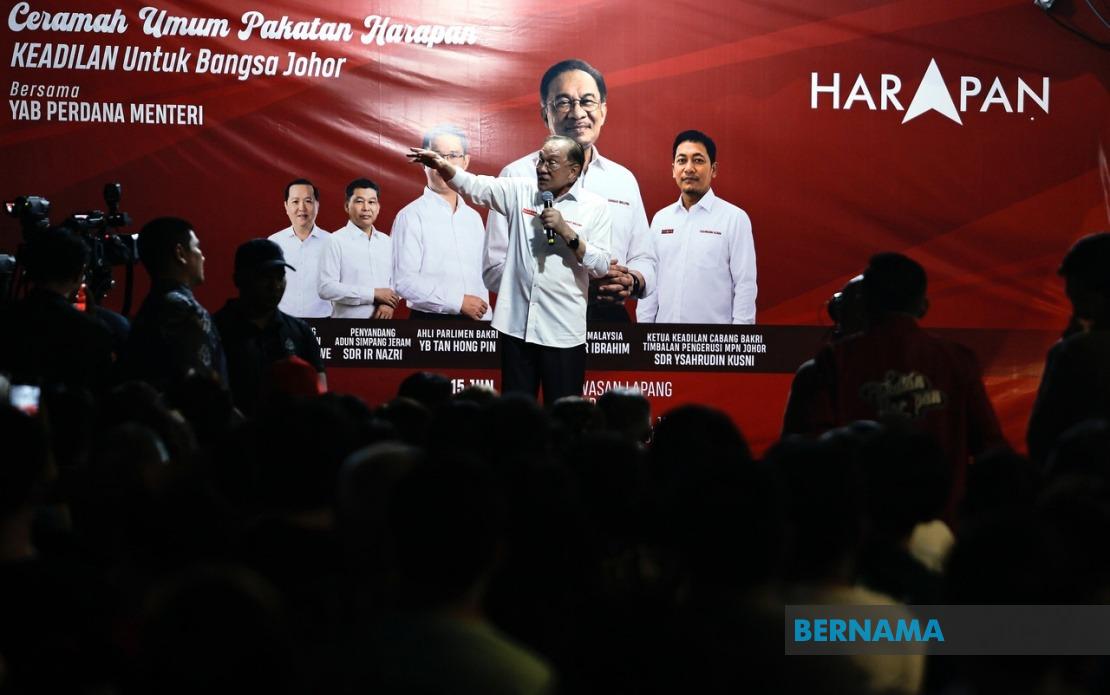
Prime Minister Datuk Seri Anwar Ibrahim has issued a stark appeal for national unity and technological focus, urging the Malaysian government and its citizens to concentrate on positioning the country as a regional leader in artificial intelligence and quantum computing rather than succumbing to endless political bickering. Speaking at a Pakatan Harapan rally in Muar on June 15, Anwar emphasised that Malaysia's prosperity and global standing depend on strategic investment in cutting-edge technology sectors, not on perpetual disagreements over divisive communal and religious issues that plague political discourse.
The Prime Minister's intervention reflects growing concern within the government that Malaysia risks squandering its competitive advantages in the regional technology landscape while political leaders engage in repetitive conflicts that alienate both domestic and international stakeholders. His comments, made during the PH Grand Rally "Justice for the People of Johor" alongside PKR Vice-President Datuk Seri Dr. Zaliha Mustafa and Johor PH Chairman Aminolhuda Hassan, signal a deliberate strategic pivot toward a development-focused agenda that transcends traditional political fault lines.
Anwar pointed to concrete government initiatives already underway, including ambitious plans to attract foreign direct investment in AI technology and data centre infrastructure, alongside exploratory efforts into quantum computing capabilities revealed during his recent visit to Japan. These initiatives represent Malaysia's attempt to position itself within the global technology supply chain, particularly as regional competitors like Singapore and South Korea consolidate their positions as innovation hubs. The government recognises that success in these sectors requires sustained political stability, coherent policy frameworks, and cross-partisan cooperation that prioritises economic objectives over factional interests.
The Prime Minister articulated a generational argument, framing the pursuit of technological advancement as a fundamental obligation to Malaysia's younger population. Anwar contended that the next generation's prosperity and employment opportunities are inextricably linked to the nation's capacity to develop expertise and infrastructure in emerging technologies rather than remaining trapped in low-value manufacturing or service sectors. This perspective reflects a broader global recognition that countries failing to invest adequately in AI and quantum computing risk economic marginalisation as these technologies reshape labour markets, productivity, and competitive advantage across all sectors.
Crucially, Anwar's statement constitutes an implicit criticism of contemporary Malaysian political culture, where leaders frequently mobilise divisive narratives surrounding ethnicity, religion, and cultural identity to consolidate electoral support. His rhetorical question—"if politics is just about fighting day in and day out over Chinese, Malay, Indian, temples, and mosques, just endless bickering, when are we going to take care of this country?"—captures exasperation with a political environment that many observers argue has become increasingly fractious and counterproductive. The statement suggests that the Prime Minister views such divisive politics not merely as morally problematic but as economically detrimental, a distraction from the institutional and intellectual effort required to establish Malaysia as a technology leader.
The appeal for national unity carries particular weight given Malaysia's demographics and the historical sensitivities surrounding inter-communal relations. By emphasising that Malays, Chinese, and Indians must collectively work toward nation-building rather than engaging in perpetual zero-sum competition, Anwar attempts to reframe national interest around shared prosperity derived from technological advancement. This framing implicitly suggests that communal tensions, while politically convenient for certain parties, ultimately serve no one's interests and actively undermine the collective national project of economic transformation.
Anwar's observations about international perceptions of Malaysia are noteworthy for reflecting genuine shifts in global investor sentiment. He noted that international observers increasingly view Malaysia as an attractive investment destination, suggesting that the country's political instability and internal conflicts have not entirely eroded its reputation abroad. However, this window of opportunity may not remain indefinite. Sustained political discord could gradually discourage foreign investors seeking stable, predictable governance environments, particularly in sensitive technology sectors where regulatory coherence and political support are essential for long-term commitment.
The emphasis on quantum computing represents a particularly ambitious element of Malaysia's technological aspirations. Unlike AI, where several Southeast Asian nations have developed relevant expertise, quantum computing remains an emerging frontier dominated by developed nations and well-funded technology corporations. Malaysia's exploration of this technology suggests governmental recognition that the country must invest in frontier research rather than merely adopting existing technologies, a posture that demands considerable intellectual capital, sustained funding, and protection from short-term political pressures that might divert resources toward immediate electoral objectives.
Anwar's call for political leaders to avoid exploiting hatred and divisive sentiment, while focusing instead on the practical problems affecting ordinary citizens, represents a normative statement about what responsible political leadership should entail in contemporary Malaysia. His insistence that political success depends on leaders demonstrating genuine competence in addressing concrete grievances—employment, education, healthcare, infrastructure—rather than mobilising emotional attachments to identity-based grievances, reflects a vision of politics centred on deliverables rather than symbolism. Whether this exhortation resonates with Malaysia's broader political establishment, or whether narrow factional interests ultimately prevail over national strategic considerations, remains uncertain.
The broader implication of Anwar's intervention is that Malaysia faces a critical juncture where technological transformation and economic competitiveness cannot be achieved within a political framework characterised by perpetual communal tensions and institutional paralysis. The government is essentially arguing that Malaysia must choose between remaining trapped in cycles of divisive politics that produce few tangible benefits, or embracing a unifying narrative of technological progress that offers concrete economic advantages for all communities. Whether Malaysian society, as currently constituted, possesses the political cohesion and sustained commitment necessary to realise such an ambitious technological transition remains perhaps the central question confronting the nation's development prospects.

