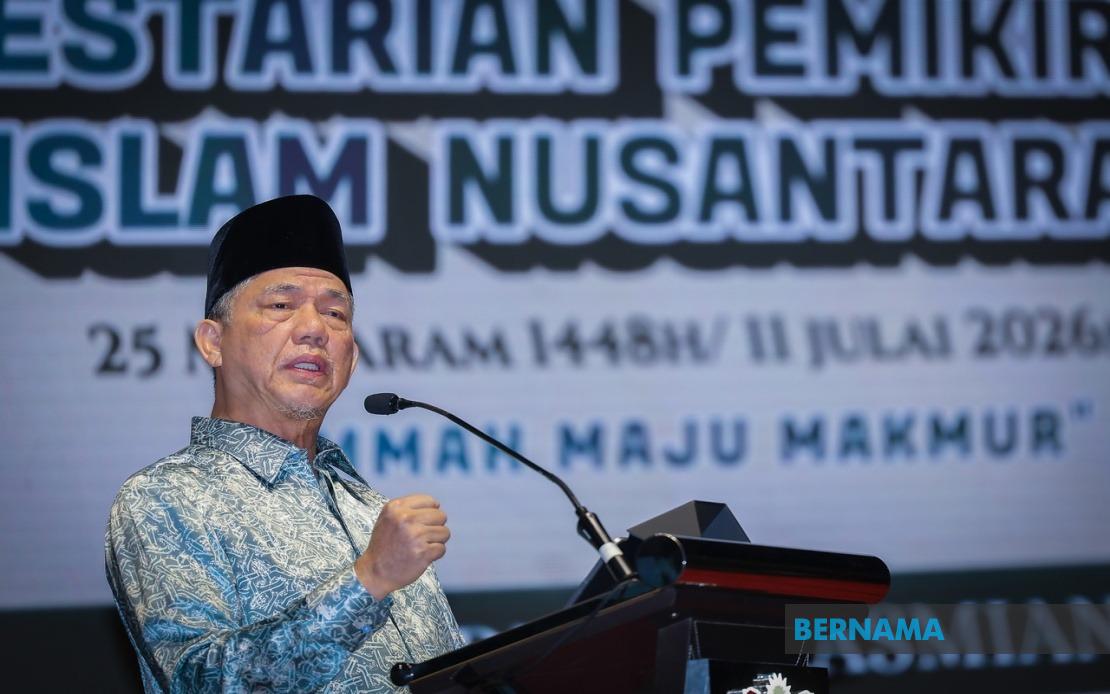
Malaysia will adopt a comprehensive approach to combat extremist and radical ideologies that threaten the nation's peace, stability and the cohesion of its multi-racial fabric, Deputy Prime Minister Datuk Seri Fadillah Yusof announced during the opening of the 2026M/1448H Sustainability of Nusantara Islamic Thought Seminar in Kuching on July 11. The government views such ideologies as fundamental security challenges that demand coordinated action across multiple institutions and society at large.
Fadillah emphasised that building a progressive and moderately-oriented society forms the cornerstone of any effective counter-extremism strategy. This foundation must be constructed through deliberate character development initiatives that draw strength from religious teachings and ethical frameworks. The Deputy Prime Minister outlined a vision where moral education becomes the first line of defence, operating upstream to prevent radical ideas from gaining purchase among vulnerable populations before they crystallise into threats requiring state intervention.
The senior minister stressed that government action cannot function in isolation. Instead, a dispersed network of responsibility must engage families, schools, universities, and community organisations in the shared mission of inoculating Malaysians against extremist messaging. Each institution brings distinct leverage points: parents shape foundational values during critical developmental stages; educators instil critical thinking alongside moral reasoning; community leaders model moderate interpretations of faith and nationalism. This layered approach recognises that ideological resilience develops through accumulated exposure to healthy examples rather than through prohibition alone.
Central to Fadillah's argument is the assertion that character underpins ideology resistance more reliably than external enforcement mechanisms. Individuals anchored by strong moral principles, developed through education rooted in Quranic teachings and the Sunnah, demonstrate greater capacity to evaluate extremist recruitment narratives with scepticism. This represents a long-term investment in social immunisation, contrasting with security measures that address symptoms rather than underlying susceptibility to radicalisation.
The Deputy Prime Minister positioned legislation as a necessary but secondary component within a broader defensive architecture. While legal tools serve important functions in prosecuting those who cross from ideological expression into concrete security threats, they operate most effectively when undergirded by a society already resistant to extremist appeals. Rather than deploying legislation as the primary response, Fadillah argued for its strategic deployment at the final enforcement boundary, after preventive measures across education, family structures and community engagement have been exhausted.
Malaysia's approach must navigate the particular complexities of a diverse nation where religious teachings, national identity and communal harmony intersect closely. The stakes extend beyond abstract security metrics to encompass the lived experience of citizens across different faith communities and ethnic backgrounds. Extremist ideologies targeting any group or promoting violence based on religious or racial grievance pose direct threats to the delicate equilibrium that has enabled Malaysia's relative stability despite demographic and religious diversity.
Deputy Inspector-General of Police Tan Sri Ayob Khan Mydin Pitchay, present at the seminar, offered perspective from the law enforcement sector regarding institutional mechanisms for addressing security threats. He observed that the repealed Internal Security Act represented among the most effective tools available to authorities for responding to emergent threats affecting national security, religious harmony, and matters involving race, religion and royalty. The ISA had enabled rapid preventive action when ideologies or teachings were identified as jeopardising national security or racial unity, and when teachings contravened rulings issued by the National Fatwa Council, without requiring State Islamic Religious Departments to initiate proceedings independently.
The discussion of the ISA's historical effectiveness reflects ongoing tensions within Malaysian security policy regarding the balance between preventive authority and civil liberties protection. Law enforcement agencies maintain that certain instruments provide flexibility necessary for addressing fast-moving ideological threats before they mature into direct security incidents. However, the decision to repeal the ISA reflected broader assessments regarding alternative mechanisms and democratic governance principles. The current emphasis on character development and community-based prevention represents an attempt to achieve similar protective objectives through distributed social responsibility rather than concentrated state power.
For Malaysia's regional context, this approach carries implications extending beyond domestic security. Extremist ideologies often operate across borders, utilising digital networks to recruit and coordinate activities transcending national boundaries. Southeast Asian nations face shared challenges from transnational radicalisation pipelines that target youth through online platforms. Malaysia's emphasis on moral education and character development as primary defences aligns with broader regional conversations about building societies with stronger cultural and religious immune systems against ideological infiltration.
The seminar itself, focused on the sustainability of Nusantara Islamic thought, reflects deliberate efforts to promote moderate interpretations of Islam as an antidote to extremist versions. Nusantara traditions emphasise pluralism, accommodation of diverse communities, and integration of Islamic principles with local cultural contexts. By elevating these interpretations through academic forums and policy discussions, Malaysia seeks to establish moderate Islamic thought as the dominant framework through which citizens understand their religious obligations and national identity.
Implementing the vision articulated by Fadillah requires sustained commitment from educational systems, which must embed moral reasoning and religious literacy into curricula from primary levels through university education. Teachers require training to facilitate these conversations without imposing narrow ideological orthodoxies, a delicate balance requiring investment in educator development. Religious authorities and community leaders must actively promote moderate interpretations while engaging respectfully with divergent viewpoints, strengthening rather than fragmenting social bonds.
The effectiveness of this preventive approach will ultimately be measured not in institutional metrics but in generational outcomes: whether young Malaysians develop robust capacity to evaluate competing ideological claims, whether they experience their religious identity as compatible with civic nationalism and respect for pluralism, and whether they view peaceful community participation as more meaningful than extremist mobilisation. Building such resistance requires patience, resources and coordinated effort across government, civil society and families over years rather than months.

