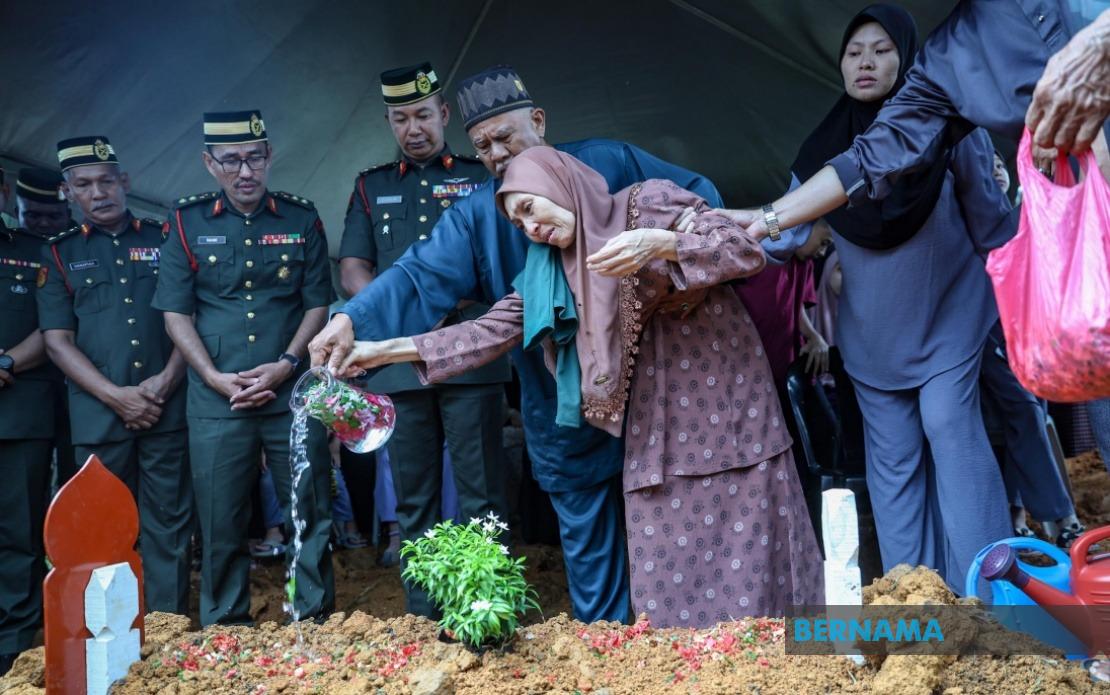
The body of Private Siti Khadijah Sungip, a 24-year-old soldier in the Malaysian Army's First Squadron of the Royal Engineer Regiment, was committed to earth at Taman Sri Lambak Muslim Cemetery in Kluang on June 17, concluding a sorrowful day that drew military personnel, family members, and community members to pay final respects. Her death came less than 24 hours after a catastrophic explosion during routine grenade-throwing exercises at Hobart Camp in Gurun, Kedah, claiming the lives of two military personnel in what authorities have described as a training incident.
The funeral service, held at 1.15 pm, reflected the gravity of the loss within Malaysia's defence establishment. The ceremony took on added ceremonial weight when Brigadier General Datuk Zulhelmy Masdar, Commander of the 7th Brigade headquartered at Mahkota Camp, formally presented the Jalur Gemilang to Private Siti Khadijah's father, Sungip Jais, 65. This symbolic gesture, performed during official military funeral rites, represents the state's acknowledgement of sacrifice and service. The presence of senior military leadership underscored the significance of the incident and the respect accorded to the fallen soldier.
The sequence of events leading to the burial began when Private Siti Khadijah and her fellow soldier, Corporal Norazmi Abu Bakar of the Sixth Battalion of the Royal Malay Regiment, were conducting what should have been routine training exercises at the target range. At 10.57 am on June 16, an explosion occurred during grenade-throwing operations, inflicting severe injuries on both personnel. The two soldiers were immediately evacuated by emergency services, with the intention to transport them to Sultan Abdul Halim Hospital in Sungai Petani for urgent medical intervention. However, the extent of their injuries proved fatal, and both were pronounced dead en route to the facility.
Following standard procedures, Private Siti Khadijah's remains were transferred to Sultanah Bahiyah Hospital in Alor Setar, where post-mortem examination was conducted. The examination concluded at approximately 2.30 am on June 17, allowing her body to be transported back to her family residence in Taman Sri Lambak by noon that same day. The return of her body was supervised by the First Field Troop Leader, Lieutenant Muhammad Lutfil Hadi Osman, accompanied by four members of the Royal Engineer Regiment contingent from Sangro Camp in Taiping, Perak, ensuring proper military protocol was maintained throughout the transfer process.
Upon arrival at her parents' residence at 12.10 pm, the customary funeral preparations commenced. The body was subsequently taken to Darul Iman Mosque for religious rites performed in accordance with Islamic practice. Major Mohd Azlan Shah Abdul Razak, serving with the Malaysian Army Field Engineering Institute, led the funeral prayer, providing spiritual solace to the assembled mourners. The entire procedure reflected the intersection of military tradition and religious observance that characterises dignified military funerals in Malaysia.
The incident raises significant questions about safety protocols during hazardous military training exercises. Grenade-throwing training, while essential for infantry and engineer personnel, carries inherent risks that require meticulous adherence to safety measures and proper supervision. The Malaysian Army has not yet released detailed findings regarding the specific circumstances that led to the explosion, though the fact that two personnel died in the incident suggests either a catastrophic equipment failure or a breach in established safety procedures. Both possibilities warrant thorough investigation to prevent similar tragedies.
Private Siti Khadijah's death represents a sobering reminder of the dangers faced by Malaysian service personnel even during peacetime training operations. Female participation in the Malaysian Army, while still proportionally limited, has grown considerably over recent decades, with women serving in various combat and support roles. Her position in the Royal Engineer Regiment demonstrates the integration of women into technical military specialisations. Her loss resonates particularly within the context of increasing female military service, as her family and colleagues confront the reality that military duty carries risks regardless of gender.
The Malaysian public, meanwhile, faces the broader question of how the armed forces balance operational readiness with personnel safety. While training must prepare soldiers for combat conditions, the methods employed must incorporate safeguards proportionate to peacetime circumstances. The dual deaths in a single incident suggest the accident was neither a minor mishap nor an isolated failure but rather a significant event with potential systemic implications. Military leadership will be under pressure to conduct a thorough review of training protocols at Hobart Camp and similar facilities across the nation.
For the family of Private Siti Khadijah, the funeral ceremony provided a formal occasion for grieving and closure, though the loss of a young soldier in her prime represents an immeasurable personal tragedy. Her service record, achievements, and potential contributions to the military remain overshadowed by the manner of her death. The formal military funeral, while honouring her service, cannot diminish the profound absence she leaves within her family and unit. In the weeks ahead, the Malaysian Army will conduct both internal investigations and formal inquiries into the Hobart Camp incident, seeking to understand what went wrong and how such incidents might be prevented in future training operations.

