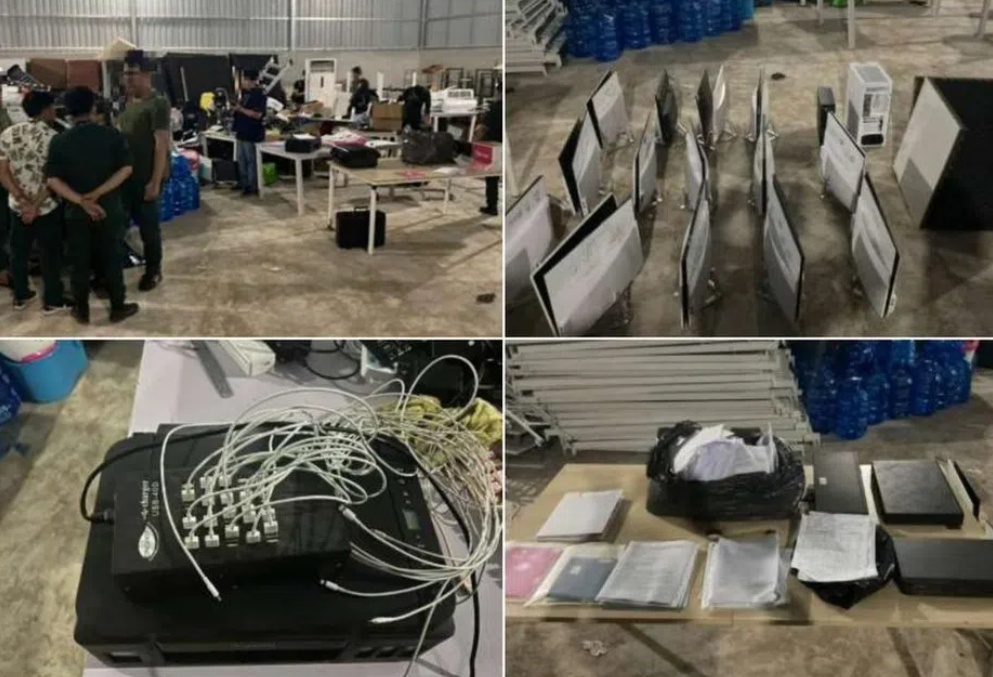
A Malaysian man's attempt to join a sophisticated fraud operation in Cambodia has landed him in jail, serving as a cautionary tale about the organised criminal networks that continue to plague Southeast Asia. Yip Chee Ming, aged 30, received a sentence of 16 months and two weeks on Friday, June 26, after admitting to membership in an organised crime syndicate. Despite his minimal involvement and spectacular failure at the actual work, the courts took a firm stance on his participation in what amounted to one of the region's most coordinated international scam networks.
The syndicate that recruited Yip operated from a five-storey compound in Phnom Penh, Cambodia's capital, where it orchestrated an elaborate scheme designed to impersonate government officials and extract money from victims across Singapore. Between September 3, 2024, and September 5, 2025, authorities linked the operation to at least 528 reported fraud cases with confirmed losses totalling approximately S$52.5 million—a staggering sum that underscores the scale and sophistication of cross-border cybercrime affecting the region. The operation's success lay not in individual brilliance but in systematic organisation, regimented structures, and ruthless specialisation of labour.
Yip's introduction to the criminal enterprise came through a friend named Jason in October 2024. Rather than approaching the opportunity with suspicion, both men agreed to explore the possibility, demonstrating how these networks often exploit personal relationships and social trust to recruit participants. The organisation's leadership, including identified figure Tang Soon Wah, extended an invitation for the pair to visit the compound in Phnom Penh to inspect the facilities before committing. This calculated transparency—showing potential recruits the actual operation rather than conducting everything through encrypted channels—reflects a disturbing confidence in the syndicate's perceived invulnerability. The men returned to Malaysia to deliberate before boarding a flight on November 21, 2024, signalling the beginning of their involvement with transnational organised crime.
The internal structure of the Phnom Penh operation reveals how modern cybercriminal organisations function with corporate precision. At the top sat leadership who maintained overall strategic direction and managed financial distribution. Beneath them were supervisors and trainers who maintained quality control—quite literally teaching recruits like Yip how to adopt Singaporean accents and follow scripted dialogue to increase their persuasiveness. The organisation even maintained a dedicated money laundering division that converted illicit cryptocurrency proceeds, suggesting a level of financial sophistication comparable to legitimate international enterprises. Documents indicated the syndicate contained at least 78 suspected members spread across these hierarchical tiers, each with clearly defined responsibilities.
Yip commenced his role on November 22, 2024, with a compensation package of US$1,800 (equivalent to S$2,333) monthly, supplemented by one per cent commission from each person he successfully defrauded. His assigned role was to impersonate a banking officer during calls to potential victims—a task he had been provided scripts to execute. However, what the organisation failed to account for was that not every person possesses the psychological makeup or conversational finesse required for confidence crimes. Despite adhering meticulously to the provided dialogue, Yip could not convince a single potential victim to transfer funds. His second attempt on November 23, 2024, proved equally fruitless. Recognising liability when confronted with it, Tang dismissed Yip after merely three days of employment, taking the precaution of deleting their message history to minimise documentation of his association with the operation.
What transpired between Yip's dismissal and his eventual arrest in Singapore remains unclear from court documents—the precise mechanism by which he returned to Malaysia was not specified. However, on September 9, 2025, he was detained during a coordinated operation mounted jointly by Singapore Police and the Cambodian National Police. The enforcement action swept up a total of twelve individuals alleged to have participated in the syndicate at various levels. Nine of the accused were Singapore residents: Deon Tan Ke Yuan, 25; Lester Ng Jing Hai, 29; Christy Neo Wei En, 29; Heiqal Lee, 30; Tay Jun Xiang, 32; Ng Wei Kang, 33; Zachary Lee Jia An, 35; Melvin Tan Wenzheng, 35; and Lau Haoxiang, 39. The remaining detainees comprised Malaysian Muhamad Asyraf Anuar, 29, and Filipino national De Villar Rizalyn Panganiban, 34—demonstrating the truly transnational character of the conspiracy.
Yip's conviction proceeded on the basis of a single charge of organised crime group membership, with an additional fraud count considered during sentencing deliberations. The legal consequence—16 months and two weeks imprisonment—reflects the judiciary's perspective that participation in organised syndicated crime demands substantial punishment regardless of individual success or failure in executing assigned tasks. Under Singapore law, membership in an organised crime group carries penalties of up to five years imprisonment, fines reaching S$100,000, or both, providing courts considerable latitude in determining proportionate sentences. The relatively modest sentence imposed on Yip may reflect recognition of his minimal contribution and rapid termination from the operation, yet it nonetheless delivers a clear message about legal accountability.
The broader context surrounding this prosecution reveals a troubling escalation in one particular category of scam activity. Although overall fraud reports declined during 2025 compared to the previous year, government official impersonation scams experienced explosive growth, more than doubling from 1,504 cases in 2024 to 3,363 cases in 2025. These schemes now rank as the fifth most prevalent fraud category affecting Singapore residents. The Phnom Penh-based syndicate that briefly employed Yip exemplifies the methodical, well-resourced operations that cybercriminals have constructed specifically to exploit this particular vulnerability in the population. The sophistication extends beyond simple telephone fraud; these organisations employ training protocols, accent coaching, and systematic testing of recruits' abilities—strategies that would not be out of place in legitimate sales organisations.
For Malaysia and the broader Southeast Asian region, the case underscores how criminal networks leverage cross-border mobility to establish operational bases in jurisdictions with weak enforcement capacity while targeting wealthy urban centres in neighbouring countries. The ease with which Yip and Jason travelled to Cambodia, were integrated into a functioning criminal enterprise, and subsequently arrested months later reveals the permeability of borders and the limited capacity of individual law enforcement agencies to prevent their nationals from becoming involved in transnational schemes. The prosecution represents a rare successful intervention, but law enforcement officials acknowledge that many participants remain undetected, and similar operations likely continue functioning elsewhere throughout the region. Yip's case, while individually unremarkable in terms of criminal achievement, carries significance as a data point in the escalating arms race between organised fraud networks and regional security agencies attempting to curtail their activities.

