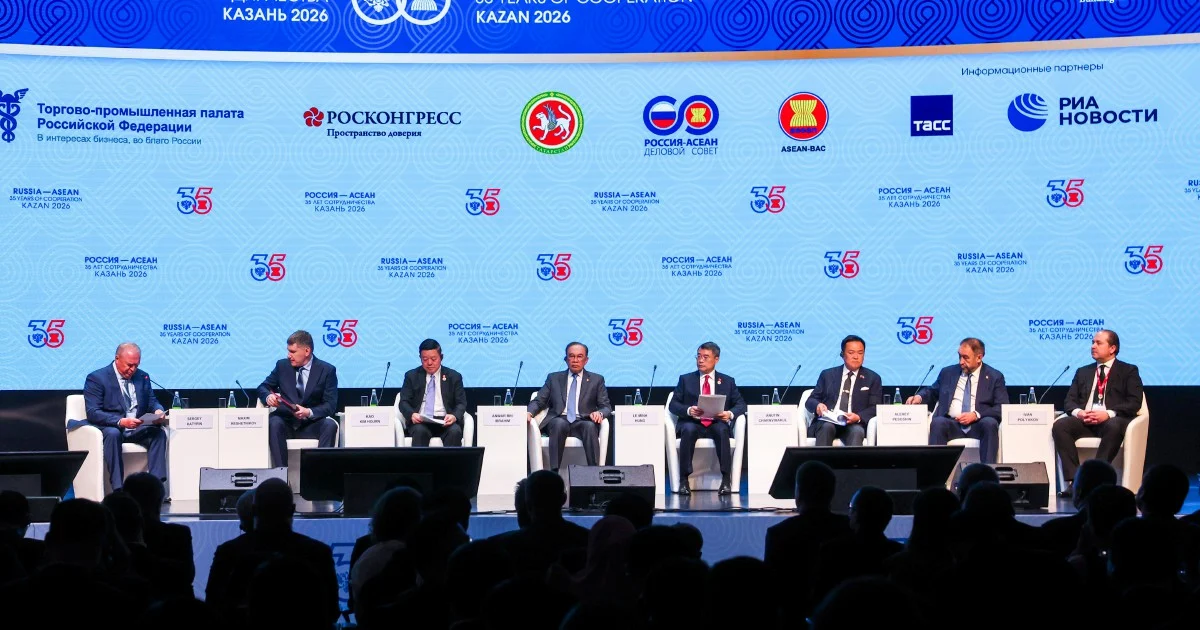
Prime Minister Datuk Seri Anwar Ibrahim has called for a substantial expansion of collaborative frameworks between Asean and Russia, positioning deeper ties in food security and energy as central pillars of regional development. Speaking during an engagement in Kazan, Anwar outlined a comprehensive vision that extends beyond bilateral relations to encompass strategic multilateral cooperation addressing shared vulnerabilities and growth opportunities across Southeast Asia and Russia.
The Malaysian Premier's remarks reflect a broader regional strategy to diversify economic partnerships and reduce dependency on traditional Western markets. For Southeast Asian nations grappling with volatile commodity prices, supply chain disruptions, and energy transitions, the prospect of strengthened cooperation with Russia presents both opportunities and strategic considerations. Russia's position as a major energy exporter and agricultural producer offers potential benefits for Asean economies managing inflationary pressures and food affordability challenges that have directly impacted household finances across the region.
Food security emerged as a priority area in Anwar's discussion, underscoring vulnerabilities exposed during recent global disruptions. Several Asean members—particularly those with large populations and limited arable land—depend substantially on imports for staple grains and proteins. Russia, alongside Belarus, traditionally supplied significant proportions of fertilisers and grain to developing markets. Formalised cooperation mechanisms could stabilise supply channels and create predictable trading relationships, though geopolitical considerations and existing sanctions frameworks introduce complexity to implementation.
Energy cooperation represents perhaps the most strategically significant pillar of expanded ties. As Southeast Asia pursues ambitious renewable energy transitions while maintaining current infrastructure capacity, access to diverse energy sources becomes critical for economic stability. Russia's natural gas, oil, and increasingly its renewable technology expertise could complement regional energy portfolios, particularly for nations transitioning away from coal dependence. However, this sector remains particularly sensitive to international political dynamics and requires careful navigation of broader geopolitical alignments.
Anwar's inclusion of advanced manufacturing in the cooperation framework signals recognition of shifting global production patterns. With growing interest in reshoring and diversifying supply chains away from traditional manufacturing hubs, Russia-Asean cooperation in value-added manufacturing could create employment opportunities across the region whilst building economic resilience. This sector offers relatively lower political risk compared to energy cooperation, though technological transfer and capital investment requirements present practical challenges.
The emphasis on digital technologies and education reflects longer-term capacity-building objectives essential for regional competitiveness. Digital infrastructure development, cybersecurity frameworks, and technology education partnerships could position Southeast Asia advantageously in an increasingly digital global economy. Russia possesses recognised expertise in mathematics, engineering, and technology sectors that could enrich educational exchanges and research collaborations across Asean member states.
From Malaysia's perspective, deeper Asean-Russia ties offer strategic benefits beyond immediate economic gains. Enhanced regional unity and diversified partnership bases strengthen Asean's centrality in regional architecture, a principle embedded in Malaysia's foreign policy approach. Strengthening collective Asean engagement with major powers, including Russia, reinforces the bloc's independence and negotiating strength in an increasingly multipolar international system.
Implementation of Anwar's vision requires overcoming substantial structural obstacles. Existing international sanctions regimes limit financial flows and technology transfer with Russia in several sensitive sectors. Divergent regulatory standards across Asean members complicate unified negotiating positions. Additionally, varying geopolitical orientations amongst Asean states—with some maintaining particularly close Western ties—necessitate careful coalition-building within the bloc.
The timing of Anwar's remarks in Kazan suggests Malaysia's ongoing commitment to bridge-building diplomacy across geopolitical divides, a stance increasingly central to Kuala Lumpur's regional role. By publicly advocating expanded cooperation whilst avoiding divisive language, Malaysia positions itself as a pragmatic intermediary capable of facilitating dialogues that transcend ideological binaries. This approach resonates with broader Asean traditions of non-alignment, though it requires constant calibration of competing international pressures.
Practical pathways forward involve establishing structured dialogue mechanisms between Asean institutions and Russian counterparts, potentially through enhanced engagement within existing forums like the East Asia Summit or dedicated Asean-Russia working groups. Trade facilitation agreements, joint investments in infrastructure, and educational scholarship programmes offer implementable starting points requiring less political friction than sensitive sectors.
The economic potential remains considerable. Trade between Asean and Russia averaged approximately USD 27-30 billion annually in recent years, substantially below theoretical potential given regional populations and resource endowments. Targeted cooperation could incrementally expand these figures whilst generating employment and technological benefits across Southeast Asia. Agricultural cooperation alone—encompassing equipment provision, fertiliser supply, and food processing technology—could meaningfully address regional food inflation concerns.
Looking forward, Asean's collective response to Anwar's proposals will shape implementation success. Regional consensus-building around specific cooperative initiatives, combined with diplomatic efforts clarifying the non-aligned nature of such partnerships, could enable meaningful expansion of ties without deepening international tensions. The challenge lies in translating Anwar's rhetorical vision into concrete institutional arrangements and investment flows that demonstrably benefit Southeast Asian populations whilst respecting diverse member-state foreign policy preferences.

