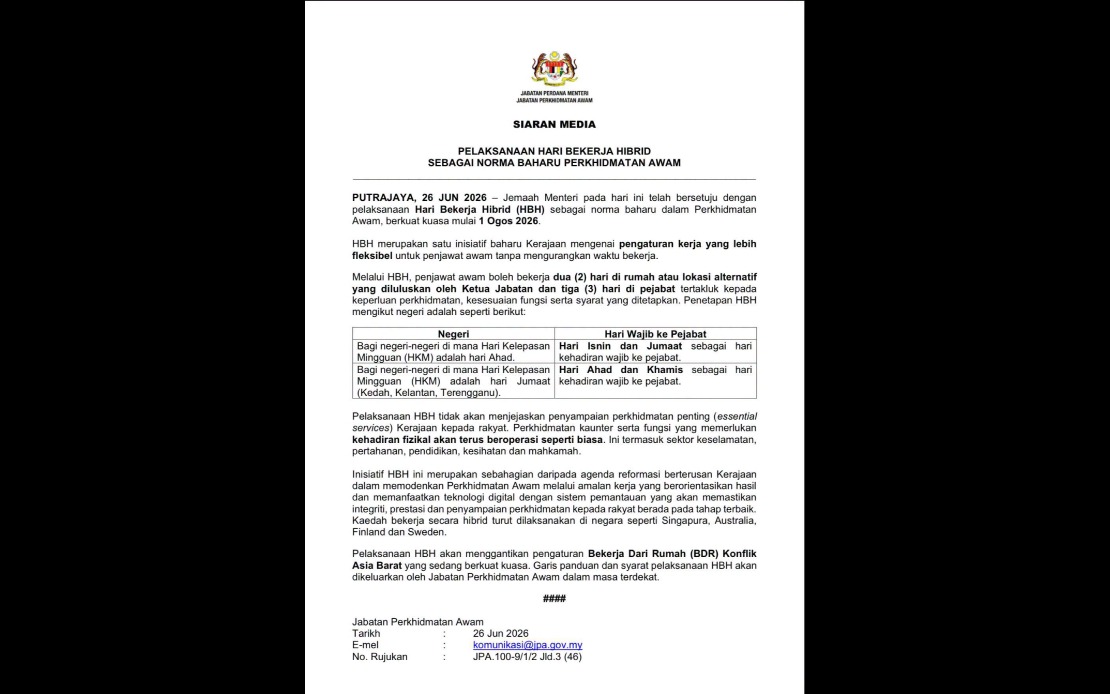
Malaysia's Cabinet has approved a new hybrid work arrangement for the nation's civil service, marking a significant shift in how government employees will structure their working week from August 1 onwards. The Public Service Department announced the decision on June 26, signalling that the government is formalising flexible work practices that have become increasingly common across the region and globally since the pandemic forced remote work adoption.
Under the Hybrid Work Day framework, civil servants will have the flexibility to spend two days working from home or at an alternative location approved by their departmental head, while maintaining a mandatory three-day in-office presence. This represents a middle ground between the previous work-from-home arrangement and traditional five-day office attendance, designed to balance employee flexibility with government service delivery requirements. The arrangement remains subject to specific conditions including service requirements, job suitability assessments, and departmental regulations, ensuring that critical government functions remain unaffected.
The initiative sits within Malaysia's broader public service modernisation agenda, reflecting recognition that traditional office-based work structures may no longer be optimal for government efficiency. By introducing results-based work practices and encouraging greater digital technology adoption, the government appears to be acknowledging that productivity and service quality can be maintained—or even enhanced—through flexible arrangements. This strategic pivot aligns Malaysia with other developed and developing nations that have similarly restructured their public sectors in response to changing work environments and employee expectations.
Implementation details reveal careful consideration of Malaysia's diverse geographic and administrative landscape. For states observing Sunday as the weekly rest day, Monday and Friday have been designated as mandatory office attendance days, ensuring consistent in-person coverage mid-week. Conversely, in Kedah, Kelantan, and Terengganu—where Friday serves as the weekly holiday—Sunday and Thursday will become compulsory office days. This differentiated approach demonstrates that the Public Service Department has tailored the policy to respect existing state-level working arrangements while maintaining operational consistency.
Critically, the government has committed that essential public services will experience no disruption from this transition. Counter services and functions requiring physical presence—spanning security, defence, education, healthcare, and the judiciary—will continue operating on standard schedules. This assurance is particularly important for Malaysia, where citizen-facing services remain heavily dependent on in-person interactions in many sectors. The careful carving out of these essential functions suggests the government recognises that not all civil service roles can effectively transition to hybrid arrangements, and that maintaining public trust requires uninterrupted access to critical services.
The monitoring mechanisms that will accompany the hybrid work day rollout appear designed to address potential accountability concerns. The Public Service Department has indicated that systems will be established to track integrity, performance metrics, and service delivery standards, suggesting the government is aware that flexible arrangements require robust oversight to prevent productivity losses or service degradation. This proactive approach to monitoring may set a template for other Southeast Asian governments considering similar transitions.
International precedent has clearly influenced Malaysia's decision-making. The Public Service Department specifically cited adoption of hybrid arrangements in Singapore, Australia, Finland, and Sweden—a geographically and culturally diverse set of nations ranging from developed Western democracies to prosperous Asian city-states. This reference suggests the government conducted comparative analysis to ensure the policy would be viable within Malaysia's administrative context, rather than simply importing a foreign model wholesale.
The shift from the existing Work From Home arrangement to a formalised Hybrid Work Day structure represents more than semantic rebranding. By establishing predetermined remote and office days, the government creates predictability for both employees and service users. Unlike ad-hoc work-from-home arrangements that varied by department and manager discretion, this standardised framework establishes clear expectations about when government offices will have full staffing and when services may experience reduced in-person availability. This regularity should theoretically improve both planning and service access.
For Malaysian civil servants, the announcement carries mixed implications. The policy grants welcome flexibility compared to traditional five-day office requirements, potentially reducing commute times, improving work-life balance, and lowering transportation costs in a nation where traffic congestion particularly affects urban workers. However, the mandatory three-day in-office requirement means this is not unlimited remote work freedom, and the emphasis on service and functional suitability suggests certain roles may receive more restricted remote access than others.
The policy also has significance for Malaysia's broader employment landscape. As the nation's largest single employer, the civil service's adoption of hybrid work may influence private sector practices and employee expectations across the economy. Workers in other sectors may increasingly demand similar flexibility, potentially accelerating Malaysia's transition toward more modern work arrangements across all employment sectors.
The government has indicated that detailed implementation guidelines will follow, suggesting the June announcement represents a policy direction rather than final operational procedure. These guidelines will likely clarify critical details including approval processes for alternative work locations, dispute resolution mechanisms when departments deny remote work requests, and technology standards required for home-based work. The subsequent months before August 1 implementation will be crucial for departments to prepare infrastructure, policies, and training.
This hybrid work initiative also reflects Malaysia's positioning as a forward-thinking government navigating post-pandemic economic recovery. By modernising work practices, the administration signals commitment to contemporary employment standards while maintaining public service integrity—a balance that will be closely watched by other Southeast Asian nations considering similar transitions in their own civil services.

