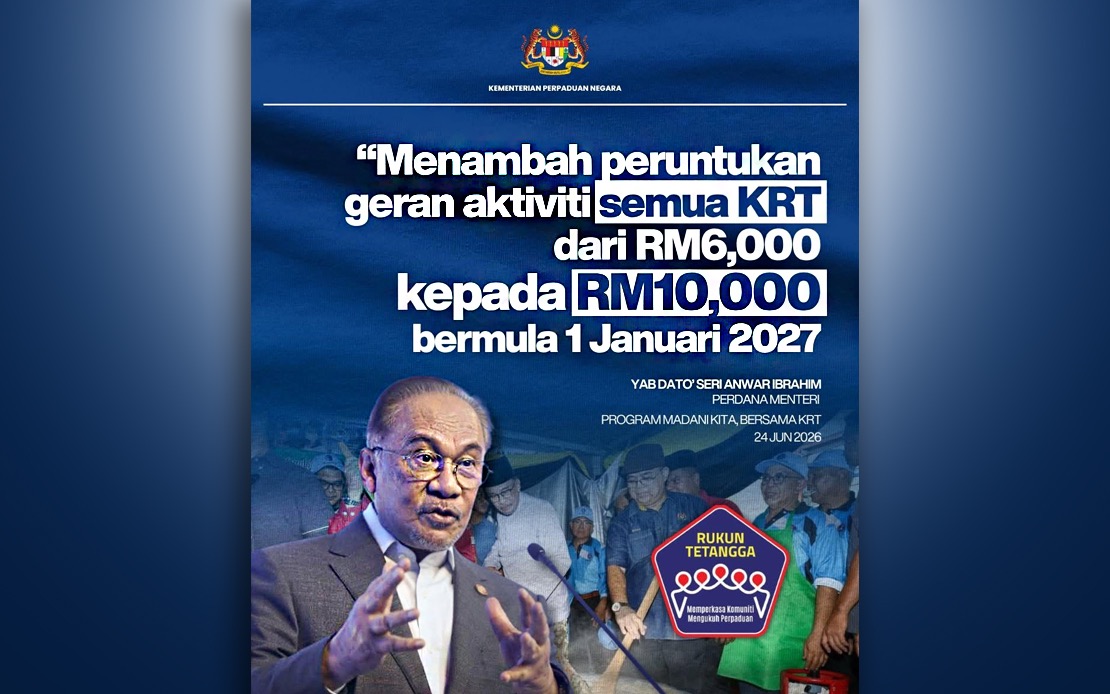
Prime Minister Datuk Seri Anwar Ibrahim has unveiled a substantial increase in funding for Malaysia's grassroots neighbourhood watch movement, raising the annual grant allocated to each of the nation's 8,615 KRT (Kawasan Rukun Tetangga) areas from RM6,000 to RM10,000. The enhancement takes effect from January 1, 2027, and was announced during the MADANI KITA engagement programme held in Dataran Segamat, Johor, underscoring the Government's commitment to strengthening community institutions at the neighbourhood level.
National Unity Minister Datuk Aaron Ago Dagang characterised the grant increase as formal acknowledgement of the KRT's enduring contribution to Malaysian society over more than fifty years. He framed the decision within the broader MADANI Government agenda of empowering grassroots organisations that function as pillars supporting social cohesion, emphasising that neighbourhood watch groups have demonstrated their capacity to drive both national unity and community progress. The ministry views this financial boost as essential to enabling KRT chapters to expand their operational reach and deepen their impact across the communities they serve.
The scale of the KRT movement remains substantial, with approximately 250,000 active members distributing their efforts across the nation's neighbourhood watch areas. These members collectively engage with more than 12 million Malaysians through their activities, indicating the breadth of KRT's grassroots influence. Over the past twelve months alone, the movement has executed over 100,000 separate community activities, reflecting the voluntary labour and organisational commitment invested by members in pursuit of neighbourhood cohesion and local development. This historical track record suggests the additional funding will be channelled into an already-functioning ecosystem of community engagement.
Aaron outlined the intended uses for the enhanced grants, indicating they would support a diverse range of initiatives designed to strengthen neighbourhoods from multiple angles. The expanded budget is expected to facilitate more ambitious unity activities that bring residents together across demographic lines, community development projects addressing local infrastructure and service gaps, targeted welfare programmes for vulnerable household members, educational initiatives ranging from literacy to skills training, neighbourhood security measures that leverage community participation, volunteer recruitment and coordination efforts, and economic empowerment schemes designed to generate local income and entrepreneurial opportunities. This multifaceted approach reflects a recognition that neighbourhood cohesion requires simultaneous progress across social, economic, and security dimensions.
The minister placed particular emphasis on the philosophical foundation underlying the KRT system, positioning neighbourliness and interpersonal trust as fundamental to Malaysia's national strength. In a nation comprising diverse racial, religious, and cultural communities, he argued, the capacity of ordinary citizens to build positive relationships with neighbours of different backgrounds represents the authentic basis for national harmony. He characterised KRT as a proven institutional mechanism for facilitating such relationship-building, serving as platforms where residents discover common ground, construct trust across communal boundaries, and develop the social ties necessary to sustain peaceful coexistence. This framing elevates KRT beyond simple security or administrative functions to position it as a strategic component of Malaysia's multicultural social infrastructure.
The timing of the announcement and implementation reflects broader governance considerations. The decision to announce the increase in mid-2024 for implementation at the start of 2027 provides a extended notice period allowing KRT chapters to plan for enhanced programming and capacity expansion. This measured timeline also signals confidence in the stability of government funding commitments and suggests coordination across budget cycles. For neighbourhood watch leaders, the advance notice permits recruitment and training of additional coordinators and volunteers to effectively absorb and utilise the increased resources, potentially preventing the scenario where sudden funding increases simply accumulate without productive application.
From a regional perspective, Malaysia's approach to neighbourhood-level governance and community empowerment through the KRT system offers distinctive features within Southeast Asia. Many neighbouring nations have experimented with various models of community policing and neighbourhood administration, yet Malaysia's integration of unity-building, welfare provision, and voluntary participation reflects specific historical and social circumstances. The explicit elevation of the KRT's unity function rather than framing it primarily as a security mechanism distinguishes this model and aligns with the MADANI Government's broader philosophy emphasising social cohesion as foundational to development.
The fiscal commitment represented by this grant increase warrants examination. Multiplying the new RM10,000 annual grant across 8,615 KRT areas yields an annual nationwide expenditure of approximately RM86.15 million, representing a substantial increase from the previous RM51.69 million at RM6,000 per area. For a government pursuing development objectives across multiple sectors, this reallocation reflects deliberate prioritisation of grassroots community infrastructure, signalling that the administration views investment in neighbourhood-level institutions as strategically important to national objectives. The increase amounts to a 67 percent boost per KRT area, a significant proportional enhancement that should materially expand programme capacity across the majority of the nation's neighbourhoods.
Implementation challenges will likely emerge as KRT chapters work to absorb and deploy the additional resources effectively. Capacity constraints in smaller or rural KRT areas, variations in volunteer availability and organisational sophistication, and questions of equitable fund allocation across diverse community contexts may require oversight and support mechanisms from the Ministry of National Unity. The ministry's statement that it remains committed to ensuring optimal utilisation of the additional funding suggests awareness of these potential implementation complexities and indicates an intention to provide guidance and monitoring rather than simply distributing funds without accountability frameworks.
The broader policy signal embedded in this announcement extends beyond the funding increase itself. By publicly elevating the KRT system through a prime ministerial announcement and ministerial articulation of its strategic importance, the Government reinforces the legitimacy and visibility of neighbourhood watch organisations within the national governance hierarchy. This recognition may encourage enhanced participation from both residents and volunteers, potentially expanding the movement's reach and effectiveness independently of the financial increase. For Malaysian communities experiencing fragmentation or intercommunal tension, the clear government backing for neighbourhood-level unity initiatives provides institutional encouragement for grassroots cohesion-building.
Looking forward, the success of this initiative will depend significantly on KRT's capacity to translate increased funding into demonstrable improvements in neighbourhood conditions and community relationships. The diverse array of intended programme areas suggests ambition, but also complexity in measuring effectiveness across such varied objectives. Whether the grant increase produces measurable gains in neighbourhood safety, community trust, social participation, or economic opportunity will become apparent through 2027 onwards, potentially influencing future government support levels and informing other Southeast Asian nations considering similar grassroots empowerment strategies.

