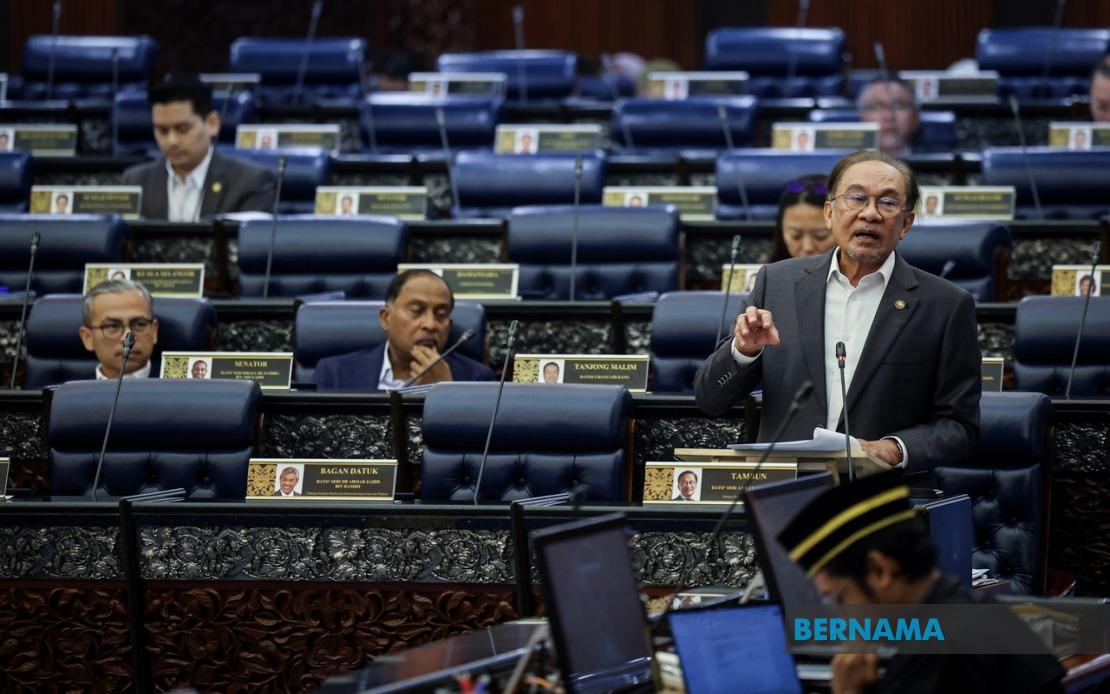
Prime Minister Datuk Seri Anwar Ibrahim has attributed Malaysia's slide down the World Press Freedom Index to international assessment criteria that encompass not just regulatory action, but also the nature of content that prompted such action. Speaking in Parliament on July 7, Anwar explained that Malaysia's ranking fell to 95th place this year from 88th position previously, a slip that has drawn scrutiny from observers of media freedoms in Southeast Asia. The Prime Minister's remarks represent an important attempt to reframe the government's enforcement posture, distinguishing between restrictions on press freedom and what he characterises as necessary boundaries on specific categories of speech.
The government's actions against Sin Chew Daily and Sinar Harian featured prominently in Anwar's explanation. Sin Chew Daily faced consequences for publishing an inaccurate representation of the Jalur Gemilang, while Sinar Harian was dealt with over its publication of the Inspector-General of Police's biography. These cases, Anwar indicated, were observed critically by the international media establishment and consequently influenced Malaysia's assessment under metrics used by Reporters Without Borders. Rather than defending the enforcement decisions outright, Anwar suggested that international observers failed to appreciate the Malaysian context—particularly the cultural and constitutional significance of national symbols and institutions that warrant protective measures distinct from those in other democracies.
Central to Anwar's argument is the concept of the "3R issues"—religion, race, and the royal institution—which he positioned as legitimate grounds for regulatory intervention. This framing acknowledges that some content restrictions exist, but presents them as bounded and principled rather than arbitrary or politically motivated. Anwar emphasised that the government operates within parameters established by the Conference of Rulers, which maintains close oversight of materials that could be construed as insulting to the monarchy or inflammatory on communal lines. This constitutional arrangement, deeply rooted in Malaysia's foundational social contract, does differentiate the Malaysian approach from Western liberal democracies where such restrictions would be unthinkable. However, the tension between this framework and international press freedom standards remains evident in how foreign assessments weigh Malaysian actions.
The Prime Minister drew an important distinction between enforcement and mere criticism or factual error. According to Anwar, the government does not prosecute content that is simply inaccurate in a political context or that criticises leadership. Instead, he stated the preference is for public clarification and parliamentary explanation, demonstrating restraint in how regulatory powers are deployed. This characterisation matters for understanding the government's self-perception, even if international observers may evaluate actual enforcement patterns differently. The government, through this narrative, presents itself as exercising surgical precision rather than blunt censorship—distinguishing between the chilling effect of broad suppression and targeted intervention against genuinely problematic categories of speech.
A significant development Anwar highlighted was the recent amendment to Section 233 of the Communications and Multimedia Act 1998. This change removed satirical remarks directed at the Prime Minister or other political leaders from criminal liability, representing a substantive expansion of permissible speech around government figures. For Malaysian media practitioners and digital content creators, this amendment offers genuine protection previously absent and signals governmental willingness to accommodate international norms around political commentary. The move is particularly noteworthy given Malaysia's history of robust defamation laws and sedition provisions that have constrained political discourse. Yet this liberalisation occurred against the backdrop of heightened enforcement on 3R matters, creating a complex regulatory environment where some speech is decriminalised while other categories face intensified scrutiny.
Anwar also provided an unusual perspective on the role of social media platforms in influencing Malaysia's ranking. He noted that content removal often occurs through platform decisions in response to user complaints rather than government directives, meaning Malaysia receives international opprobrium for actions beyond its direct control. The Prime Minister cited his own experience, where social media platforms removed posts concerning Hamas despite government disagreement with the deletion. This observation highlights a structural complication in how press freedom indices assess countries—the frameworks often fail to distinguish between state censorship and private platform moderation, which operates according to corporate policies rather than governmental mandate. For Malaysia's international reputation, this conflation presents a challenge: the country may be penalised for phenomena that reflect global tech governance rather than local authoritarianism.
The role of the Malaysian Communications and Multimedia Commission (MCMC) further complicates the picture. Anwar acknowledged that requests from MCMC do not automatically translate into content removal, as final authority rests with platform operators themselves. This distribution of power between national regulators and multinational technology companies represents a new frontier in press freedom discussions, particularly relevant for Southeast Asian countries grappling with digital governance. The practical outcome is that Malaysia's regulatory capacity is mediated and constrained by decisions made in Silicon Valley or other tech hubs, limiting the direct causality between government action and actual content suppression. Nonetheless, international assessments may view even the issuance of requests as indicative of governmental intent to suppress, regardless of enforcement success.
For Malaysian media organisations and journalists, the environment reflects genuine complexity. While recent amendments offer broader protections for political speech, the boundaries around 3R content remain significant and enforced. International indices like Reporters Without Borders incorporate multiple variables—political environment, legal framework, economic conditions, socio-cultural context, and security considerations—meaning Malaysia's ranking reflects accumulated factors rather than a single policy. The presence of enforcement actions, even if limited in scope, reverberates through international assessments because each regulatory intervention serves as concrete evidence of government willingness to restrict speech. The question for Malaysia becomes whether the cultural and constitutional justifications for 3R protections can be reconciled with expectations of press freedom systems that have emerged from different historical and social contexts.
Anwar's parliamentary explanation also reflects the broader diplomatic challenge facing Malaysia. As a Muslim-majority democracy with constitutional protections for indigenous peoples and monarchy, Malaysia occupies a unique position within global conversations about press freedom. The standards applied by Western-based assessment organisations, often derived from liberal constitutional traditions, do not naturally accommodate Malaysia's institutional arrangements or communal sensitivities. Yet Malaysia cannot simply dismiss international rankings as culturally insensitive without acknowledging legitimate concerns about how regulatory powers are implemented in practice. The credibility of Anwar's distinction between principled 3R enforcement and political suppression depends ultimately on demonstrable restraint and transparency in how these categories are applied.
Looking forward, Malaysia faces a reconciliation challenge. The government has demonstrated willingness to expand protections for political speech through legislative amendment, a positive signal for press freedom advocates. Simultaneously, continued enforcement on 3R matters, justified or not, will continue influencing international assessments that treat content restrictions largely uniformly regardless of their substantive rationale. For Malaysian civil society and media stakeholders, the focus should be on ensuring that 3R protections operate with genuine circumscription and procedural transparency, distinguishing them clearly from pretexts for suppressing legitimate political discourse. The gap between Malaysia's self-assessment as a restrained regulator and its international ranking as a moderately constrained media environment suggests that either enforcement patterns require significant moderation, or international assessment frameworks require recalibration to accommodate context-specific speech boundaries.

