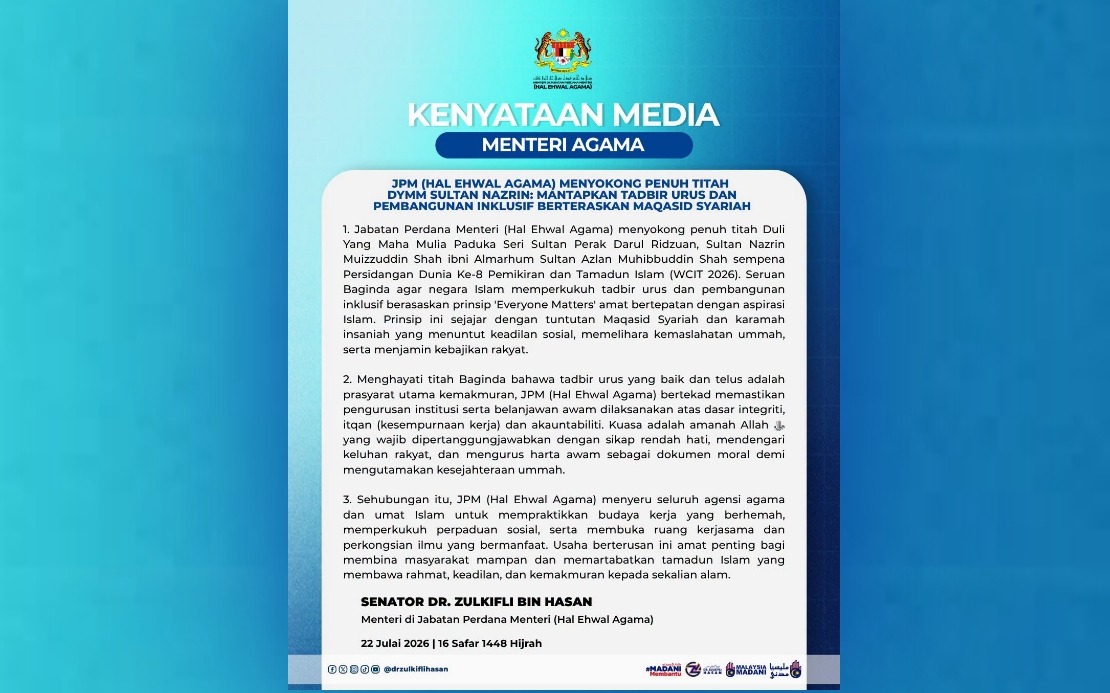
The Prime Minister's Department (Religious Affairs) has committed itself to advancing the governance of Malaysia's religious institutions through a framework centred on integrity, accountability and public welfare—a direction that directly reflects the vision articulated by Sultan Nazrin Shah during his recent address to international Islamic scholars. This alignment represents an attempt to translate royal guidance into concrete institutional practice, embedding principles of good governance into the machinery that oversees religious affairs across the nation.
Minister in the Prime Minister's Department (Religious Affairs) Dr Zulkifli Hasan explained that the Sultan's advocacy for adopting an "Everyone Matters" approach is fundamentally compatible with core Islamic teachings. Rather than viewing secular governance concepts and Islamic jurisprudence as competing frameworks, the minister positioned the principle as naturally consonant with both Maqasid Syariah—the overarching objectives of Islamic law—and the Islamic concept of karamah insaniah, or human dignity. This framing carries significance beyond mere rhetorical gesture; it suggests an institutional strategy to position Malaysia's religious governance as rooted in Islamic authenticity while maintaining standards of transparency and inclusivity that resonate with contemporary expectations of public administration.
Sultan Nazrin articulated his vision at the 8th World Conference on Islamic Thought and Civilisation, where he emphasised that effective public service transcends demographic boundaries. A government apparatus that genuinely serves all citizens—irrespective of ethnicity, religious affiliation or political persuasion—embodies national cohesion and demonstrates leadership characterised by humility and responsiveness. This principle carries particular weight in Malaysia's diverse context, where religious administration intersects with questions of pluralism and social harmony. The Sultan's framing of inclusive governance as prerequisite to national unity rather than threat to religious authority offers intellectual legitimacy for institutional reforms that prioritise accessibility and fairness in religious affairs management.
The minister further elaborated that the department recognises authority as an amanah, or sacred trust from Allah, requiring practitioners to exercise power with humility and genuine attentiveness to public concerns. This theological grounding proves consequential; it reframes accountability mechanisms not as external impositions but as fulfillments of Islamic obligation. Dr Zulkifli underscored that stewardship of public finances demands recognition of moral responsibility toward the ummah's collective welfare, positioning fiscal integrity as an Islamic imperative rather than a technocratic requirement.
Sultan Nazrin's broader remarks at the international conference touched on development economics and geopolitical realities facing Muslim-majority nations. He cautioned against the illusion of self-sufficiency, noting that in an interconnected global system, prosperity emerges through engagement rather than isolation. Trade, investment flows, knowledge transfer and technological advancement constitute the actual levers of national advancement; therefore, Muslim countries must build institutional and governance capacities that enable productive participation in international systems. This perspective carries implications for how Malaysia approaches its role as a Southeast Asian Islamic centre and a participant in global commerce and diplomacy.
The emphasis on good governance as a prerequisite for prosperity represents a deliberate intellectual challenge to narratives that position Islamic authenticity and modern administrative standards as fundamentally incompatible. By anchoring governance improvements in Islamic concepts and royal guidance, the government seeks to overcome resistance to reforms that might otherwise face criticism as Westernisation or dilution of religious values. This rhetorical strategy proves particularly relevant in Malaysia, where debates over religious authority, secular law and institutional modernisation often become politicised.
Dr Zulkifli's call for religious agencies and the broader Muslim community to cultivate courtesy in workplace culture and strengthen collaborative practices suggests recognition that institutional reform requires cultural transformation alongside structural changes. Excellence in work—understood through the Islamic concept of itqan—demands not merely compliance with regulations but cultivation of professional ethos grounded in spiritual commitment to service. This approach attempts to bridge individual piety and institutional performance, suggesting that personal Islamic practice should manifest in how bureaucrats treat colleagues and public constituencies.
The commitment to foster social unity through collaboration and knowledge-sharing carries significance for Malaysia's interreligious landscape. When stated in the context of a department overseeing religious institutions, such language suggests willingness to engage beyond sectarian boundaries. Whether this translates into practice—through dialogues with non-Muslim communities, consultation mechanisms involving different faith perspectives, or institutional reforms that genuinely accommodate religious plurality—remains to be demonstrated. The rhetoric establishes a benchmark against which future policies can be evaluated.
For Southeast Asian observers, Malaysia's articulation of an Islamic governance model centred on accountability, inclusivity and meritocratic excellence offers a regional counterpoint to various international frameworks of institutional reform. Rather than adopting wholesale the governance paradigms of Western donor organisations or technocratic international bodies, the approach attempts to develop an indigenous model that claims Islamic legitimacy while pursuing contemporary standards of public administration. The success or failure of this attempt will likely influence how other Muslim-majority nations in the region approach similar questions of institutional modernisation.
The Sultan's intervention through royal address followed by ministerial elaboration demonstrates institutional choreography typical of Malaysia's constitutional monarchy system, where the ruler provides moral and intellectual authority while government departments operationalise royal vision through administrative machinery. This partnership model presumes alignment between palace guidance and executive implementation—an alignment that strengthens policy legitimacy but also raises questions about accountability mechanisms should institutional practice diverge from stated principles. The coming months will test whether commitments to integrity and inclusivity translate into observable changes in how religious institutions serve Malaysia's diverse population.

