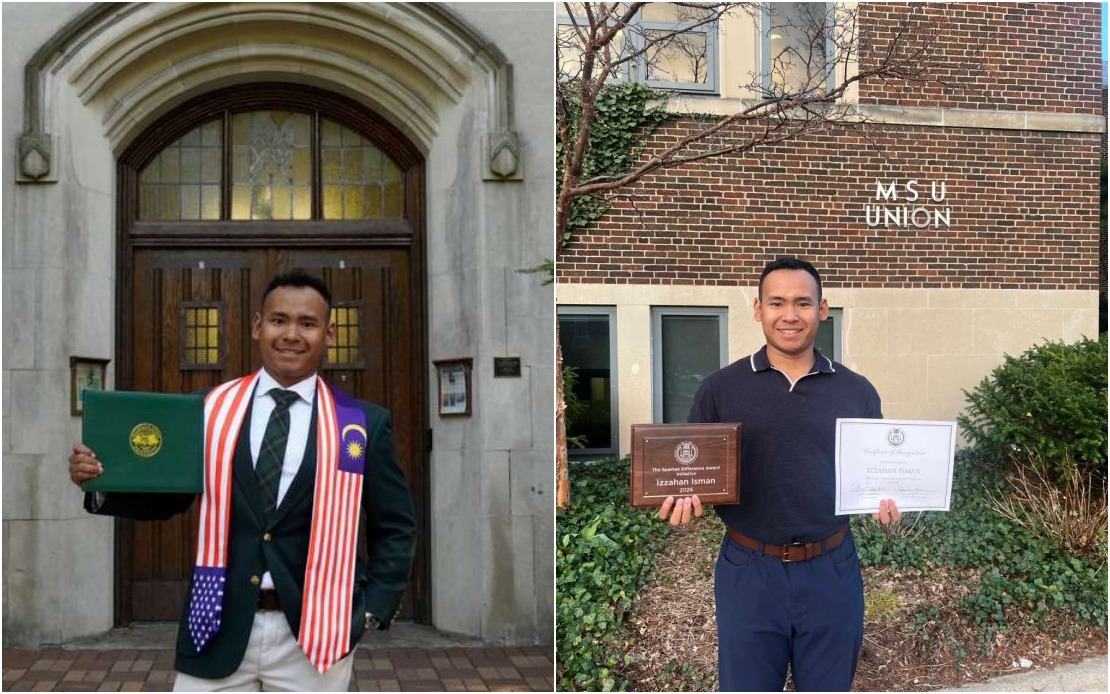
Muhammad Izzahan Isman's journey through higher education in the United States demonstrates how traditional Islamic learning can complement and enhance performance in contemporary academic settings. The 22-year-old MARA scholar, who recently completed his Bachelor of Arts in Economics at Michigan State University, attributes much of his success to the mental rigour and cognitive discipline instilled through years of Quranic memorisation during his secondary education in Malaysia.
The relationship between tahfiz education and academic performance has long been anecdotal in Malaysian discourse, but Izzahan's experience provides a concrete example of how memorisation-based learning translates into broader intellectual capabilities. Speaking to Bernama, he explained that the process of memorising and understanding the Quran exercises the brain in ways that prove transferable to other domains of study. The dual requirement of retention and comprehension creates neural pathways that enhance adaptive learning—a skill particularly valuable when tackling complex subjects like economics in a foreign educational context.
Izzahan's academic credentials speak to this assertion. Graduating with a CGPA of 3.72 from Michigan State University represents sustained excellence throughout his undergraduate programme. This performance did not emerge in isolation; it reflected the foundational discipline he developed as a student at Sekolah Berasrama Penuh Integrasi (SBPI) Rawang, one of Malaysia's premier residential schools integrating Islamic and conventional curricula. His ability to maintain rigorous academic standards while navigating the challenges of studying abroad suggests that the analytical frameworks learned through Quranic study provided a robust intellectual foundation.
Beyond classroom achievement, Izzahan applied his problem-solving capabilities in practical work settings. His part-time role as a management assistant at Michigan State University exposed him to operational inefficiencies—specifically, the recurring loss of trained student employees upon graduation, which forced managers into repetitive training cycles. Rather than viewing this as an inevitable institutional challenge, he channelled his analytical skills into developing a comprehensive training manual that systematised the onboarding process. This initiative simultaneously reduced training duration and enhanced operational efficiency, demonstrating that the cognitive discipline fostered through tahfiz extends into real-world application and innovation.
The tangible recognition he received validates this approach. The Spartan Difference Award and the Green Cranium Award, both bestowed by Michigan State University, acknowledge contributions beyond standard academic performance. Similarly, his receipt of the Reserve Officers' Training Corps (ROTC) Academic Ribbon—awarded for maintaining a GPA exceeding 3.5—further underscores his consistent intellectual discipline. For Malaysian readers, such achievements carry particular significance given Malaysia's emphasis on developing high-calibre graduates who can compete globally and contribute meaningfully to the economy.
What distinguishes Izzahan's account is his explicit acknowledgment of the psychological and emotional dimensions of success abroad. He describes the necessity of self-discipline rooted in a coherent sense of purpose as essential to navigating life in a foreign country without becoming derailed by distraction or isolation. This perspective aligns with educational research suggesting that students with internalised values and long-term vision demonstrate greater resilience when facing the psychological pressures of international study. For aspiring Malaysian students considering tertiary education overseas, his emphasis on maintaining clarity about personal goals and values offers practical wisdom beyond academic technique.
The Malaysian context amplifies the relevance of Izzahan's trajectory. Malaysia has invested substantially in programmes like the Young Talent Development Programme (YTP), through which MARA identifies and nurtures promising young Malaysians for overseas education. Such programmes rest on the premise that exposure to world-class institutions abroad, combined with rigorous selection and support, produces graduates capable of driving national development. Izzahan's success validates this investment while simultaneously suggesting that integration with Islamic education—rather than existing in tension with it—can enhance rather than hinder international academic competitiveness.
Looking forward, Izzahan articulates ambitions that reflect Malaysia's strategic priorities. His intention to contribute to Malaysia's financial sector and support the nation's aspiration to establish itself as a leading regional financial hub represents precisely the kind of high-value human capital return that MARA and similar scholarship programmes aim to generate. An economist trained at a respected American institution and committed to applying expertise domestically addresses a genuine gap in Malaysia's financial infrastructure development. His stated commitment to further developing expertise before contributing domestically suggests a realistic understanding of career progression and knowledge deepening.
The broader implication of Izzahan's experience concerns the evolution of educational paradigms in Malaysia and the region. Rather than viewing Islamic education and contemporary academic training as competing frameworks, his narrative suggests they function most effectively in complementary relationship. The tahfiz tradition's emphasis on disciplined mental exertion, comprehensive understanding, and internalised values provides psychological and cognitive scaffolding upon which modern academic and professional competencies can be built. This integration reflects Malaysia's historical strength in balancing religious and secular education and offers a model that other Southeast Asian nations with significant Muslim populations might consider.
Moreover, Izzahan's path illustrates how Malaysian graduates can successfully integrate into American academic and professional environments without abandoning the values and discipline instilled through Islamic education. This challenges a sometimes implicit assumption that global competitiveness requires wholesale cultural adaptation or the abandonment of faith-based frameworks. Instead, his achievements suggest that maintaining grounded sense of purpose and values may actually enhance rather than compromise success in demanding international environments. For Malaysian youth considering overseas study, particularly those from Islamic educational backgrounds, his example provides both encouragement and a conceptual framework for navigating the transition.
The social media attention Izzahan garnered during his American studies reflects broader Malaysian interest in success stories that reconcile multiple identity dimensions—the accomplished scholar, the practising Muslim, the professional innovator, and the committed national contributor. In an era where such integration is sometimes portrayed as difficult or exceptional, Izzahan's narrative normalises the possibility of achieving excellence across multiple domains simultaneously. His return to Malaysia to advance the financial sector, informed by American training but rooted in Malaysian commitment, represents the kind of circular flow of human capital that strengthens both individual development and national capacity.

