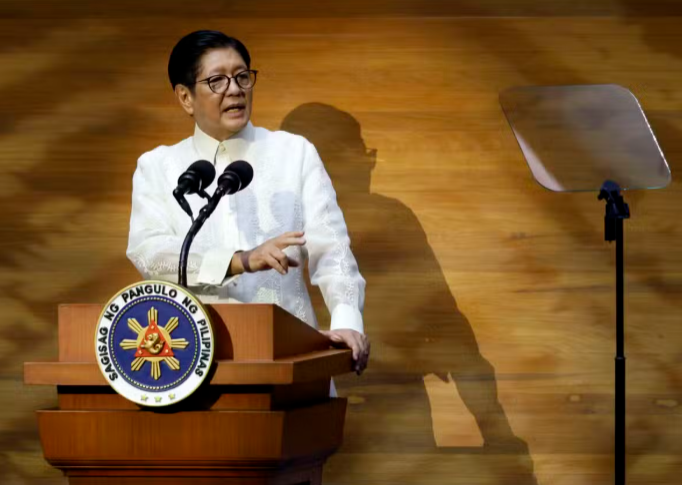
Philippine President Ferdinand Marcos has signalled an uncompromising stance on corruption by declaring that familial ties will not shield his relatives from the government's antigraft campaign, drawing attention to the Office of the Ombudsman's ongoing investigation into his first cousin Martin Romualdez, the former Speaker and Leyte Representative implicated in a massive infrastructure scandal.
Making these remarks during his fifth State of the Nation Address before Congress, Marcos framed the anticorruption effort as a matter of constitutional duty rather than personal preference. The statement carries particular weight given Romualdez's prominence in Philippine politics and his long association with the President. Rather than downplaying the sensitive family dynamics at stake, Marcos chose to emphasize that his role transcends kinship obligations, positioning himself as servant of the nation rather than protector of political allies.
The flood control scandal has ballooned into one of the administration's marquee anticorruption cases, encompassing alleged misappropriations across multiple infrastructure projects. The investigation originated from Marcos's dramatic 2024 State of the Nation Address, where he publicly castigated those involved with the now-memorable phrase "Mahiya naman kayo," roughly translating to "Have some shame." This rhetorical flourish sparked the creation of Executive Order No. 94 establishing the Independent Commission for Infrastructure to audit questionable projects from the previous decade.
Romualdez responded to the President's public rebuke with measured restraint, issuing a statement that acknowledged the family pain while affirming his respect for Marcos's position. Rather than mounting a defensive posture, Romualdez claimed he never sought preferential treatment and expressed confidence in his ability to prove his innocence through the judicial process. His measured tone suggests an attempt to preserve family relations while maintaining his position that the evidence will exonerate him of wrongdoing.
The scale of the investigation has proven remarkably comprehensive. The Independent Commission completed its fact-finding mandate in February, producing nine separate referrals that implicate 65 lawmakers, contractors, and current or former officials of the Department of Public Works and Highways and the Commission on Audit. At present, at least 45 individuals face criminal charges across the Sandiganbayan and regional trial courts, including sitting Senator Jinggoy Estrada and former Senator Ramon "Bong" Revilla Jr., alongside numerous former DPWH personnel and private contractors.
For Malaysian and Southeast Asian observers, the Romualdez case carries implications beyond the Philippines. It demonstrates how investigative mechanisms can pursue powerful political figures regardless of their connection to the sitting executive, a capacity that varies significantly across the region. The case illustrates the tension between loyalty networks and institutional accountability that characterises governance in many Southeast Asian democracies, where personal relationships often supersede formal institutional structures.
The financial dimension of the scandal underscores the stakes involved in the anticorruption drive. Marcos reported that the government has recovered, frozen, or preserved nearly 25 billion Philippine pesos in funds and assets connected to the accused individuals. Additionally, more than 800 million pesos have already been returned to the National Treasury, while payments for defective, counterfeit, or entirely nonexistent projects have been blocked, preventing further diversion of public resources. These figures suggest systematic rather than incidental corruption within flood control procurement.
The removal of former Public Works Secretary Manuel Bonoan as a respondent after his acceptance as a state witness indicates the prosecutorial strategy emerging from the investigation. Such arrangements allow prosecutors to build stronger cases against more senior figures by securing cooperation from lower-ranking officials. Meanwhile, the failure to apprehend former House appropriations committee chair Zaldy Co within the prescribed timeframe resulted in the archiving of his separate graft case, highlighting procedural limitations that can affect outcomes in high-profile corruption prosecutions.
Reforms within the Department of Public Works and Highways under Secretary Vince Dizon form the institutional response to the scandal's underlying systemic failures. The recruitment of new graduates and contract workers, coupled with comprehensive reviews of projects from planning through implementation, aims to prevent future anomalies. Such institutional restructuring reflects recognition that corruption emerges not merely from individual moral failures but from structural vulnerabilities that facilitate misconduct.
The anticorruption campaign has consumed substantial presidential attention and public discourse. Marcos's one-hour-and-26-minute State of the Nation Address, his longest since assuming office in 2022, devoted considerable time to the investigation's progress and philosophy. This rhetorical emphasis suggests that corruption fighting has become central to the administration's political identity and public messaging strategy. The President's willingness to distance himself from his cousin publicly indicates calculation that the reputational benefits of apparent impartiality outweigh the political costs of family estrangement.
The cases now proceed through the Office of the Ombudsman and the Department of Justice's National Prosecution Service, institutions that will bear responsibility for securing convictions. Marcos's invocation of faith in judicial processes and the notion that "the wheels of justice are turning" frames the next phase as one of institutional independence, where the executive's role diminishes and prosecutorial and judicial actors assume primary responsibility. This transition from executive-initiated investigation to institutionalised prosecution represents a critical juncture in determining the scandal's ultimate political and legal consequences.

