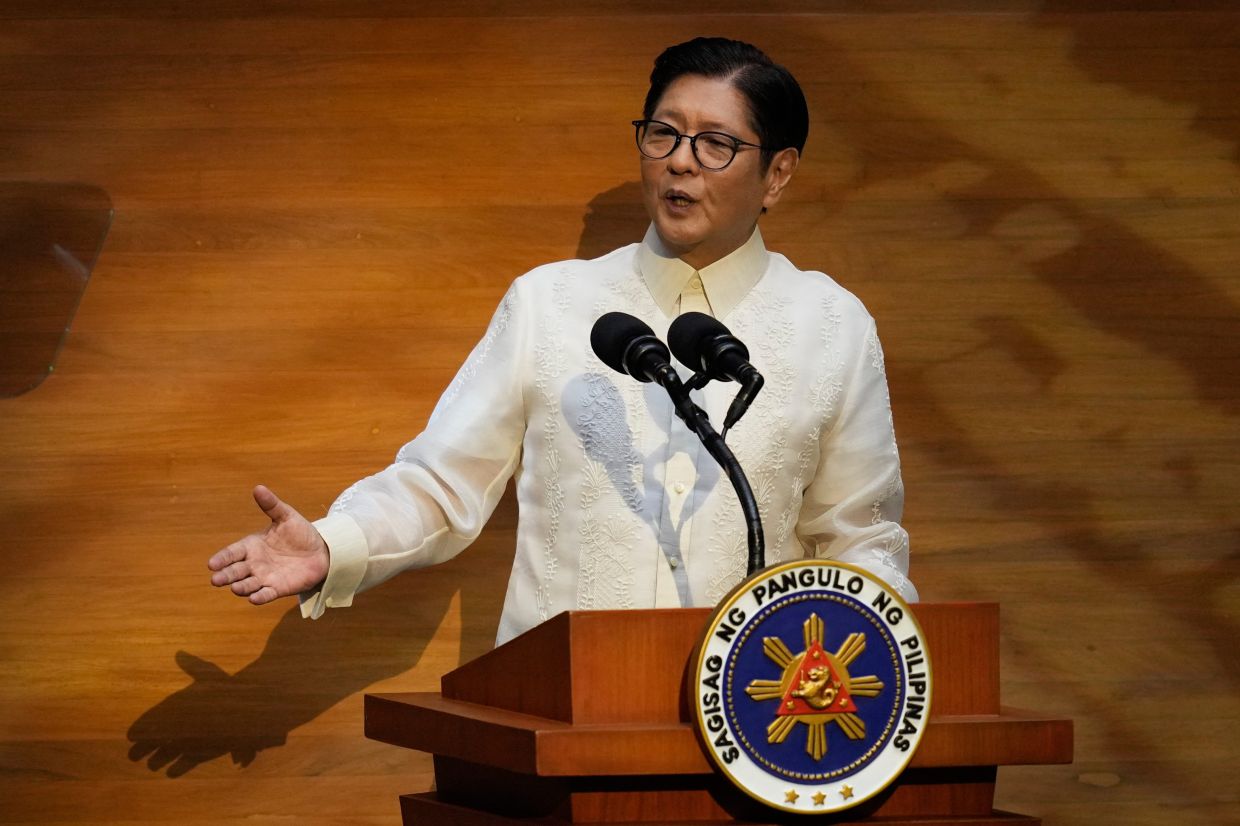
Philippine President Ferdinand Marcos Jr. used his state of the nation address on Monday to deliver a pointed, if carefully worded, rebuke of China's conduct in the disputed South China Sea, reasserting his government's commitment to enforcing a 2016 arbitration ruling that invalidated Beijing's expansive territorial claims. Speaking without naming China directly, Marcos vowed that Manila would employ every peaceful and legal mechanism at its disposal to uphold the decision, signalling resolute defiance against what he characterised as attempts to undermine the Philippines' maritime rights. The speech also marked a dramatic moment in domestic politics, with the president indicating that corruption charges would soon be filed against his cousin and former House Speaker Martin Romualdez, demonstrating that even family ties will not shield allies from accountability.
Marcos' carefully calibrated language on the South China Sea reflected the delicate diplomatic balance Manila maintains with Beijing, a major trading partner and neighbour. Rather than direct confrontation, the president invoked Philippine values and national dignity, declaring that "Filipinos are a noble and great race" and that the nation "does not yield" to external pressure or coercion. These remarks, which drew vigorous applause from lawmakers, appeared designed to rally domestic support for his maritime policy while avoiding the kind of inflammatory rhetoric that could further escalate regional tensions. The speech came days after China's state media outlet China Daily published AI-generated cartoons depicting Filipinos as monkeys, prompting Marcos to summon Chinese Ambassador Jing Quan to the presidential office and lodge an official protest against what Manila condemned as "racist and dehumanizing" imagery.
The underlying dispute centres on the 2016 arbitration award issued by a tribunal in The Hague under the United Nations Convention on the Law of the Sea. The ruling invalidated China's sweeping "nine-dash line" claim that encompasses most of the South China Sea, a verdict that Beijing has consistently rejected as a "political farce disguised as a legal proceeding." Marcos emphasised that this award represents a "definitive benchmark" for interpreting maritime law and remains binding on all parties, including China, which notably refused to participate in the arbitration process after a 2013 standoff between Chinese and Philippine vessels near Scarborough Shoal prompted Manila to initiate the legal challenge. The Chinese Foreign Ministry, responding through spokesperson Lin Jian, reiterated Beijing's long-held position that the award is "illegal, null and void and has no binding force," underscoring the intractable nature of this geopolitical dispute.
The escalating confrontations in the South China Sea have acquired greater urgency in recent years, with Chinese coast guard vessels, Philippine naval forces, and Vietnamese units engaged in increasingly tense encounters over fishing rights and territorial control. This strategic waterway, through which trillions of dollars in global trade pass annually, also remains contested by Malaysia, Brunei, and Taiwan, making it a potential flashpoint for broader regional instability. For Malaysia and other Southeast Asian nations, the Philippines' assertion of its rights carries significant implications, as their own maritime claims similarly depend on international law and the sanctity of arbitration rulings. By defending the 2016 award, Marcos is effectively defending the rules-based international order that smaller nations rely upon to counter the coercive power of larger neighbours.
On the domestic front, Marcos' announcement regarding Martin Romualdez represents a significant political development, marking the first time he has publicly signalled that his cousin—a key ally who served as House Speaker until his resignation last year—would face formal legal consequences in connection with a massive corruption scandal. The president, acknowledging the personal difficulty of the situation, declared that "this is painful to me, but we have to do the right thing," emphasising that he is "not a president for my family" or personal allies. This statement carries weight in the Philippine context, where dynastic politics and patronage networks have historically insulated powerful figures from prosecution, making such public statements from a sitting president relatively uncommon.
The corruption allegations centre on kickback schemes allegedly involving flood control projects, through which Romualdez and other legislators are accused of illegally pocketing substantial funds. The investigation, which has already resulted in charges against an incumbent senator, a former senator, a former public works secretary who previously served under Marcos himself, and various government engineers and construction company executives, has recovered or frozen nearly 25 billion pesos worth of assets belonging to suspects. Romualdez, who remains a congressman despite stepping down as House Speaker, has consistently maintained his innocence and stated his readiness to defend himself in court, though the impending charges represent a dramatic shift in his political fortunes.
The dual focus of Marcos' address—reasserting national sovereignty in maritime disputes while simultaneously signalling accountability for corruption within the political establishment—reflects the administration's attempt to project an image of principled governance. By coupling a firm stance on China with willingness to prosecute family members, the president seeks to demonstrate that his government operates according to law and moral principle rather than factional interest. This positioning matters significantly for regional stability, as it suggests that the Philippines intends to maintain a rules-based approach to international disputes even as it resists Chinese pressure, potentially influencing how other Southeast Asian nations calibrate their own responses to Beijing's expansionist policies.
The timing of these announcements carries strategic significance as well. The Philippines faces mounting pressure from China on multiple fronts—not only through military posturing in the South China Sea but also through diplomatic and media campaigns designed to delegitimise Manila's legal victories and international standing. The racist imagery distributed by China Daily represented an escalation of this information warfare, attempting to undermine Philippine credibility by dehumanising the Filipino people. Marcos' forceful rebuttal, combined with his defiant defence of the arbitration award, signals that Manila will not be intimidated by such tactics and remains committed to the international legal mechanisms that underpin regional stability.
Looking forward, the implications of Marcos' dual pronouncements extend beyond the Philippines. For Malaysia, Vietnam, and other claimant states in the South China Sea, the Philippine president's determination to enforce the 2016 arbitration award provides both encouragement and a potential model for resistance. Conversely, China's dismissal of the legal ruling and its turn to cultural and diplomatic pressure suggests that Beijing views the maritime disputes as matters to be resolved through assertion of power rather than adherence to international law. This fundamental disagreement over the authority of legal arbitration versus raw geopolitical leverage will likely define South China Sea politics for years to come, making the Philippines' willingness to sustain its legal position despite economic and military disadvantages a test case for whether international law can constrain rising powers or whether it remains merely a convenient tool for the weak.

