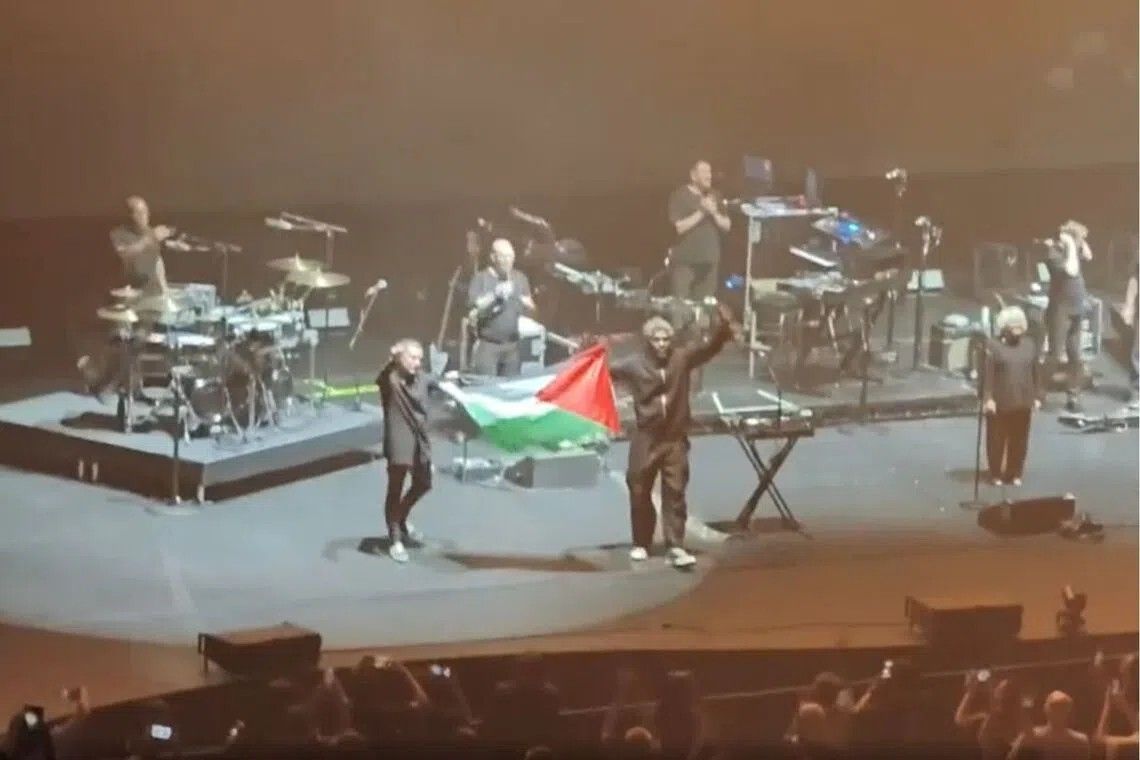
Singapore has moved to ban the British trip-hop band Massive Attack from future performances in the city-state after police investigations concluded that two members violated the nation's strict regulations governing foreign political symbols. The incident unfolded during a concert on Wednesday when band members unfurled a Palestinian flag on stage while one member shouted "Free Palestine", prompting a swift enforcement action by authorities in the tightly regulated city-state.
The two performers involved have been issued stern warnings and permanently barred from re-entering Singapore, according to police statements released late Friday. While authorities did not publicly identify the band members, video footage circulating online clearly documented the flag display, which drew sustained applause and cheers from the audience at the venue. The police investigation, conducted in consultation with state prosecutors, determined that the act constituted a breach of Singapore's licensing conditions for the event.
Singapore maintains comprehensive restrictions on the public display of foreign flags, national emblems, and political banners without explicit government permits. This regulatory framework forms part of the city-state's broader approach to managing public discourse and assembly, enforced through legislation that ranks among the world's strictest. The display at the Massive Attack concert directly contravened these established protocols, triggering what authorities characterised as a serious breach warranting immediate intervention.
Beyond the police sanctions, Singapore's media regulator has launched a separate investigation into whether the concert organisers breached the conditions attached to their performance licence. In an official statement, police noted that despite the event promoter's prior acknowledgement of applicable licence conditions, the band proceeded with the flag display and political statement. The regulator has indicated that it will not approve any future applications for Massive Attack performances in Singapore, cementing the practical effect of the entry ban imposed on the musicians.
The broader context reveals an ongoing tension between artistic expression and state regulation in Singapore. Massive Attack has built a considerable portion of its public profile around vocal criticism of Israeli military operations in Gaza and has consistently mobilised its platform to amplify Palestinian advocacy. The band's activism extends beyond musical performances; frontman Robert Del Naja was arrested alongside more than 200 other protesters in London's Trafalgar Square in April while demonstrating in support of Palestine Action, a group that has been prohibited from operating in the United Kingdom.
For Malaysia and the wider Southeast Asian region, the Massive Attack incident carries implications regarding how different governments manage the intersection of cultural events, political expression, and social cohesion. While Malaysia's regulatory approach differs from Singapore's, the question of permissible political messaging at concert venues remains relevant to regional entertainment licensing frameworks. The Singapore case demonstrates how swiftly and decisively authorities can move when they perceive threats to what they term "rule of law" and social stability, setting a precedent that may influence how other regional governments assess comparable situations.
Singapore's position as Southeast Asia's premier concert destination has been carefully cultivated through investments in infrastructure and hosting capabilities. The city-state has successfully attracted major touring acts including Taylor Swift, Coldplay, Ed Sheeran, and Bruno Mars, generating significant economic activity and enhancing its cultural profile. The Massive Attack ban represents a clear assertion that this status comes with expectations regarding political conduct, and that violations will result in concrete consequences including performance bans and entry restrictions.
The police statement accompanying the enforcement action explicitly urged the public, including foreign visitors and performers, to "refrain from importing foreign politics as this can undermine our social cohesion and the rule of law." This framing characterises political expression around the Israeli-Palestinian conflict as an external imposition rather than a legitimate topic of public discourse, reflecting Singapore's official position on how international disputes should be managed within its borders. The statement reflects official thinking about where the boundaries of acceptable speech lie within Singapore's highly controlled information environment.
The incident raises questions about how artists and tour organisers will navigate regulatory environments across Southeast Asia going forward. For promoters booking international acts, the Massive Attack case serves as a stark reminder that artistic freedom remains substantially constrained in certain key regional markets. This may influence decisions about which performers and potentially which messaging themes are compatible with touring schedules across the region, with implications for cultural diversity and the range of voices heard in Southeast Asian concert venues.
The concert promoter involved has not publicly commented on the police action or provided any statement regarding the sanctions. This silence may reflect uncertainty about the appropriate response in an environment where challenging regulatory authority carries potential commercial consequences. The absence of pushback from the entertainment industry also suggests either acceptance of Singapore's regulatory framework as a precondition of market access or tactical silence aimed at preserving future licensing opportunities.
Looking ahead, the ban raises broader questions about how Singapore balances its aspiration to be a global entertainment hub with its commitment to political control. The city-state's regulatory approach differs markedly from the more permissive stance toward political messaging found in many Western concert venues, where artists routinely address contentious international issues. This divergence will likely become more pronounced as geopolitical tensions, particularly regarding the Middle East, continue to generate activism among musicians and their audiences worldwide.

