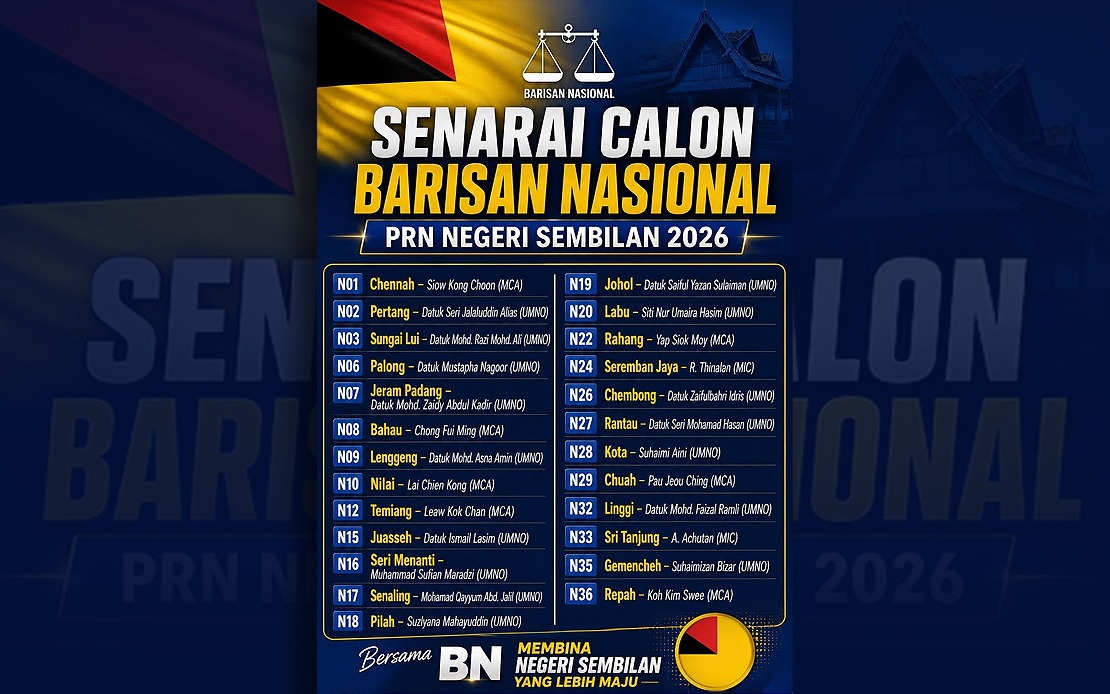
Barisan Nasional has finalized its seat allocation strategy for the 16th Negeri Sembilan state election, designating seven State Legislative Assembly seats for MCA and assigning four seats to MIC, according to BN chairman Datuk Seri Dr Ahmad Zahid Hamidi. The Deputy Prime Minister made the announcement following a meeting with prospective coalition candidates at Wisma UMNO Negeri Sembilan in Seremban on July 15, underscoring the coalition's commitment to maintaining its component party structure ahead of the contest.
The seat distribution reflects a deliberate strategic calculation centered on winability rather than arbitrary allocation. Ahmad Zahid emphasized that the formula employed by BN leadership took into serious consideration the projected electoral potential of individual candidates across their respective constituencies. This methodology represents a pragmatic approach to seat negotiation within the coalition, where party size and perceived strength in particular areas determine final candidate fielding arrangements. The approach mirrors standard practice adopted during previous state contests and federal elections, ensuring consistency in how BN manages its internal party dynamics.
The BN chairman disclosed that all prospective candidates invited to the assembly had formally signed undertakings and pledged their allegiance to him in his capacity as BN chairman. This ceremonial process, while routine in Malaysian electoral practice, carries significance in reinforcing party discipline and ensuring that selected candidates understand the expectations placed upon them by the coalition leadership. The meeting functioned as both a vetting exercise and an opportunity for Ahmad Zahid to personally engage with those who would represent BN at the ballot box.
Candidate nomination has been scheduled for July 18, with the Election Commission setting out a compressed electoral timeline that will culminate in polling day on August 1. Early voting is scheduled for July 28, providing an opportunity for eligible voters unable to cast ballots on the main polling date. This timetable compresses the campaign period significantly, reducing the time available for parties to mobilize grassroots support and communicate their platforms to voters.
The forthcoming election carries considerable political weight for BN, particularly given the coalition's performance in the previous state contest. During the 15th Negeri Sembilan state election, BN secured fourteen seats, falling substantially short of a legislative majority. In contrast, Pakatan Harapan captured seventeen seats, establishing its dominance in the state assembly, while Perikatan Nasional claimed five seats. This outcome represented a significant setback for BN in a state that had historically been within its political orbit, highlighting the erosion of the coalition's traditional support base.
The allocation of seats to MCA and MIC reflects the continued role these parties play within the BN structure, despite their diminished electoral fortunes compared to UMNO. MCA, traditionally representing Malaysian Chinese business and middle-class interests, has seen its parliamentary representation decline substantially over successive electoral cycles. MIC, the Malaysian Indian Congress, faces similar challenges in mobilizing its voter base and maintaining relevance within the coalition framework. By awarding these parties eleven combined seats, BN leadership signals its desire to preserve its multiethnic coalition character while managing competition between component parties.
Negeri Sembilan's political trajectory over the past decade reveals broader shifts within Malaysian electoral behavior. The state's shift toward opposition-friendly voting patterns reflects broader urban discontent and the emergence of new political movements that have challenged BN's traditional dominance. The presence of Perikatan Nasional as a third force, capturing five seats in the previous election, introduces additional complexity to the electoral mathematics and suggests that anti-establishment sentiment extends beyond Pakatan Harapan's conventional support base.
Ahmad Zahid's role in personally overseeing candidate selection and orchestrating the announcement ceremony underscores the significance BN attaches to the Negeri Sembilan contest. As Deputy Prime Minister and coalition chairman, his direct involvement signals that the election extends beyond localized state politics and carries implications for federal stability. The announcement of the full candidate slate was scheduled for the evening of July 15 at Stadium Tuanku Abdul Rahman Paroi, a venue chosen presumably for its capacity to accommodate supporters and media contingents.
For MCA and MIC specifically, the election presents an opportunity to demonstrate continued electoral relevance within Malaysia's evolving political landscape. The parties face pressure to deliver wins in their allocated seats while simultaneously managing the challenge of declining membership and generational renewal. Success or failure in Negeri Sembilan will reverberate within coalition discussions regarding seat allocation in future contests, potentially influencing their negotiating position during federal electoral redistribution exercises.
The compressed campaign period necessitates rapid mobilization by all competing parties. Ground machinery must be activated immediately following nomination to saturate constituencies with campaign messaging and voter engagement activities. For BN, this requires coordinating across multiple party structures to ensure coherent messaging while allowing individual component parties to address their specific community constituencies through tailored campaigns.
The outcome in Negeri Sembilan will provide important signals regarding BN's capacity to reverse recent electoral reverses or whether the coalition faces further erosion of its base support. Opposition parties will view the state as a crucial battleground where they can consolidate recent gains or test their organizational strength. Third-force actors like Perikatan Nasional will attempt to maintain their presence as an alternative to both BN and Pakatan Harapan, particularly among Malay-Muslim voters dissatisfied with the established coalition.

