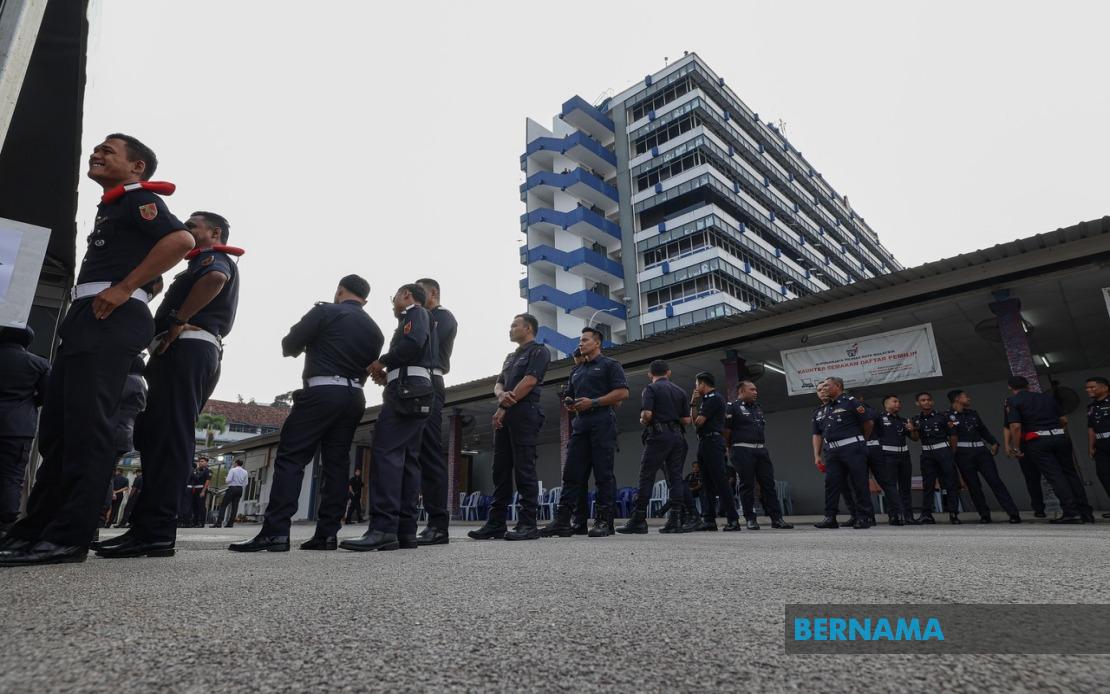
The 16th Negeri Sembilan State Election got underway with early voting on July 28, drawing thousands of military and police personnel to designated polling centres across the state. A combined 1,481 military personnel and their spouses cast ballots at the Army Basic Training Centre (PUSASDA) in Port Dickson, while 979 police personnel and their spouses voted at the Negeri Sembilan Police Contingent Headquarters (IPK) in Seremban. The staggered voting process reflected the Election Commission's recognition that security personnel require flexibility given their duty rosters and deployment patterns.
The PUSASDA polling operation utilised 11 separate voting streams to manage the flow of military voters, with the centre open from 8 am to 5 pm. Military eligibility for early voting centres on the Bagan Pinang constituency, where the three-way race features incumbent Abdul Fatah Zakaria representing Perikatan Nasional, Sheikh Junaidy Jamaludin of Parti Pribumi Bersatu Malaysia, and Nasir Raman fielded by Pakatan Harapan. The enthusiasm among eligible voters was evident from dawn, with military personnel beginning to queue before 7 am to participate in the democratic process. Army Chief Gen Tan Sri Azhan Md Othman was scheduled to observe proceedings at the centre during mid-morning, underscoring the institutional importance placed on security sector participation.
Police voting concentrated on the Temiang seat, where three candidates are contesting. ASP Harminder Singh Pritam Singh holds the distinction of being the first police early voter to cast his ballot at Stream 1 of the Seremban headquarters. Among those participating was Datuk Ahmad Dzaffir Mohd Yussof, a Crime Prevention Board member at the Home Ministry in Putrajaya with extensive experience in police administration, having previously directed operations at Bukit Aman and served as Negeri Sembilan's police chief. The Temiang constituency presents voters with choices between Ho Weng Wah from Pakatan Harapan, Leaw Kok Chan representing Barisan Nasional, and Fazly Hamid of Bersatu. Negeri Sembilan police chief Datuk Alzafny Ahmad visited the headquarters to oversee the voting process and subsequently address the media at the Nilai District Police Headquarters.
The broader early voting framework encompassed 38 polling centres distributed throughout Negeri Sembilan, accommodating a significantly larger eligible pool than the military and police contingents. In total, 16,884 military personnel and their spouses could participate in early voting, whilst 5,455 police force members and their spouses enjoyed the same privilege. This dual arrangement reflects Malaysia's constitutional provision permitting armed forces and police personnel to vote before the general electorate due to their operational commitments. The staggered closure times across voting centres, with 18 polling stations shutting at noon, two at 2 pm, and the remainder at 5 pm, allowed the Election Commission to manage logistical pressures while ensuring all eligible voters could participate.
The significance of early voting provisions extends beyond mere administrative convenience. Security sector participation in electoral processes carries symbolic weight in democratic systems, signalling that institutions responsible for maintaining order remain subordinate to civilian democratic norms. By facilitating military and police voting before the general population, election authorities affirm these personnel's citizenship rights whilst acknowledging their operational realities. In the Malaysian context, such inclusive mechanisms strengthen the legitimacy of election outcomes, particularly in states like Negeri Sembilan where contests have historically proven competitive.
The Bagan Pinang and Temiang constituencies represent distinct electoral battlegrounds that will help shape the state government's composition following Saturday's polling day. Bagan Pinang's three-way split between Perikatan Nasional's sitting representative, a Bersatu challenger, and the Pakatan Harapan candidate reflects the fragmentation characterising Malaysian electoral politics post-2018. Similarly, Temiang's contest involving Barisan Nasional, Pakatan Harapan, and Bersatu demonstrates how the traditional coalition structure has fractured, with former allies now competing directly. Early voting patterns among military and police personnel can sometimes suggest broader demographic trends, though their relatively small numbers within overall constituencies limit such analysis.
For readers across Southeast Asia monitoring Malaysian political developments, Negeri Sembilan's state election carries relevance beyond the state's borders. Malaysia's federal structure means state elections frequently serve as barometers for national political sentiment, influencing the calculations of federal-level coalition partners and opposition blocs. The state's positioning between Kuala Lumpur and its industrial zones makes its governance matters of regional economic interest. Results will inform how effectively multiracial coalitions continue governing in Malaysia and whether recent political realignments prove durable or temporary.
The Election Commission's management of the early voting process itself warrants attention from election administration specialists. The deployment of multiple voting streams, coordination with security sector leadership, and logistical planning required to process over 22,000 early voters across numerous centres demonstrates institutional capacity. Such technical competence builds public confidence in electoral integrity, a prerequisite for accepting outcomes in competitive races. Saturday's general polling day would reveal whether the early voting operation's apparent smoothness translated into an orderly election day experience nationwide.
Military and police early voting represents a distinctly Malaysian electoral feature with roots in the country's constitutional framework and security sector integration into state structures. Unlike some democracies that restrict or discourage government employee voting to maintain political neutrality, Malaysia explicitly accommodates these groups through dedicated voting provisions. This approach assumes that security personnel, like all citizens, possess legitimate interests in electoral outcomes whilst recognising their professional obligations might prevent standard voting day participation. The practical success of this system on July 28 suggested the mechanisms, refined through multiple state and federal elections, continue functioning effectively.

