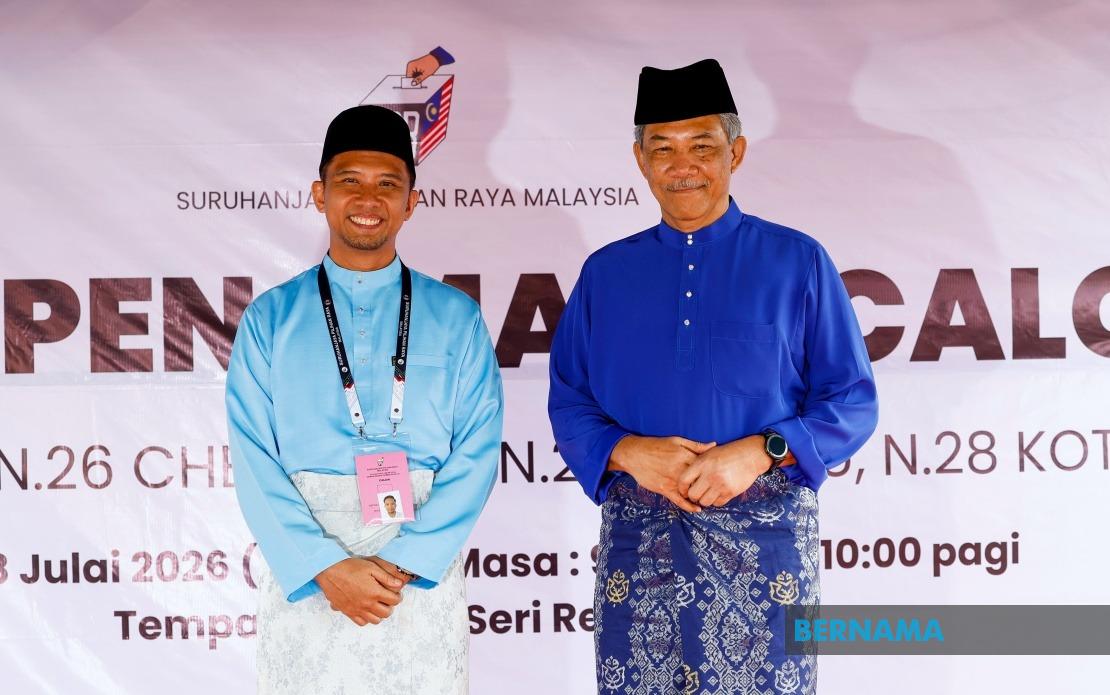
The Rantau state constituency has shaped into a two-candidate race in the 16th Negeri Sembilan state election, pitting state Barisan Nasional chairman and Foreign Minister Datuk Seri Mohamad Hasan against Pakatan Harapan's Dr Azizul Hakim Mahdi. The Rembau returning officer, Mohd Zamri Mohd Esa, confirmed the one-on-one contest following the conclusion of nomination proceedings at Dewan Sri Rembau on July 18, officially setting the stage for a competitive battle in a seat that has remained in BN's grasp for two decades.
Monamad Hasan's political tenure in Rantau stretches back to 2004, establishing him as an entrenched incumbent with substantial organisational machinery and voter familiarity. As UMNO deputy president alongside his cabinet portfolio, he carries considerable political weight and national profile within the BN machinery. His previous electoral performance demonstrates his electoral appeal in the constituency, having claimed victory in the 2023 state election with 16,957 votes against Pakatan Harapan's Rozmal Malakan, who managed only 6,677 votes—a commanding margin of over 10,000 votes that underscored the difficulty challengers have faced in dislodging him from this seat.
Following the conclusion of the nomination process, Mohamad articulated BN's campaign strategy, emphasising the coalition's intention to systematically present its electoral manifesto while mobilising grassroots support. He stressed that rigorous groundwork and organisational discipline would be essential to converting BN's policy message into electoral success on polling day. His remarks reflected confidence in the machinery's capability to replicate the dominant victory achieved just eighteen months earlier, though the political landscape has undergone notable shifts since that contest.
Dr Azizul Hakim Mahdi, the 35-year-old Pakatan Harapan challenger, presents a markedly different profile from traditional politicians. A medical doctor by profession with a decade of healthcare experience and ownership of three private clinics across Senawang, Puncak Alam, and Melaka, he embodies Pakatan's apparent strategy of fielding younger, professionally-qualified candidates who can credibly articulate specific policy platforms. His campaign messaging pivots on healthcare accessibility and community welfare, leveraging his medical credentials to establish authenticity when discussing health infrastructure and service delivery—issues that resonate particularly in constituencies where residents grapple with stretched public healthcare systems.
The Rantau contest occurs within a broader electoral landscape in Negeri Sembilan that reveals fragmented opposition support in several constituencies. The neighbouring Paroi seat is witnessing a three-way battle between Pakatan Harapan's Ahmad Shahir Mohd Shah, the Menteri Besar's press secretary, alongside Perikatan Nasional's Kamarol Ridzuan Mohd Zin and Bersatu's Mohd Nazree Mohd Yunus. Similarly, Kota will see three candidates contending, with BN's Suhaimi Aini defending against Pakatan's Muhammad Allif Ibrahim and Bersatu's Akmal Noradzmi Abdul Rahim. This fragmentation of anti-BN votes across multiple parties potentially advantages the better-organised Barisan machinery, though Pakatan's concentration of resources in select seats like Rantau indicates strategic prioritisation of winnable contests.
Chembong presents a more straightforward two-candidate scenario, where incumbent BN's Datuk Zaifulbahri Idris confronts Pakatan Harapan's Danish Nazran Murad. The concentration of opposition challenge in select seats suggests that neither Pakatan nor Perikatan possesses the organisational coherence or voter alignment to mount comprehensive state-wide challenges, with each focusing fire on constituencies deemed strategically valuable or where local conditions favour their respective camps.
The wider electoral context involves 889,490 registered voters across Negeri Sembilan's 36-seat state assembly, a significantly sized electorate whose composition and engagement levels will prove decisive. The voter base comprises 867,151 ordinary voters alongside 16,884 military personnel and their spouses and 5,455 police personnel voting early on July 28, with general polling occurring on August 1. Early voting arrangements for uniformed personnel warrant attention, as these constituencies have historically demonstrated voting patterns distinct from the civilian electorate, and their preferences may prove consequential in closely contested seats.
The state assembly was dissolved on June 5, initiating an intensive campaign period that allows parties limited time to reshape voter perceptions and mobilise support. For Pakatan Harapan's Rantau campaign, the challenge lies in overcoming Mohamad Hasan's institutional advantages, personal incumbent popularity, and BN's superior ground organisation. Their strategy appears to hinge on youth appeal, professional credibility, and targeted messaging on healthcare—betting that these factors can chip away at BN's margins among specific voter demographics, particularly younger, education-focused constituencies who might prioritise service delivery platforms over traditional party loyalty.
Mohamad Hasan's defence of the seat carries implications beyond Rantau itself. His retention would reinforce BN's control of Negeri Sembilan's legislature and validate the coalition's ability to defend traditionally held territory against an increasingly competitive Pakatan Harapan apparatus. Conversely, an upset loss would signal shifting electoral dynamics in states where BN has assumed demographic and organisational advantage, potentially energising opposition campaigns elsewhere and suggesting that personalised, issue-focused candidacies can penetrate previously secure BN bastions. The Rantau battleground thus serves as a microcosm of broader competitive dynamics reshaping Malaysia's state-level politics.
For Malaysian and Southeast Asian observers, the Negeri Sembilan election demonstrates how federal-level political reputations, ministerial portfolios, and administrative experience interact with local constituency dynamics. Mohamad Hasan's dual roles as Foreign Minister and state BN chairman position him as a bridge between federal and state governance, with potential spillover effects from his national prominence. Yet such high-profile status can also invite particular scrutiny and mobilisation of anti-government sentiment if national issues become salient during localised campaigns. The contest between Hasan's accumulated political capital and Dr Azizul Hakim's fresh, professionally-grounded alternative will illuminate whether Malaysian voters view state elections primarily through parties' track records and national narratives, or increasingly through lens of local service delivery and representative credentials.

