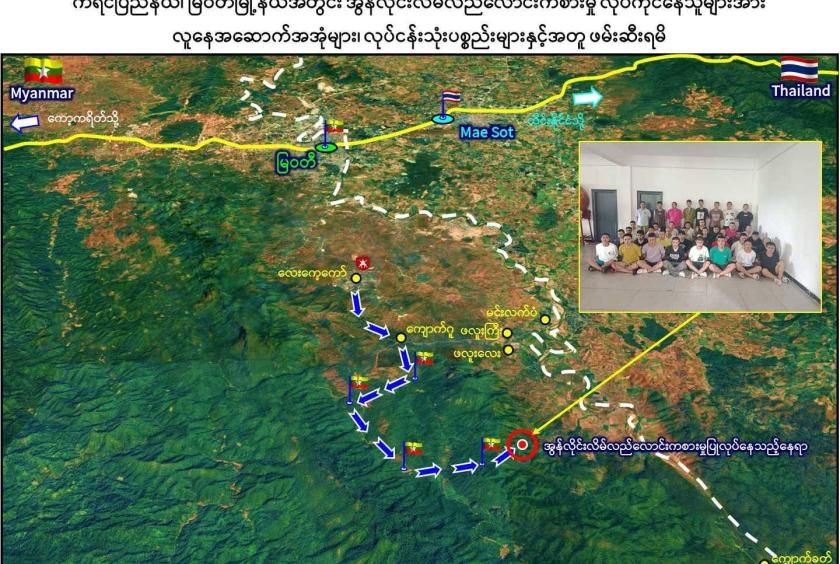
Myanmar's security forces have dismantled what authorities describe as a major hub for online fraud and illegal gambling, detaining 777 individuals during a sweeping operation in the Kyauk Khat area of Myawaddy Township in Kayin State. The raid represents one of the country's most significant enforcement actions against transnational cybercrime networks that have flourished in border regions, drawing international attention to Myanmar's struggle to control criminal enterprises operating within its territory.
The detained individuals reflect the multinational character of these scam operations, with the vast majority comprising 631 Chinese nationals, while Myanmar citizens accounted for 143 of those arrested. Thai authorities contributed to the intelligence or coordination, as evidenced by the apprehension of three Thai nationals. This composition underscores how regional criminal networks exploit Myanmar's porous borders and weak state capacity in conflict zones to establish operations targeting victims across Asia and beyond.
The material confiscation during the raid provides insight into the technological sophistication of these fraud enterprises. Authorities recovered one Starlink satellite terminal, indicating these operations maintain independent communications infrastructure to avoid detection through conventional telecommunications networks. The seizure of 85 computers and 183 mobile phones suggests a substantial, well-equipped fraud factory capable of managing multiple scam campaigns simultaneously, likely coordinating with criminal networks across multiple countries and processing victim transactions at scale.
According to government statements, the security operation was initiated following intelligence gathering about illegal compounds in the region. The deployment of forces to Myawaddy Township reflects official acknowledgment that border areas under contested control have become sanctuaries for international criminal activity. Myawaddy's location in Kayin State places it within territory where Myanmar's central authority competes with ethnic armed organisations and newer resistance groups for control, creating governance vacuums that criminal syndicates exploit.
The operation took a combative turn when security forces encountered resistance from armed groups, with authorities claiming that units affiliated with the Karen National Liberation Army and the People's Defence Force had been actively protecting the scam operations in exchange for payments. These allegations suggest systematic corruption and cooperation between Myanmar's conflict actors and international criminal enterprises, a pattern that has emerged in recent years as various armed factions seek funding sources beyond traditional military operations and taxation of local populations.
During the engagement, 13 members from these armed groups were killed, according to official reports. The military also seized nine firearms, ammunition stockpiles, bunkers, and additional military equipment from the compounds. This aspect of the operation highlights how criminal networks operating in conflict zones become entangled with local power structures, sometimes providing employment and revenue that sustains armed groups parallel to their military activities.
For regional observers and neighbouring countries, the raid illustrates the transnational nature of cybercrime threats originating from Myanmar's territory. These scam networks typically target victims across Southeast Asia, East Asia, and increasingly globally, with fraud schemes ranging from romance scams and fake investment opportunities to illegal gambling platforms. The presence of primarily Chinese nationals suggests these operations may be coordinated with international crime syndicates based in China or serving Chinese-speaking diaspora communities worldwide.
The detainees now face processing through Myanmar's legal system, though the country's judicial infrastructure has been severely compromised following the 2021 military coup and subsequent civil conflict. The investigation phase will likely occur under conditions of political instability and potential inconsistent application of law. Whether these individuals receive fair trials or meaningful prosecution remains uncertain, given Myanmar's fractured governance and the involvement of military and armed group actors in their capture.
Confiscated equipment will be handled according to official legal procedures, though details about technological evidence preservation or international cooperation in investigations remain unclear. Given the international dimensions of these crimes, coordination with law enforcement agencies in China, Thailand, and other affected countries would enhance the effectiveness of prosecutions and dismantle supporting infrastructure abroad.
Myanmar's government has signalled commitment to further action, pledging continued cooperation with neighbouring states and international partners to dismantle online scam networks and illegal gambling operations. However, meaningful progress requires not only tactical raids but sustained efforts to strengthen governance in border regions, reduce corruption among security forces and armed groups, and address the underlying conditions that make Myanmar attractive for such operations. The persistence of these networks despite occasional enforcement actions suggests that without institutional reform and sustained pressure on international criminal financing channels, similar operations will likely reconstitute.
The incident also raises questions about the relationship between Myanmar's political instability and the flourishing of cybercrime infrastructure. As state capacity has deteriorated and armed conflict has intensified, criminal organisations have found increasingly permissive environments. Regional security analysts note that combating these networks effectively requires addressing Myanmar's broader governance crisis and the fragmentation of state authority in contested territories.

