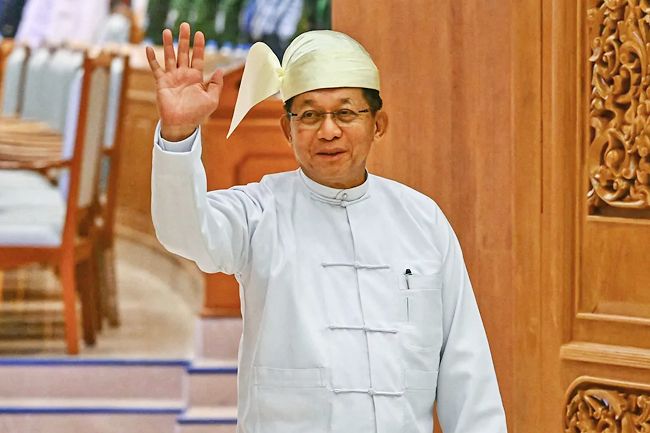
Myanmar's military leader Min Aung Hlaing is scheduled to visit Bangkok on August 6 and 7 for talks with Thai Prime Minister Anutin Charnvirakul, Thailand's Foreign Minister Sihasak Phuangketkeow announced this week. The planned meeting comes as Thailand intensifies diplomatic efforts to bring Myanmar back into the fold of the Association of Southeast Asian Nations, a campaign that has proven deeply contentious among the bloc's ten members and reflects fundamental disagreements about how to handle the crisis engulfing the region's eastern neighbour.
The timing of this bilateral engagement arrives after what Sihasak described as substantive discussions among ASEAN foreign ministers in Manila regarding the most effective pathway for Myanmar's diplomatic rehabilitation. Since the junta's 2021 coup that ousted democratically elected leader Aung San Suu Kyi, Myanmar has occupied an awkward liminal status within ASEAN—technically remaining a member state yet formally barred from all major ministerial assemblies and decision-making bodies. This exclusion has left the organisation grappling with its foundational principle of non-interference whilst confronting a regional humanitarian catastrophe of mounting proportions.
Thailand's willingness to champion Myanmar's reintegration carries particular strategic weight given its geopolitical position. Sharing a lengthy and porous border with Myanmar whilst simultaneously hosting millions of Burmese refugees and migrant workers, Thailand faces direct consequences from the military regime's policies and the ongoing civil conflict that has fractured much of the country. Bangkok's advocacy for bringing Naypyidaw back into ASEAN's inner circles has nevertheless triggered sharp disagreements with other member states, revealing fractures in the bloc's consensus-based decision-making apparatus.
Sihasak's characterisation of the engagement strategy as a "dual-track approach" provides crucial insight into Thailand's thinking. Rather than abandoning pressure for political change, Bangkok intends to pursue concrete bilateral cooperation whilst maintaining the framework of ASEAN's long-standing five-point peace plan. This plan, repeatedly cited but never effectively implemented, calls for immediate cessation of violence, dialogue between the junta and opposition forces, humanitarian assistance, and eventual democratic transition.
The foreign minister acknowledged that progress in Myanmar would necessarily unfold incrementally rather than through dramatic breakthroughs. He identified several tangible benchmarks against which international observers might measure movement towards normalisation, including whether the regime grants the ASEAN special envoy access to Suu Kyi, who remains imprisoned following disputed trials. Additionally, any reduction in armed violence particularly along the volatile Thai-Myanmar border could signal meaningful shifts in the junta's posture towards both its opponents and neighbouring countries.
Thailand has articulated particular concern regarding transnational crime networks flourishing within Myanmar's ungoverned spaces, including online scam operations that have victimised citizens throughout Southeast Asia and beyond. Drug trafficking through Myanmar continues to flood the region with narcotics, creating public health crises across Thailand, Laos, and other neighbours. These bilateral grievances provide Bangkok with legitimate grounds for engagement independent of broader democratisation debates, allowing Thai policymakers to justify dialogue whilst still claiming commitment to ASEAN's political principles.
The Burmese military's installation of Min Aung Hlaing as president through heavily circumscribed elections sparked international criticism regarding their legitimacy. Nevertheless, Sihasak expressed cautious optimism that even this limited electoral process might create openings for negotiations with Myanmar's armed ethnic organisations and democratic opposition movements. Thailand specifically proposed its potential role in facilitating dialogue with ethnic groups positioned along the Thai-Myanmar border, viewing such intermediation as a foundational step toward broader reconciliation.
Parallel to bilateral overtures, ASEAN itself is contemplating institutional reforms to address Myanmar's intractability. Philippine Foreign Minister Theresa Lazaro revealed that the bloc is considering appointing a permanent, long-term envoy to Myanmar rather than continuing with the current annual rotation system. This rotation mechanism has demonstrably failed to produce meaningful diplomatic progress or leverage over the junta, with successive ASEAN envoys encountering stonewalling and minimal cooperation from Naypyidaw.
The Myanmar crisis has exposed fundamental tensions within ASEAN's operational philosophy and membership obligations. Founding principles emphasising non-interference in internal affairs clash directly with humanitarian imperatives and regional stability considerations, forcing member states into uncomfortable compromises. Thailand's advocacy for reintegration reflects not endorsement of military rule but rather pragmatic recognition that Myanmar's complete isolation may prove counterproductive to achieving eventual political transition.
For Malaysian observers, these developments underscore the challenges confronting Southeast Asian regionalism when confronted with political rupture in a major member state. Malaysia itself has adopted a more cautious stance than Thailand regarding Myanmar's rapid return to ASEAN proceedings, reflecting concerns that premature diplomatic normalisation might legitimise military governance without substantive political concessions. The question of Myanmar's reintegration will likely dominate future ASEAN deliberations, testing the organisation's cohesion and forcing difficult calculations about balancing principle with pragmatism in pursuing regional stability.

