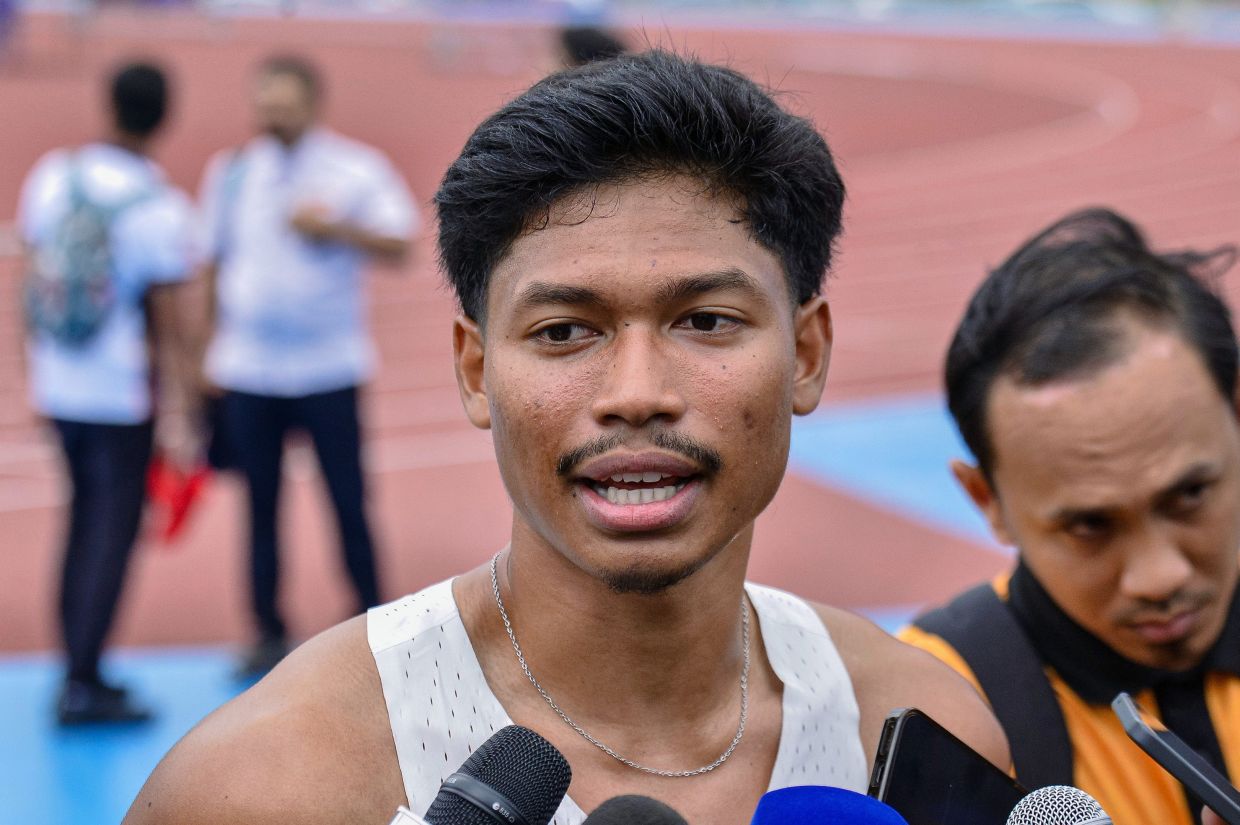
Mohd Azeem Fahmi, one of Malaysia's most promising sprinters, is set to begin a master's degree programme at Universiti Malaya, marking his return home after several years competing and studying abroad. The 21-year-old recently concluded his undergraduate studies at Auburn University in Alabama and has now secured a pathway to continue his academic and athletic development at the nation's premier research institution. During a formal visit to the university's Petaling Jaya campus, Azeem met with vice-chancellor Prof Datuk Seri Dr Noor Azuan Abu Osman, who expressed full institutional support for the athlete's postgraduate ambitions.
The courtesy meeting underscores a broader commitment from Universiti Malaya to nurture elite sporting talent alongside rigorous academic training. Alongside the vice-chancellor, key figures from the university's sports infrastructure participated in the discussions, including Associate Prof Dr Zulkarnain Jaafar, dean of the Faculty of Sports and Exercise Sciences, and Afizal Abu Othman, director of the Sports Centre. The presence of these senior academics signals the institution's intention to create an optimal environment for Azeem's continued development as both an athlete and scholar, reflecting UM's strategy of integrating world-class coaching and sports science with university-level education.
Azeem's decision to pursue postgraduate studies in Malaysia comes at a pivotal moment in his athletic career. Just days before his campus visit, he demonstrated his competitive prowess at the Malaysian Open championships held at Universiti Putra Malaysia's Serdang facility. The sprinter claimed gold medals in both the men's 100-metre individual event and the 4x100-metre relay, the latter achieved alongside teammates Danish Iftikhar Mohd Roslee, Pengiran Aidil Auf Hajam and Mohd Armin Zahryl. These victories reflect the training intensity and technical refinement he has developed during his time abroad, suggesting that his return to Malaysia need not interrupt his trajectory toward higher competitive honours.
The athlete's undergraduate journey took him across the Pacific when he relocated to the United States in January 2023 to study exercise physiology and kinesiology at Auburn University, a programme that combined theoretical knowledge with practical athletic application. During his time in Alabama, Azeem trained under coach Ken Harnden, a specialist in sprint mechanics and elite performance development. The combination of rigorous American university training standards and world-class coaching expertise has evidently accelerated his maturation as a competitor, equipping him with both the scientific foundation and technical proficiency necessary to compete at regional and international levels.
Universiti Malaya's appeal as a destination for elite athletes extends well beyond its contemporary facilities and coaching expertise. The institution boasts an impressive legacy of nurturing world-class sportspeople across multiple disciplines. Among its most celebrated alumni are diving champions Datuk Pandelela Rinong, Ooi Tze Liang and Bryan Nickson Lomas, each of whom has represented Malaysia with distinction at Olympic Games and major international competitions. These accomplished athletes represent proof of the university's capacity to develop talent at the highest echelons of competitive sport whilst maintaining academic excellence. Such precedent would have likely influenced Azeem's decision to pursue his master's degree at UM rather than seeking opportunities elsewhere.
The university's track record in athletics-focused education also includes badminton player Vivian Hoo, who represented Malaysia's national women's doubles programme whilst completing her undergraduate studies. Hoo graduated with a Bachelor of Sports Science degree in 2019, exemplifying the institution's ability to accommodate the demanding schedules and training requirements of active national representatives. The existence of such role models within UM's current and recent alumni network creates a supportive ecosystem where aspiring elite athletes can observe and learn from those who have successfully navigated the dual demands of elite competition and tertiary education.
For Malaysian sprinting specifically, Azeem's progression represents a crucial development in a discipline where regional depth has historically been inconsistent. The 100-metre event remains a fundamental measure of athletics prowess, and Malaysia has periodically struggled to produce sprinters capable of consistently winning medals at Southeast Asian Games and Commonwealth Games levels. By recruiting and supporting Azeem through postgraduate study, Universiti Malaya is making a strategic investment in the future competitiveness of Malaysian track and field. The master's programme in sports science disciplines would equip him not only to continue competing but potentially to transition into coaching or sports administration roles that could benefit the broader athletics ecosystem.
The timing of Azeem's return also carries significance for Malaysia's preparation for upcoming regional competitions. With Southeast Asian Games cycles and Commonwealth Games events on the horizon, having a sprinter of demonstrated capability based at a major Malaysian university provides stability and continuity for national team planning. Universities have become increasingly important infrastructure for maintaining athletic pipelines in the Southeast Asian context, where dedicated national sports boarding schools are limited in number. By providing Azeem with a structured environment combining postgraduate academics, world-class training facilities, and access to high-performance coaching, Universiti Malaya ensures that talent developed overseas can be retained and further cultivated domestically.
Looking forward, Azeem's master's degree pursuit also suggests a maturity in his approach to his athletic career. Rather than viewing education and sport as competing priorities, he appears to be embracing a model that integrates both, recognising that academic credentials and sports science knowledge will serve him regardless of whether his professional trajectory leads to elite athletics, coaching, or entirely different fields. This approach aligns increasingly with global best practice in athlete development, where institutions like Universiti Malaya actively encourage postgraduate study among their elite performers. The university's willingness to accommodate such pathways reflects a contemporary understanding that athletes with advanced qualifications enjoy greater career resilience and opportunities beyond competition.

