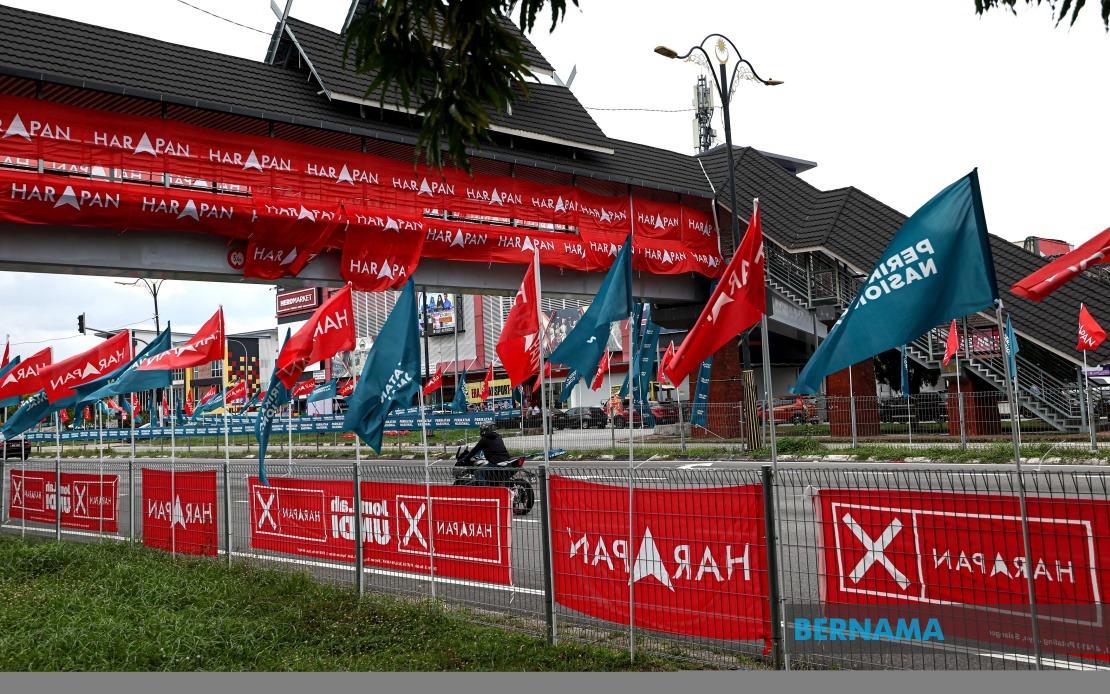
The campaign for Negeri Sembilan's 16th state election has unfolded at a measured tempo through its first seven days, with political parties holding back from the high-intensity mobilisation typically associated with Malaysian electoral contests. As the competition moves into its second week, political observers and party leaders anticipate a marked shift towards more aggressive and visible campaigning across the state, signalling that the real contest is only now beginning to take shape.
The opening phase has been characterised by conventional ground-level activities rather than the large-scale public demonstrations and rallies that often dominate Malaysian state elections. Political operatives have concentrated their efforts on house-to-house canvassing, small-group discussions at community venues, and grassroots meetings with village representatives. The visible "flag war" that typically transforms Malaysian towns into seas of party colours has remained notably restrained, with party symbols concentrated around community halls, village thoroughfares, and key transport intersections rather than saturating the urban landscape.
Both major coalitions have adopted what party strategists describe as micro-campaigning approaches, leveraging direct voter engagement and social media platforms to build support systematically rather than through large public gatherings. This tactical shift reflects evolving voter preferences and the increasing importance of personalised, localised messaging in contemporary Malaysian electoral politics. Menteri Besar Datuk Seri Aminuddin Harun, defending his Linggi seat for Pakatan Harapan, explicitly framed this first-week strategy as deliberate, emphasising the coalition's focus on establishing direct connections with community members through targeted, small-scale interactions.
The leadership presence from both coalitions has remained measured but strategically deployed. Prime Minister Datuk Seri Anwar Ibrahim, heading Pakatan Harapan, has made two visits to Negeri Sembilan during the campaign period, while Deputy Prime Minister Datuk Seri Dr Ahmad Zahid Hamidi, chairing Barisan Nasional, has undertaken three campaign visits to reinforce coalition candidates. These carefully calibrated appearances suggest leadership teams are preserving their full deployment for the more critical final week when undecided voters traditionally make their electoral choices.
Barisan Nasional's second-ranked leader, Datuk Seri Mohamad Hasan, has signalled the coalition's intentions for the coming days while acknowledging the opening week's consolidation phase. The Foreign Minister, who represents Rantau as a state assemblyman, emphasised the importance of sustained momentum through continuous voter contact, underscoring BN's commitment to ground operations across all 25 seats it is contesting. His remarks indicate the coalition views the second and third weeks as critical for translating organisational strength into electoral advantage.
The competitive landscape has crystallised rapidly despite the campaign's subdued opening. Pakatan Harapan has fielded the maximum possible 36 candidates across all state seats, establishing itself as the incumbent coalition with clear organisational reach. Barisan Nasional's 25 candidates position the coalition as a substantial challenger, whilst Bersatu's decision to field 24 candidates across the state reveals its determination to operate as a significant independent force rather than defer to Perikatan Nasional's broader framework. Perikatan Nasional itself fields 11 candidates, suggesting the coalition has concentrated resources on selected battleground seats rather than contesting comprehensively.
Several smaller parties and independent candidates round out the field of 103 total contestants. Barisan Jemaah Islamiah Se-Malaysia, Parti Orang Asli Malaysia, and Parti Sosialis Malaysia each field single candidates, while four independent candidates compete outside party structures. This multi-faction field creates potential for fragmented contests in several seats, particularly where opposition votes might split between Bersatu and Perikatan Nasional candidates.
Political science academics monitoring the contest have identified emerging patterns that suggest the election's ultimate outcome remains genuinely competitive. Dr Mujibu Abd Muis, a lecturer at Universiti Teknologi MARA's Seremban campus, has observed that the contest appears primarily structured around Pakatan Harapan and Barisan Nasional, with Perikatan Nasional still developing momentum and campaign visibility. His analysis suggests that voter evaluation criteria have shifted markedly from the speech-centred politics of previous eras towards assessing candidates' tangible community engagement and local accessibility.
This transformation in voter behaviour reflects broader changes in Malaysian electoral dynamics, where digital connectivity and social media presence increasingly influence candidate perception alongside traditional street-level visibility. The micro-campaigning strategies adopted by parties align directly with this voter evolution, allowing candidates to demonstrate responsiveness and accessibility whilst building detailed databases of constituent concerns and preferences. The approach proves particularly effective for incumbent parties seeking to highlight specific local achievements and performance records.
The final week of campaigning traditionally determines electoral outcomes in Malaysian state contests, as fence-sitters and genuinely undecided voters crystallise their preferences under time pressure. Political observers anticipate that the third week will witness substantially elevated activity levels, with senior party figures conducting multiple rallies, intensified media engagement, and concentrated canvassing in identified target constituencies. The pattern suggests that Monday's transition into the second campaign week marks the beginning of genuine electoral contest, after an opening phase more focused on organisational positioning.
Early voting is scheduled for July 28, with general polling set for August 1. The compressed timeline between these dates means the electoral contest will effectively conclude before most voters cast ballots, making the coming fortnight extraordinarily significant for determining which coalition ultimately governs Negeri Sembilan. The state's economic importance within Malaysia's manufacturing and services sectors adds national significance to what might otherwise be a routine state election, particularly given ongoing coalition realignments at the federal level.

