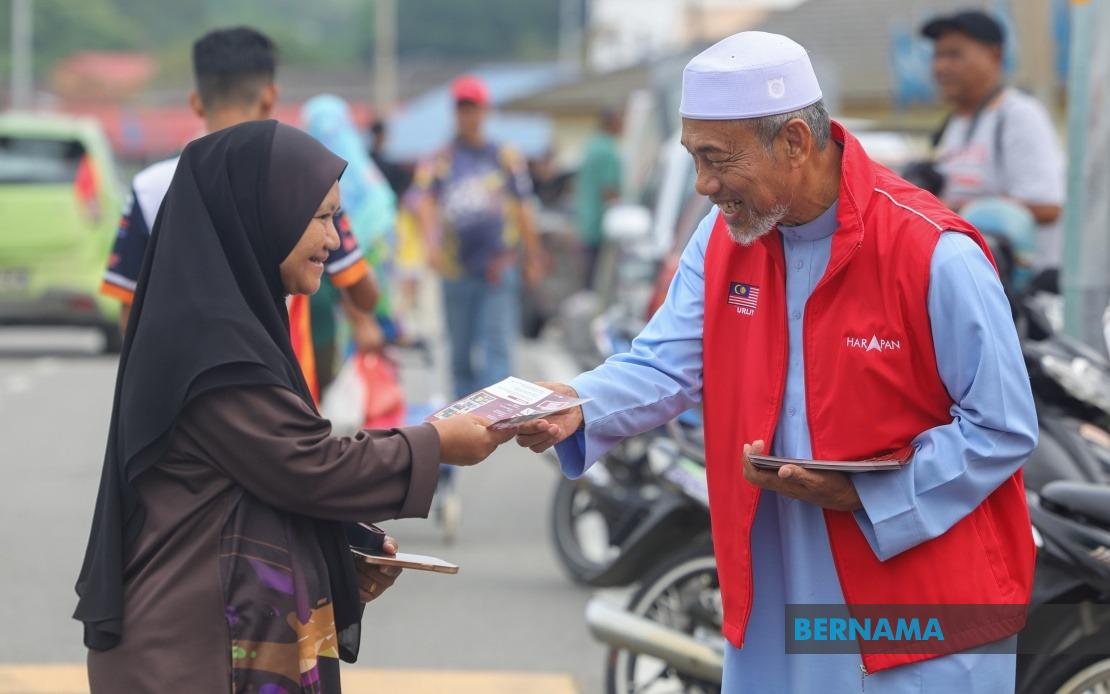
The 16th Negeri Sembilan State Election campaign has entered its critical phase as candidates across the political spectrum deploy intensive grassroots strategies to mobilise voters. With polling day set for 1 August, the twelve-day window remaining has prompted candidates to schedule multiple engagements per day, recognising that direct voter contact remains the most effective campaign tool in state-level contests throughout Malaysia. The second day of the official campaign period witnessed a flurry of activity as contenders sought to establish momentum across their respective constituencies through breakfast gatherings, market visits, and community interactions.
Menteri Besar Datuk Seri Aminuddin Harun, who is contesting the Linggi state seat under Pakatan Harapan, set the pace for PH campaigning by commencing his day with congregational prayer at Masjid Jamek Pasir Panjang. This spiritual opening to his campaign reflected a deliberate strategy of positioning candidates within the community fabric rather than treating electoral engagement as purely transactional. His subsequent movements through Pasir Panjang town, Taman Setia, Taman Kekatong, and residential areas in Telok Pelandok demonstrated the methodical precinct-by-precinct approach that state elections require, particularly in mixed urban-rural constituencies where voter demographics vary significantly.
Aminuddin, who simultaneously holds positions as Negeri Sembilan Pakatan Harapan chairman, PKR state chairman, and PKR vice-president at the national level, articulated the rationale behind such intensive ground engagement. He emphasised that walkabouts provide crucial opportunities to understand voter priorities beyond polling data and survey findings. His framing of these encounters as chances to listen to concerns and aspirations rather than simply deliver campaign messaging reflects a softer approach to candidate visibility that may prove effective in constituencies where voters have grown sceptical of purely transactional political promises. The inclusion of a dedicated community engagement session with the Indian community also signals PH's strategy to consolidate support among specific demographic groups that historically determine electoral margins in Negeri Sembilan.
On the opposition benches, DAP secretary-general Anthony Loke has similarly committed to an ambitious campaign schedule whilst defending the Chennah state seat. His campaign itinerary, beginning with a walkabout at Seremban Central Market before progressing to an evening state election dinner, demonstrates how DAP and PH candidates are distributing their efforts across different times of day to capture voters at varying locations and during different routines. Market campaigns particularly target working-class and business-owning constituencies where direct conversation opportunities multiply, allowing candidates to address immediate economic concerns rather than abstract policy platforms.
The intensity of campaign scheduling has become a distinguishing feature of this election cycle. PH candidate Kamarul Ariffin Wafa for the Seri Menanti seat had structured eight separate programmes into a single day, whilst Yaacob Mahmood, contesting for Serting, adopted a similar approach by combining early morning voter outreach in Felda Raja Alias 3 with subsequent engagement at business premises in Bandar Seri Jempol. This multiplicity of touchpoints reflects a calculation that modern voters demand accessibility and responsiveness from their representatives, and that candidates unable to demonstrate physical presence and availability may struggle to overcome incumbent advantages or party brand challenges.
The Felda constituency context is particularly significant for understanding how candidates are tailoring their approaches to specific voter bases. Yaacob Mahmood's deliberate engagement with Felda residents acknowledges that these communities, which have historically formed a substantial voting bloc in Negeri Sembilan, require targeted messaging around agricultural support, commodity pricing, and rural development. His framing of informal community programmes as opportunities for friendly discussion about local needs rather than formal political rallies suggests awareness that Felda voters, many with decades of voting experience, respond to genuine dialogue rather than rehearsed speeches.
Barisan Nasional candidates have similarly mobilised grassroots operations, though with slightly different emphasis. Datuk Seri Mohamad Hasan, the incumbent Rantau assemblyman and BN deputy chairman, concentrated his early campaign efforts at the BN Polling District Centre, indicating a strategy of consolidating existing party machinery and volunteer networks before expanding outward. This approach differs markedly from opposition candidates' emphasis on new voter conversion, reflecting the structural advantages that incumbency and established administrative networks provide to BN in state contests. The centre-based campaign initiation also allows BN to brief volunteers and coordinate messaging before they disperse into constituencies.
Jalaluddin Alias, chairman of the Negeri Sembilan UMNO Liaison Committee, incorporated youth engagement and Orang Asli community outreach into his campaign schedule. The decision to participate in a sepak takraw tournament before visiting an Orang Asli settlement demonstrates strategic diversification of candidate visibility across age groups and marginalised communities. In Malaysian state elections, such targeted outreach often proves decisive, particularly when multiple candidates contest relatively closely-matched constituencies.
The electoral mathematics underlying this intensive campaigning effort merit consideration. The Negeri Sembilan State Legislative Assembly dissolution on 5 June triggered a mobilisation process that compressed the pre-election period considerably. With 889,490 registered voters eligible to participate, and early voting scheduled for 28 July for military personnel, police officers and their spouses, candidates face a compressed timeline for meaningful voter engagement. This early-voting provision, which affects 22,339 voters across military and police contingents, creates an additional scheduling pressure, as candidates must ensure their messages reach these cohorts before they cast ballots.
The composition of the electorate itself shapes campaign strategy. Ordinary voters number 867,151, suggesting that Negeri Sembilan's electorate remains predominantly civilian-focused rather than security-force dependent, as occurs in some other states. This demographic reality has likely encouraged candidates to prioritise civilian-oriented grassroots engagement over security-force specific outreach. The distribution of voters across urban Seremban, mixed towns like Jempol and Pertang, and rural Felda areas creates a genuinely heterogeneous electorate requiring multiple campaign approaches rather than a single unified messaging strategy.
As candidates maintain their frenetic campaign schedules through the remaining pre-election period, the volume of grassroots activity serves multiple functions beyond simple voter persuasion. It demonstrates candidate energy and commitment to voters who reward visible effort, it generates social media content and word-of-mouth advocacy from supporters who encounter candidates in person, and it provides party organisers with real-time feedback about voter sentiment and emerging issues that might require policy responsiveness. The Negeri Sembilan election, therefore, functions as a test case for how Malaysian political parties calibrate their ground operations in an era of declining voter turnout and increasing electoral competitiveness at the state level.
The coming weeks will determine whether this intensive grassroots engagement translates into electoral success for any particular coalition, and whether the strategic focus on direct voter contact ultimately outweighs other campaign factors such as incumbency, party brand strength, and economic conditions. For Malaysian political observers, the Negeri Sembilan contest offers instructive lessons about campaign dynamics in contests where no single party commands overwhelming dominance and where multiple coalitions compete seriously for legislative control.

