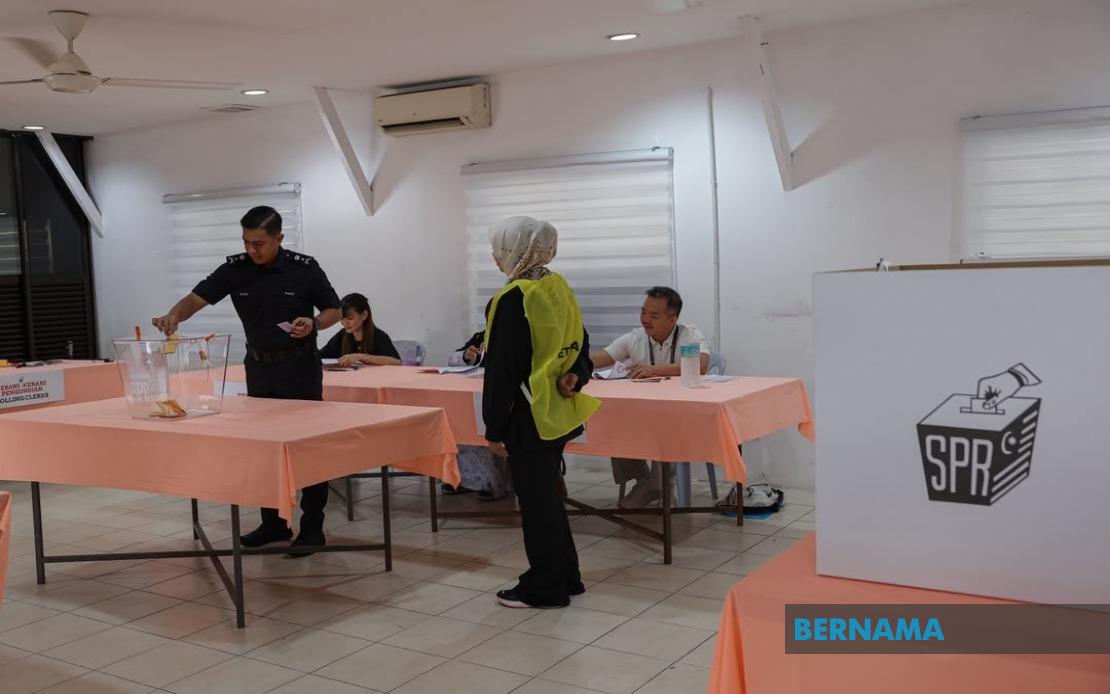
Early voting in the 16th Negeri Sembilan State Election commenced on July 28, with all 38 designated polling centres unlocking their doors at 8 am to facilitate military and police personnel in casting their ballots before the official election day. This staggered voting approach reflects election management practices across Southeast Asia, where security forces are often given advance polling windows to ensure their participation without disrupting operational duties. The Election Commission facilitated the voting of 22,339 military and police officers alongside their spouses, underscoring the significant role these voter blocs play in state electoral outcomes.
The Malaysian Armed Forces represented the larger contingent among early voters, with 16,884 personnel and their spouses allocated across eight specially prepared polling stations. This distribution strategy concentrated military voting at fewer locations, potentially reflecting the geographic concentration of military installations across the state. In contrast, the Royal Malaysia Police contingent of 5,455 voters was spread across 30 centres, suggesting a more dispersed police presence throughout Negeri Sembilan's towns and districts. The differential allocation of polling centres reveals logistical considerations that extend beyond mere voter convenience, touching on security arrangements and transportation needs inherent in managing such operations.
Voting proceeded according to a structured timetable, with polling stations closing in stages between noon and 5 pm as determined by the Election Commission's scheduling. This phased closure approach differs from standard election day procedures, likely designed to manage crowd flow and ensure orderly processing given the concentrated voter volume. Weather conditions across most of Negeri Sembilan remained favourable on the early voting day, eliminating potential obstacles that occasionally affect turnout in Malaysian elections. The clement conditions facilitated smooth operations across the dispersed centres, particularly important given the state's varied terrain ranging from Seremban's urban core to outlying rural constituencies.
The broader electoral context reveals a competitive landscape that extends well beyond the government-opposition binary. The 16th Negeri Sembilan State Legislative Assembly comprises 36 seats contested by 103 candidates representing a fragmented political ecosystem. Pakatan Harapan's decision to field all 36 candidates demonstrates confidence in contesting every constituency, positioning the coalition as the primary challenger to incumbent administrations. Barisan Nasional's 25 candidates indicate a strategic focus on winnable seats rather than universal coverage, a common tactic employed by coalitions managing resources across multiple simultaneous state contests. Bersatu's 24 candidates represent the party's persistent effort to establish itself as a significant state-level force independent of Perikatan Nasional's broader coalition framework.
The inclusion of Perikatan Nasional, fielding 11 candidates, adds another layer to the state's political complexity. This coalition structure suggests strategic coordination between Bersatu and PN candidates in certain constituencies, though the overlap requires careful navigation to avoid splitting anti-PH votes. Four independent candidates, along with representatives from smaller parties including Berjasa, ASLI, and PSM, create additional vote-splitting scenarios that could prove decisive in closely contested marginal seats. Negeri Sembilan's political trajectory increasingly mirrors national patterns, where single-party dominance has fragmented into multi-cornered contests requiring sophisticated coalition management and strategic seat allocations.
The dissolution of the Negeri Sembilan State Assembly on June 5 set the electoral timetable, with July 28's early voting representing a pre-campaign milestone building momentum toward August 1's main election day. This compressed timeline compressed traditional campaign periods, requiring candidates to mobilise supporters rapidly while navigating the July school holidays and monsoon season considerations affecting accessibility in certain areas. For Malaysian political observers, the Negeri Sembilan election serves as a bellwether for broader coalition dynamics and voter sentiment ahead of potentially decisive national contests in coming years.
Approximately 889,490 ordinary voters will determine the state assembly's final composition on August 1, representing a significant portion of Negeri Sembilan's population base. This figure underscores the state's moderate size within Malaysia's electoral geography, positioned between the smaller states like Perlis and Melaka and the larger industrial states of Selangor and Johor. Voter mobilisation strategies across the competing coalitions necessarily differ from approaches employed in larger, more densely populated states, where infrastructure and logistical challenges multiply substantially. Negeri Sembilan's more manageable scale permits direct grassroots engagement strategies that larger states increasingly delegate to digital platforms and macro-level media campaigns.
For Malaysian observers tracking coalition cohesion, the Negeri Sembilan contest offers insights into whether Pakatan Harapan maintains electoral momentum in non-urban constituencies where BN has historically performed competitively. The relatively strong Bersatu presence suggests ongoing tensions within Perikatan Nasional's strategic calculations, particularly regarding seat allocations and candidate suitability determinations. These internal coalition dynamics often prove as consequential as inter-coalition competition, determining which candidates receive party machinery support and campaign resources essential to winning tight marginal contests. The state election thus illuminates broader fractures within Malaysia's political landscape that persist beneath formal coalition structures.
Regional implications extend throughout Southeast Asia's electoral landscape, where Malaysia's multiparty democracy continues experimenting with coalition governance and fragmented voter preferences. Negeri Sembilan's results will influence opposition confidence in mobilising rural constituencies alongside urban bases, a challenge confronting democratic parties across ASEAN. The state's ethnic and religious diversity mirrors Malaysian composition broadly, making electoral patterns potentially indicative of national trajectories. Political scientists monitoring democratic consolidation in Southeast Asia will scrutinise both voter turnout metrics and coalition performance to assess whether Malaysia's system successfully accommodates diverse political expression or devolves toward unworkable fragmentation requiring realignment.
The security forces' early voting participation holds particular significance for understanding how institutional voters behave independently of civilian population trends. Their voting patterns and turnout rates provide data suggesting whether specific coalitions maintain institutional support or whether security personnel increasingly reflect broader demographic voting shifts. In Malaysian politics, where allegations of institutional bias periodically surface, security force voting provides transparency opportunities demonstrating whether electoral administration remains politically neutral. The early voting centres' successful opening and operation on July 28 thus represents both procedural normalcy and substantive democratic functionality worthy of continued monitoring as Malaysia navigates complex political transitions throughout 2024 and beyond.

