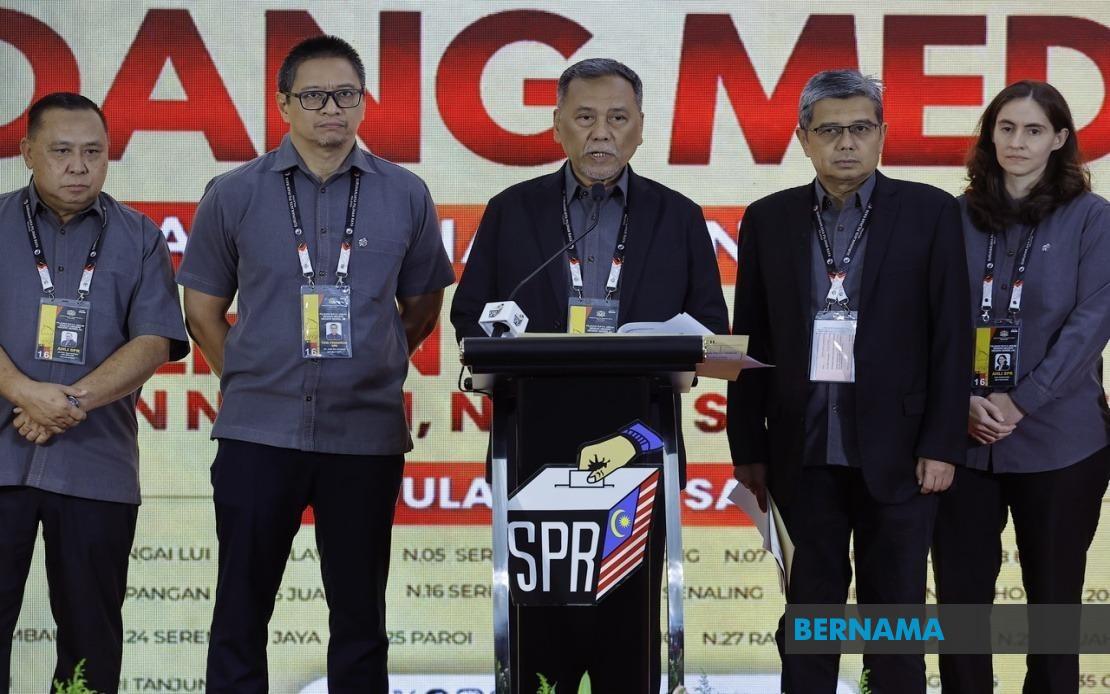
The 16th Negeri Sembilan state election is shaping up to be a tightly contested affair, with the Election Commission formally certifying 103 candidates across the state's 36 seats following the completion of nominations on July 18. The race will feature an unusually fragmented political landscape, with nearly three-fifths of constituencies bracing for multi-way battles that could significantly impact vote efficiency and seat distribution across the state assembly.
Election Commission chairman Datuk Seri Ramlan Harun disclosed that the nomination verification process confirmed candidates' eligibility to contest after the submission deadline closed at 10 am at eight designated centres throughout Negeri Sembilan. The announcement underscores the logistical complexity of managing nominations across the state, reflecting broader challenges Malaysia's electoral authorities face in coordinating state-level competitions that have grown increasingly competitive and complex in recent years.
Pakatan Harapan has emerged as the clear frontrunner in terms of numerical strength, fielding 36 candidates across all available seats—a strategy that signals confidence in the coalition's ability to contest every constituency. Barisan Nasional, the traditional powerhouse in many Malaysian states, has adopted a more selective approach by nominating 25 candidates, effectively conceding certain seats to focus resources on winnable terrain. This disparity in candidate deployment reveals shifting strategic calculations in Malaysia's political landscape, where coalitions now carefully manage their footprint based on demographic shifts and recent electoral performance.
The remainder of the slate comprises a diverse range of political players reflecting Malaysia's increasingly pluralistic political ecosystem. Bersatu, the party that triggered the collapse of the previous PH government in 2020 and later aligned with Perikatan Nasional, has fielded 24 candidates—a substantial presence that could fragment the Malay-Muslim vote across multiple constituencies. Perikatan Nasional proper is contesting 11 seats, while marginal players including Berjasa, ASLI, and PSM have each fielded single candidates, alongside four independent contenders seeking to capitalise on voter frustration with established parties or local grievances.
The proliferation of three-cornered contests in 21 of the 36 constituencies represents the most notable feature of this election's structural composition. Ramlan confirmed that 11 seats will see straightforward two-way battles, while four constituencies—namely Nilai, Sri Tanjung, Jeram Padang, and Rahang—will witness even more fragmented contests involving four or five candidates. This fracturing of the electoral battlefield introduces significant unpredictability; candidates who secure 30 per cent of the vote could win decisively in multi-way races, a reality that fundamentally alters campaign strategy and voter behaviour compared to traditional two-way contests.
Demographic analysis of the candidate pool reveals a continued gender imbalance in Malaysian electoral politics, with 94 male candidates vastly outnumbering nine female contenders—a 10-to-1 ratio that persists despite growing advocacy for women's representation in elected office. Age diversity is somewhat more pronounced, with candidates ranging from a 23-year-old Bersatu representative in Sri Tanjung to a 70-year-old Pakatan Harapan nominee in Gemencheh, suggesting that while major parties recruit across generations, younger candidates remain relatively scarce in electoral competition.
Negeri Sembilan's electorate comprises approximately 889,490 eligible voters distributed across the state's constituencies. The voting population includes 867,151 ordinary citizens, 16,884 military personnel and their spouses, and 5,455 police officers—each subject to distinct voting arrangements and logistical considerations. The military and police contingent, while small as a proportion of total voters, holds symbolic and strategic importance, as these blocs traditionally favour established coalitions and can occasionally determine outcomes in closely contested marginal seats.
The state assembly's dissolution on June 5 triggered this electoral process, which the Election Commission has scheduled with early voting designated for July 28 and polling day set for August 1. This compressed timeline between nomination closure and election day—roughly two weeks—provides candidates and party machinery limited opportunity for grassroots campaigning and voter persuasion compared to federal elections, potentially advantaging incumbents with greater name recognition and organisational capacity already embedded in local communities.
For Malaysian observers and regional analysts, the Negeri Sembilan election serves as an important bellwether for broader political trends in the country. The state, located in the strategically important central region linking Kuala Lumpur to the southern states, has traditionally been a competitive zone where no single coalition commands overwhelming dominance. The strong Pakatan Harapan showing in candidate deployment suggests the coalition is attempting to rebuild momentum following its loss of federal power, while Bersatu's substantial candidate numbers underline the ongoing fragmentation of Malay-Muslim political representation that has characterised Malaysian politics since 2020.
The election results, arriving roughly one year before the next scheduled federal polls, could provide crucial insights into voter sentiment regarding coalitional politics, economic management during a period of moderate inflation, and the state government's performance on local issues ranging from infrastructure development to governance. Negeri Sembilan's relatively compact size and moderate electorate make it an efficient testing ground for political messaging and campaign innovation, with findings likely informing national strategy as parties prepare for the eventual general election.

