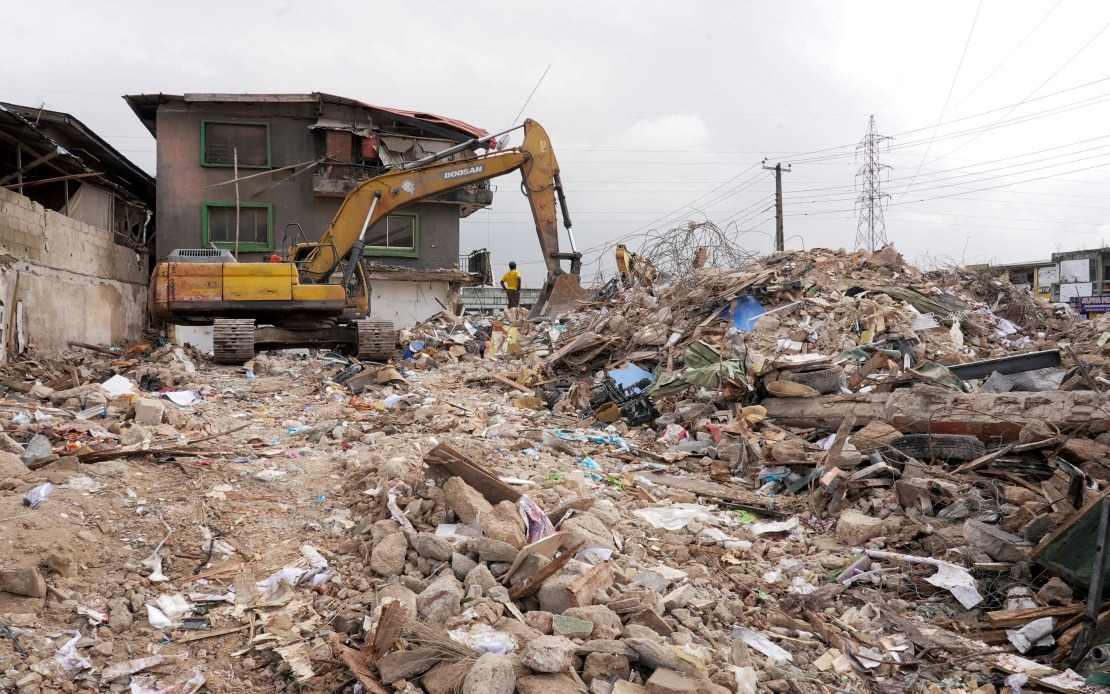
A three-storey shopping complex in the Alakija district of Lagos collapsed on Thursday morning, resulting in nine fatalities and 27 rescued survivors according to local emergency authorities who announced the completion of rescue efforts on Friday. The building, situated along the busy Lagos-Badagry Expressway in Nigeria's southwestern state, brought down considerable rubble that trapped dozens of occupants during peak commercial hours.
Olufemi Oke-Osanyintolu, permanent secretary of the Lagos State Emergency Management Agency, described intensive efforts by rescue personnel who worked continuously throughout Thursday and into Friday morning to extract victims from beneath the debris field. Teams coordinated the careful removal of wreckage while searching for additional survivors, a process demanding both speed and precision to minimize further harm to those buried underneath.
The rescued individuals sustained injuries ranging from minor to severe and were transported to medical facilities for treatment and assessment. Preliminary investigation suggests most fatalities and injuries involved shop proprietors and their customers who had begun normal commercial operations when the structure failed. Several residents from adjacent neighbourhoods also found themselves trapped within the collapsed building, adding complexity to the overall casualty count.
The rescue operation drew participation from multiple agencies and organisations operating in the Lagos area. The China Civil Engineering Construction Corporation, currently executing a railway development project in the region, deployed resources and personnel to assist extraction efforts, demonstrating the scale of coordination required for such emergencies.
Emergency responders confirmed that all individuals initially trapped beneath the rubble had been located and evacuated by early Friday, enabling the formal conclusion of the active rescue phase. However, the fundamental question of why the structure failed remains unanswered, with authorities announcing an investigation into the collapse's underlying causes.
The incident adds to a troubling pattern of structural failures across Nigeria that claim lives and damage confidence in building standards. Engineering experts consistently identify three primary culprits: deterioration of older constructions lacking proper maintenance, systematic disregard for established building codes by developers and contractors, and widespread use of inferior construction materials that compromise structural integrity. These deficiencies accumulate over time, creating hazardous conditions that ultimately manifest in catastrophic failure.
Nigeria's construction sector faces particular vulnerability given rapid urbanization, limited enforcement of safety regulations, and economic incentives that encourage cost-cutting over compliance. Lagos, as the nation's largest city and economic hub, experiences especially intense pressure for rapid building development, sometimes at the expense of rigorous safety protocols. The Lagos-Badagry Expressway corridor, where this collapse occurred, represents precisely this kind of high-growth area experiencing accelerated commercial development.
For Malaysian stakeholders and regional observers, the Lagos incident offers sobering perspective on the critical importance of stringent building code enforcement and regular structural inspections. Southeast Asia has benefited from strengthened regulatory frameworks following several high-profile collapses in recent decades, yet complacency remains a constant risk as development accelerates across the region. The contrast between regulatory maturity in Malaysia and conditions in parts of West Africa underscores why consistent application of engineering standards and independent oversight prove essential to public safety.
The investigation into this Alakija collapse will likely focus on whether permits were properly issued, whether construction complied with approved plans, and whether necessary inspections occurred during and after construction. Such inquiries frequently reveal chains of negligence, corruption, or deliberate violations that accumulate to create dangerous conditions. Learning from such investigations, when findings are properly publicized and acted upon, can drive systemic improvements.
Lagos State authorities face mounting pressure to strengthen oversight mechanisms and enforcement of existing regulations to prevent future tragedies. The participation of international contractors like the China Civil Engineering Construction Corporation in rescue operations highlights how construction incidents transcend borders and affect multiple stakeholders. Going forward, preventing such collapses demands investment in professional building inspectorates, regular structural audits of existing buildings, strict material testing protocols, and meaningful penalties for violations that create public danger.

