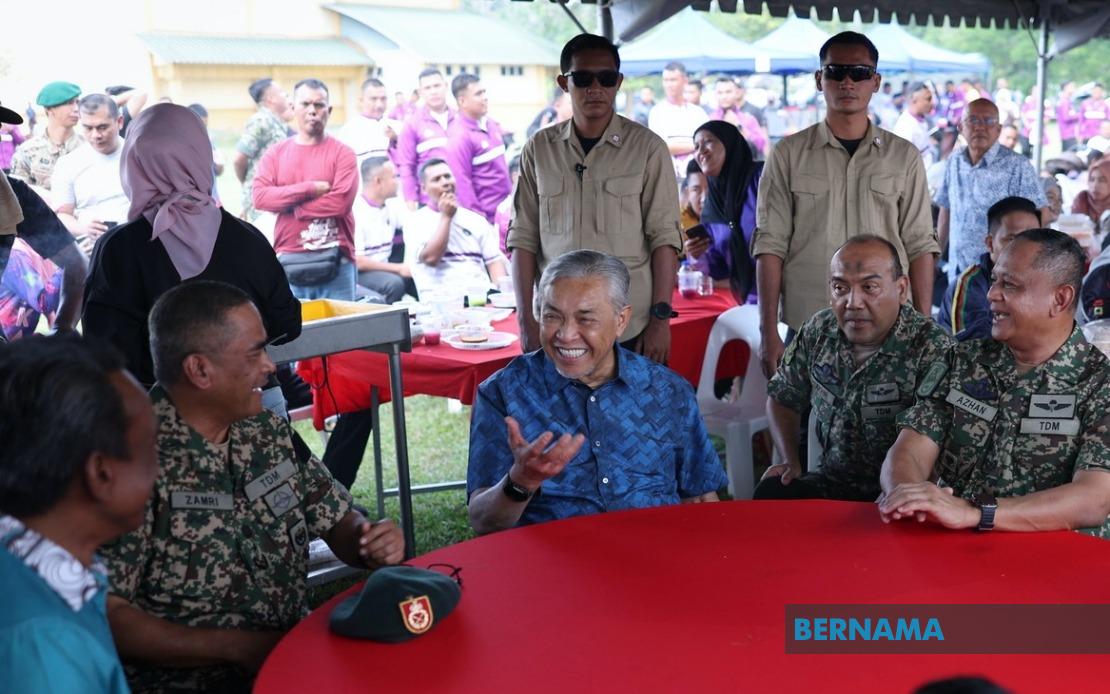
Deputy Prime Minister Datuk Seri Dr Ahmad Zahid Hamidi has delivered a firm message that accountability applies universally in Malaysia's political and institutional landscape, stating that anyone identified in wrongdoing through the Tabung Haji Royal Commission of Inquiry will face legal scrutiny regardless of their status or position. Speaking during an engagement at the Malaysian Armed Forces Southern Zone Family Day Carnival at Kem Syed Sirajuddin in Gemas on July 26, the Barisan Nasional chairman underscored the government's determination to handle the RCI findings with full transparency and procedural rigor.
Ahmad Zahid's remarks come as the Cabinet prepares to consider the release of the comprehensive RCI report on Lembaga Tabung Haji, a matter that has drawn considerable public and political attention given the institution's significance to Muslim pilgrims and their savings. His statement represents an important clarification of the government's position ahead of what is expected to be a contentious public disclosure, signalling that institutional rank or political affiliation will not shield anyone from appropriate legal processes.
The Deputy Prime Minister articulated a structured approach to addressing any irregularities that the RCI investigation may have uncovered. Should the report identify instances of abuse of power, administrative irregularities, criminal breach of trust, or other malpractices, he explained that established legal mechanisms would be activated, including formal police reports, commercial crimes investigations, and broader legal proceedings as warranted. This procedural commitment reflects broader efforts by the current administration to demonstrate institutional independence and adherence to rule of law principles.
As UMNO president, Ahmad Zahid also fielded questions regarding potential political ramifications of the report's release, particularly given its timing just days before the Negeri Sembilan state election. The election, scheduled for August 1 with early voting on July 30, represents a critical electoral test for the Barisan Nasional coalition in the peninsular state. Critics have noted the strategic sensitivity of releasing a potentially damaging institutional report during an active campaign period, yet Ahmad Zahid expressed confidence that voters would distinguish between institutional governance matters and electoral choices.
His assessment reflected an apparent confidence in the electorate's political maturity and discernment. According to Ahmad Zahid, the people of Negeri Sembilan, particularly registered voters, possess the sophistication to evaluate candidates and coalitions on their merits independent of broader institutional controversies. This characterization of voter behaviour may be tested by the actual outcome in a state where Barisan Nasional's performance has been mixed in recent electoral cycles.
Prime Minister Datuk Seri Anwar Ibrahim, who also holds the Finance portfolio overseeing Tabung Haji's regulatory framework, had previously signalled his own confidence that Cabinet approval for public release would be forthcoming. Anwar explained that earlier hesitation to disclose the RCI findings stemmed from concerns that premature or unmanaged disclosure might undermine public confidence in the pilgrimage savings institution, which manages funds for hundreds of thousands of Malaysian Muslims.
The rationale for delayed publication underscores the delicate balance between transparency and institutional stability that government officials must navigate. Tabung Haji holds deep cultural and religious significance in the Malaysian Muslim community, and mismanagement revelations could trigger broader concerns about the safety of accumulated pilgrimage savings. However, Anwar contended that intervening reforms and strengthening measures have materially altered the institution's position, making transparency now feasible without threatening systemic confidence.
The Prime Minister highlighted that Tabung Haji has received international recognition and undergone substantive institutional reinforcement, suggesting that the organisation's governance frameworks now withstand public scrutiny. This assertion reflects efforts by the current government to position institutional reform as substantive rather than cosmetic, with the timing of report release calibrated to follow rather than precede stabilisation measures.
The RCI investigation itself represents a major accountability initiative into an institution that manages substantial accumulated wealth on behalf of Muslim Malaysians intending to perform the Hajj pilgrimage. Reports of mismanagement, irregular investments, and governance failures had prompted calls for comprehensive investigation, ultimately resulting in the Royal Commission's establishment and now its anticipated public reporting. The breadth of names potentially implicated in the report, according to various informed commentaries, spans multiple administrations and crosses factional lines within government and the ruling coalition.
For Malaysian observers and the broader Southeast Asian region tracking governance developments, the RCI report on Tabung Haji represents a test case in institutional accountability. How thoroughly the government acts on the report's findings, whether individuals across the political spectrum face equal scrutiny, and whether affected institutions implement recommended reforms will signal the credibility of Malaysia's accountability mechanisms. The case carries particular significance given public concerns about religious institution governance across the region.
The Negeri Sembilan state election, meanwhile, serves as an immediate political pressure point for Barisan Nasional, which has seen declining fortunes in several state-level contests since the 2022 federal election. Ahmad Zahid's confidence in voter sophistication will be validated or challenged by election day results, particularly given the state's strategic importance within the broader peninsular political map.
Government officials emphasise that the forthcoming RCI disclosure represents a commitment to institutional transparency and accountability under the current administration. The principles articulated by Ahmad Zahid—that legal consequences apply uniformly regardless of position, that investigations will follow due process, and that institutional reform has been substantive—will face validation as the report emerges and any subsequent legal or administrative actions unfold in coming months.

