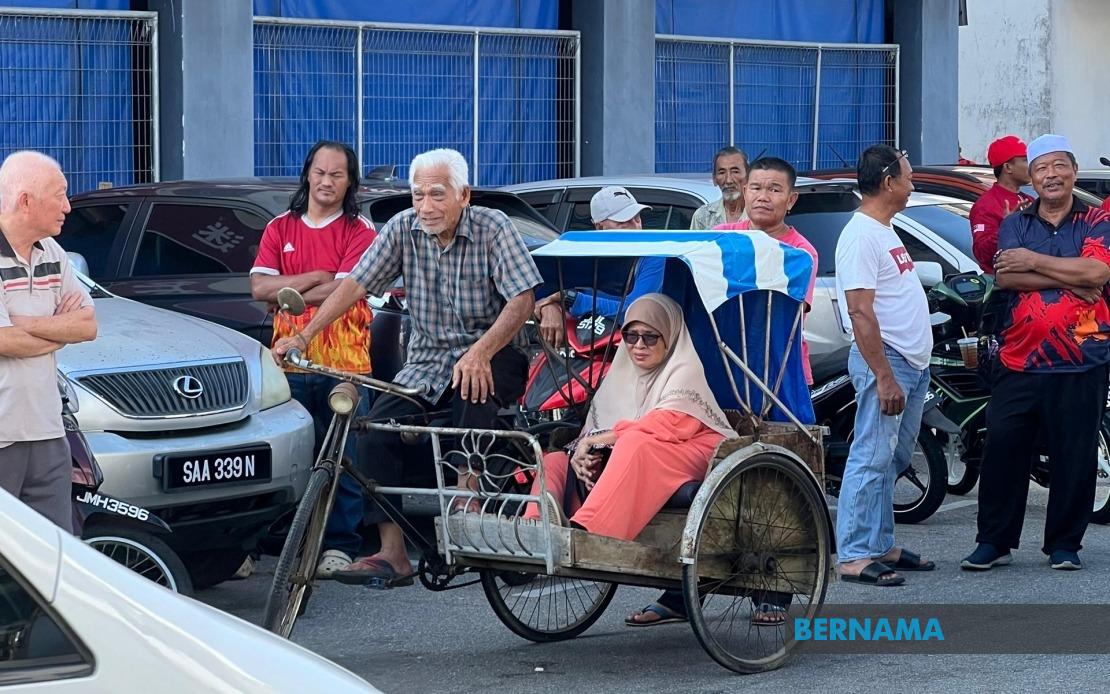
In a touching display of devotion during Malaysia's political season, Abdul Razak Pelangga, an 86-year-old resident of Kampung Parit Bugis in Batu Pahat, Johor, pedalled his trishaw nearly a kilometre in intense summer heat to give his 64-year-old wife, Jamilah Samsudin, an opportunity to catch a glimpse of Prime Minister Datuk Seri Anwar Ibrahim. The couple's journey on July 5 was prompted by news that Anwar would be making a campaign breakfast stop at Kedai Kopi Hailam Sri Medan in the Senggarang area, a visit that motivated Abdul Razak to seize what he described as a meaningful moment.
Abdul Razak, who serves as Imam of Masjid Raudhatul Jannah Parit Bugis, made a deliberate choice to travel by trishaw rather than using motorised transport. He explained his reasoning pragmatically, noting that a trishaw allowed him to avoid the complications of locating a parking space in what would be a crowded setting. The decision reflected both practical wisdom and perhaps an intentionality about the nature of the journey itself—a more measured, traditional approach to honouring the moment.
The Prime Minister's visit formed part of the PMX Meet-and-Greet Programme targeting constituents in the Senggarang state constituency, an initiative aligned with Johor's state elections scheduled for July 11. Anwar spent approximately 50 minutes at the coffee shop, engaging with local residents and creating opportunities for face-to-face interaction during what is typically a high-profile campaign engagement. Datuk Fahmi Fadzil, serving as both Pakatan Harapan Communications Director and Federal Communications Minister, accompanied the Prime Minister during this constituency outreach.
Abdul Razak's motivation to undertake the journey carried personal historical significance. Decades earlier, before Anwar's ascent to the Prime Minister's office, the politician had visited the mosque where Abdul Razak led prayers. That previous encounter left an impression—Abdul Razak recalled Anwar as personable and approachable, someone who engaged warmly during their exchange of greetings. This memory, preserved over many years and shared with his wife over time, formed the backdrop for their decision to make the trishaw journey.
What makes this episode particularly resonant is the intersection of personal sentiment with civic engagement. Although the couple could not achieve a direct face-to-face meeting with Anwar owing to the large gathering of other constituents, Abdul Razak emphasised that viewing the Prime Minister from a reasonable distance sufficed. For his wife, who had previously known Anwar only through television broadcasts, the experience represented a tangible connection to the national political sphere—a transition from mediated to proximate experience.
Beyond the charming personal narrative, Abdul Razak's actions reflected a specific moment in Malaysia's political calendar. The Johor state election campaign was in full swing, with polling day set for July 11 and early voting scheduled for July 7. Such campaign visits serve multiple functions in Malaysian electoral politics: they generate grassroots enthusiasm, provide media coverage opportunities, and create memorable moments that reinforce voters' emotional connections to political figures and their parties.
Coinidentally, Abdul Razak's trishaw journey took place just days before a milestone in his own life. The elderly Imam revealed that the election date of July 11 coincided with his 87th birthday, adding personal significance to his forthcoming civic participation. He expressed that although he had voted multiple times throughout his life, casting his ballot on his birthday while in the midst of this campaign season imbued the action with special meaning—a convergence of personal and national timelines.
The physical act of pedalling a trishaw in extreme heat warrants contextual appreciation. Batu Pahat, situated in Johor's interior regions, experiences tropical climate conditions characterised by high temperatures and humidity. For an octogenarian to undertake such physical exertion reflects not merely romantic sentiment but genuine commitment. It underscores how political engagement in Malaysia, even at the grassroots level, can inspire actions that transcend routine participation and enter the realm of personal sacrifice.
This incident also illuminates the continuing relevance of traditional transport modes in Malaysian society. The trishaw, while increasingly uncommon in urban centres, remains a fixture in smaller towns and rural areas, serving practical transportation needs whilst maintaining cultural and nostalgic significance. Abdul Razak's choice to use it, whether motivated primarily by parking pragmatism or symbolic intent, highlighted the persistence of this mode despite Malaysia's rapid motorisation.
From a broader political perspective, such encounters between citizens and national leaders carry weight in how electoral narratives develop. The Senggarang meet-and-greet programme sought to translate Pakatan Harapan's national leadership into tangible human connection at the constituency level. Moments like Abdul Razak's trishaw journey, though modest in scale, contribute to the texture of campaign seasons—they become the stories that circulate within communities, potentially influencing perceptions of political accessibility and leadership approachability.
The story also reflects generational patterns in Malaysian electoral behaviour. Abdul Razak's consistent voting record and his enthusiasm about participating on his birthday suggest deep-rooted civic commitment among older voters. This demographic often demonstrates higher turnout rates and constitutes a significant voting bloc, particularly in smaller towns where participation proportions can exceed urban averages.
Abdul Razak's determination to bring his wife within viewing distance of the Prime Minister ultimately succeeded in its objectives, albeit not in the way initially envisioned. While direct personal interaction remained impossible amid the crowd, the experience transformed from a hoped-for conversation into a shared memory of proximity and participation. For a couple in their twilight years, such moments accumulate value beyond their immediate occurrence—they become touchstones of having engaged with significant national events and figures.

