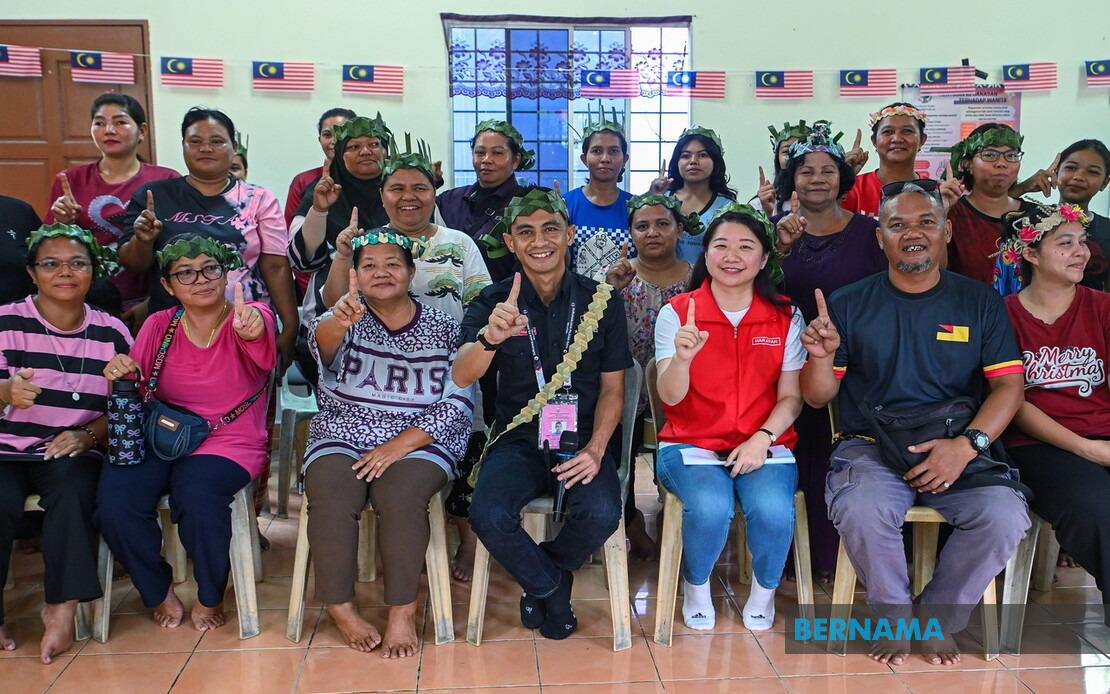
Datuk Ahmad Faez Abdul Razak, the Pakatan Harapan hopeful contesting the Labu state seat in Negeri Sembilan, has positioned indigenous welfare and economic advancement as defining pillars of his electoral platform. Speaking after attending an Orang Asli Women Empowerment initiative in Kampung Orang Asli Tekir, the first-time candidate articulated a comprehensive vision centred on uplifting the socioeconomic conditions of the state's indigenous populations through targeted investments in basic services and livelihood diversification.
Central to Ahmad Faez's manifesto is a commitment to escalate the longstanding customary land grievance affecting Kampung Orang Asli Tekir to the floor of the State Legislative Assembly, acknowledging a critical flashpoint in state-level indigenous affairs. The candidate recognised that secure tenure over traditional lands remains foundational to sustainable community development, particularly in an era when land disputes continue to impede broader economic participation by Orang Asli groups across Peninsular Malaysia. This positioning suggests an understanding that infrastructural modernisation without addressing underlying tenure insecurity would yield limited returns.
The infrastructure agenda encompasses urgent foundational upgrades that have long been deferred in marginalised settlements. Ahmad Faez pledged to expand road networks and extend digital connectivity through internet infrastructure, recognising that physical isolation and communications gaps perpetuate economic disadvantage in remote villages. Such connectivity improvements assume heightened significance for younger residents seeking employment opportunities beyond traditional subsistence activities and enabling digital commerce participation. The village chief, Nasir Musil, representing a settlement of 796 residents, similarly prioritised infrastructure development as essential to unlocking broader transformation.
Education and youth capability development feature prominently in the candidate's articulated strategy, reflecting awareness that demographic advantage among Orang Asli youth remains underutilised due to insufficient skill development pathways and limited local employment prospects. Ahmad Faez identified human capital investment as prerequisite for sustainable income generation, a perspective increasingly recognised across Southeast Asia as indigenous communities navigate structural economic transitions. The emphasis on youth skills acquisition targets the persistent gap between formal schooling completion and marketable competencies demanded by contemporary labour markets.
Economic diversification proposals reveal pragmatic engagement with existing community strengths and emerging opportunities. Ahmad Faez highlighted handicraft production as a sector where Kampung Orang Asli Tekir possesses latent comparative advantage, proposing enhanced market linkages and distribution networks to expand income potential. This approach acknowledges that cultural production represents a legitimate pathway to prosperity without requiring abandonment of traditional practices or wholesale modernisation. Simultaneously, the introduction of fertigation systems and contemporary agricultural methodologies addresses productivity constraints within farming activities that remain primary income sources for many village households, suggesting a two-track development model combining traditional and modern sectors.
The candidate's stated continuity of grassroots engagement over the preceding two years establishes a narrative distinguishing his candidacy from conventional electoral mobilisation appearing solely during campaign periods. Ahmad Faez emphasised ongoing community presence and problem-solving engagement as evidence of authentic commitment, contrasting implicitly with transactional political relationships. Village leadership validated this positioning, with Nasir Musil acknowledging Ahmad Faez among leaders demonstrating consistent village visitation and material assistance.
The electoral context itself commands attention. Ahmad Faez confronts a three-cornered contest against Mohamad Hanifah Abu Baker, the incumbent representing Parti Pribumi Bersatu Malaysia, and Siti Nur Umaira Hasim fielded by Barisan Nasional. This configuration introduces complexity absent from straight two-candidate races, potentially fragmenting voter coalitions and influencing strategic messaging. The competition between three distinct political vehicles—Pakatan Harapan's progressive social agenda, Bersatu's Bumiputera-inflected nationalism, and Barisan Nasional's incumbency advantage—offers voters meaningful ideological and operational differentiation.
A seemingly minor yet locally significant grievance involved stray cattle constituting documented road hazards within the settlement. Village leadership identified this persistent problem as requiring elected representative attention, illustrating that indigenous community concerns often encompass unglamorous practical matters alongside broader development aspirations. Ahmad Faez's receptiveness to such issues signals alignment with grassroots priority-setting rather than imposition of top-down development frameworks.
The Negeri Sembilan state elections scheduled for 1 August, with early voting commencing 28 July, occur within Malaysia's broader political realignment. The Labu contest encapsulates evolving competition dynamics in state-level politics, where indigenous welfare has become increasingly salient as demographic and political consciousness among Orang Asli constituencies grows. Ahmad Faez's emphasis on this portfolio reflects recognition that indigenous development transcends symbolic gestures, demanding concrete resource commitment and legislative advocacy.
For the broader Southeast Asian context, the Labu campaign illustrates how Malaysia's indigenous communities increasingly assert specific development demands through electoral channels. Unlike decades past when Orang Asli concerns received episodic political attention, contemporary campaigns integrate indigenous welfare as discrete policy platforms. This maturation of indigenous political voice—manifesting through direct electoral engagement and articulated governance proposals—suggests deepening structural integration of Orang Asli interests into state-level political competition. Ahmad Faez's candidacy, whether successful or not, reflects this broader trajectory of indigenous political empowerment within Malaysia's democratic system.
The feasibility of implementing these initiatives will ultimately depend upon electoral outcomes and subsequent resource allocation within the Negeri Sembilan budget and legislative processes. Yet the articulation itself represents a significant development, establishing benchmarks against which future performance can be measured and demonstrating that indigenous communities increasingly command direct candidate engagement on substantive policy grounds rather than ceremonial recognition.

