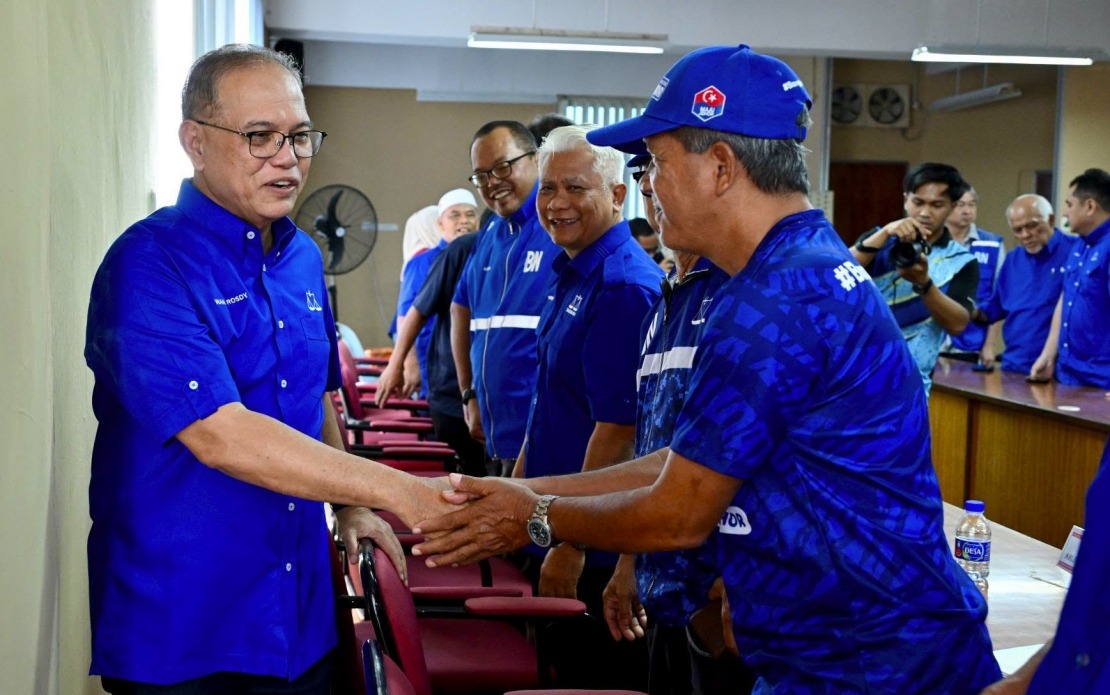
Pahang's Barisan Nasional machinery is throwing its weight behind the Johor state election campaign, with party members being strategically deployed to bolster efforts in four critical constituencies ahead of polling day on July 11. The cross-state coordination reflects the coalition's broader strategy to maintain its grip on the southern state, where 56 seats will be contested by 172 candidates in what represents a significant test of BN's electoral resilience.
The four constituencies receiving Pahang BN's focused attention—Pekan Nanas, Pulai Sebatang, Benut, and Kukup—all fall within the Tanjung Piai parliamentary boundary, suggesting a concentrated approach to securing this particular parliamentary zone. This targeted deployment underscores how Malaysian federal and state parties increasingly coordinate across state lines during critical elections, pooling organisational expertise and ground networks to maximise impact in marginal or strategically important areas.
Datak Seri Wan Rosdy Wan Ismail, who holds the dual role of Pahang BN chairman and Menteri Besar, announced the campaign involvement while addressing media at a Teachers Appreciation Ceremony in Kuantan. His willingness to publicly confirm Pahang's participation signals confidence within the coalition's leadership about the Johor contest, even as it navigates complex political dynamics in his home state. Wan Rosdy indicated he would personally venture to FELDA constituencies in Segamat to strengthen party machinery in that region, demonstrating hands-on leadership engagement.
The timing of inter-state party cooperation holds particular significance for Malaysian politics. Johor, as the country's second-largest economy and a traditionally BN-aligned state, carries outsized symbolic importance. A poor performance would reverberate through the coalition's broader electoral calculations and could embolden opposition forces across the peninsula. Conversely, a convincing BN victory would provide momentum heading into future national political cycles and reinforce the coalition's claim to represent mainstream Malaysian interests.
Wan Rosdy's optimism about BN's prospects rests partly on observations from the campaign trail itself. He spent three days in Johor around nomination day and reported witnessing strong party machinery mobilisation and enthusiastic candidate engagement. Such anecdotal assessments, while not definitive indicators, reflect the tone senior party figures are projecting publicly—a message designed to energise supporters, attract floating voters, and demoralise opposition movements.
The Johor state election assumes broader regional dimensions for Southeast Asian political observers tracking electoral trends in ASEAN's developed democracies. How Malaysian voters respond to coalition governance, particularly regarding economic management and development priorities, offers insights into voter sentiment across similar regional economies. Johor's position as a significant industrial and agricultural hub means state-level policy decisions on land management, labour practices, and infrastructure investment attract scrutiny from neighbouring Singapore and Thailand.
Pahang's involvement in the campaign also illustrates the intricate relationships within the Barisan Nasional structure itself. Different state chapters maintain distinct interests and power bases, yet during critical elections, they mobilise in coordinated fashion. This cooperation mechanism, refined over decades, enables the coalition to deploy experienced operatives and leverage provincial party networks in ways that single-state organisations cannot replicate. Such institutional advantages help explain BN's persistent electoral competitiveness despite facing increasingly fragmented and vigorous opposition challenges.
The deployment of Pahang BN members carries practical implications for ground-level campaign work. Party machinery typically handles voter registration verification, logistical coordination for rallies and ceramah sessions, polling station monitoring, and voter turnout operations. Having additional trained operatives from a neighbouring state allows coordinating committees to sustain intensive campaign activity across multiple constituencies simultaneously without exhausting local party resources.
Voter reception to BN's campaign messaging will prove decisive when July 11 arrives. Johor's electorate encompasses diverse communities—urban professionals in cities like Johor Bahru, rural agricultural workers, plantation labourers, and FELDA settlers—each responding to distinct policy priorities. Economic anxieties, infrastructure investment, affirmative action concerns, and governance competence typically dominate local election discourse, and how BN articulates its vision for addressing these concerns will determine voter behaviour.
The presence of Pahang's political machinery also sends subtle signals within BN's internal politics. By visibly supporting the Johor campaign, Pahang leadership demonstrates coalition loyalty and maintains relationships with other state chapters. Such reciprocal support becomes invaluable during future Pahang elections, creating networks of obligation and mutual assistance that sustain the broader coalition structure. This mutual reinforcement mechanism helps explain why BN, despite fragmentation and internal contradictions, has periodically demonstrated surprising electoral resilience.
Early voting on July 7 will provide preliminary indicators of momentum and voter turnout patterns before main polling day. These early results, while not determinative, often shape media narratives and final-week campaign strategies. BN's confidence in deploying resources across multiple constituencies suggests internal polling data indicates competitive positioning across several seats, though the outcome remains genuinely uncertain given Malaysia's contemporary political volatility.

