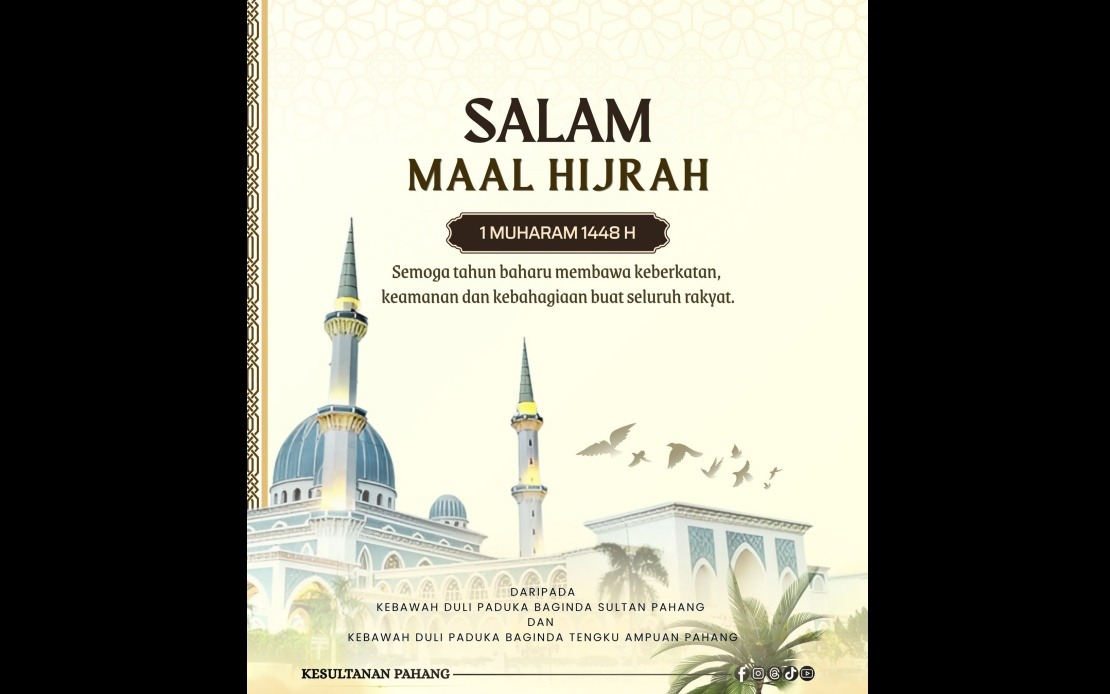
Pahang's highest-ranking royalty have marked the arrival of the Islamic New Year 1448 Hijrah with formal greetings that emphasise spiritual reflection and collective progress. Al-Sultan Abdullah Ri'ayatuddin Al-Mustafa Billah Shah and Tengku Ampuan Azizah Aminah Maimunah Iskandariah conveyed their Maal Hijrah wishes through the Kesultanan Pahang's social media channels, setting the ceremonial tone for how the occasion is observed across the eastern Malaysian state.
The royal message struck a hopeful note by expressing optimism that the new Islamic year would usher in blessings, tranquility, and contentment for all residents of Pahang. This traditional exchange of greetings serves as a significant moment in the Malaysian Islamic calendar, carrying particular weight when issued by the sultanate given their role as custodians of Islamic affairs in the state. The timing and nature of such pronouncements often guide how communities interpret the significance of the occasion and what values they should prioritise in the coming year.
Paralleling the royal address, Pahang's chief minister Datuk Seri Wan Rosdy Wan Ismail issued his own statement through Facebook, framing Maal Hijrah as an opportunity for Muslims to reassess their spiritual commitments and recommit to charitable endeavours. His remarks positioned the Islamic New Year as more than merely a calendar marker, instead presenting it as a concrete moment for resetting personal intentions and deepening one's relationship with faith. This interpretation aligns with broader Islamic teaching on the significance of new years as occasions for renewal and course correction.
Wan Rosdy's message went further by explicitly invoking the concept of Hijrah itself—the Prophet Muhammad's historical migration—as a template for understanding what change ought to mean in modern Pahang. He encouraged residents to emulate the spirit of that foundational Islamic moment by pursuing transformative improvements in their own lives and communities. This rhetorical move connects personal spiritual growth to broader societal development, suggesting that individual faithfulness and state progress are mutually reinforcing rather than separate concerns.
The chief minister emphasised that the pursuit of positive change must be anchored in strengthened communal bonds and reinforced ethical standards. He highlighted integrity as a value deserving explicit mention alongside unity, recognising that institutional trust and transparent governance form the bedrock upon which other achievements rest. For a state navigating the complexities of modern Malaysia—balancing economic development with social cohesion—this emphasis on integrity takes on practical significance beyond its purely moral dimension.
Wan Rosdy's closing invocation called upon divine mercy and protection, while requesting spiritual fortitude to sustain the population through ongoing efforts and sacrifices. This layering of personal prayer with communal aspiration reflects how Islamic ceremonies in Malaysia often blend private devotion with public civic messaging. The framing suggests that challenges ahead will require both faith and determination, acknowledging implicitly that the year ahead involves concrete work rather than automatic blessing.
For Malaysian and Southeast Asian readers, these exchanges between royal and executive authorities illustrate how Islamic observances function within the plural governance structures of federal Malaysia. The Sultan of Pahang holds constitutional authority over Islamic matters within his state, yet works alongside the elected chief minister in promoting shared values and collective well-being. This layered system of religious and political authority, unique to Malaysia's constitutional arrangement, means that statements from both the palace and the menteri besar carry reinforcing weight.
Maal Hijrah itself marks not only the Islamic calendar's turning point but also provides a cyclical pause for reflection across Muslim-majority Southeast Asia. The occasion has gained prominence in recent decades as communities increasingly use it for explicit messaging about unity, development, and spiritual commitment. In Pahang specifically, where Islam holds constitutional primacy and the sultanate retains significant cultural authority, such ceremonial exchanges carry meaning that extends beyond mere protocol.
The emphasis on renewal and transformation in these statements resonates with longer-term conversations in Malaysia about national development and social harmony. As the country navigates economic restructuring, demographic shifts, and evolving international relationships, messages linking spiritual commitment to concrete improvement efforts serve both ceremonial and instrumental purposes. They remind publics of shared foundational values while simultaneously orienting them toward future-focused action.
These greetings from Pahang's leadership also arrive within a broader Southeast Asian context where Islamic observances have become increasingly visible in public discourse and governance. Countries across the region mark Maal Hijrah and other Islamic occasions with official statements that blend religious reverence with development messaging. Pahang's articulation of these themes through both sultanate and state government channels demonstrates how multiple layers of authority can synchronise around shared values while maintaining their distinct constitutional roles.
The focus on charitable deeds and faith strengthening in both messages reflects an understanding that Islamic New Year carries prescription alongside commemoration. Rather than treating Maal Hijrah as purely retrospective—a moment for reviewing the past year—these leaders positioned it as prospective and generative. The coming year is framed as an opportunity to construct something better through deliberate commitment to ethical behaviour, strengthened relationships, and sustained effort toward communal welfare.

