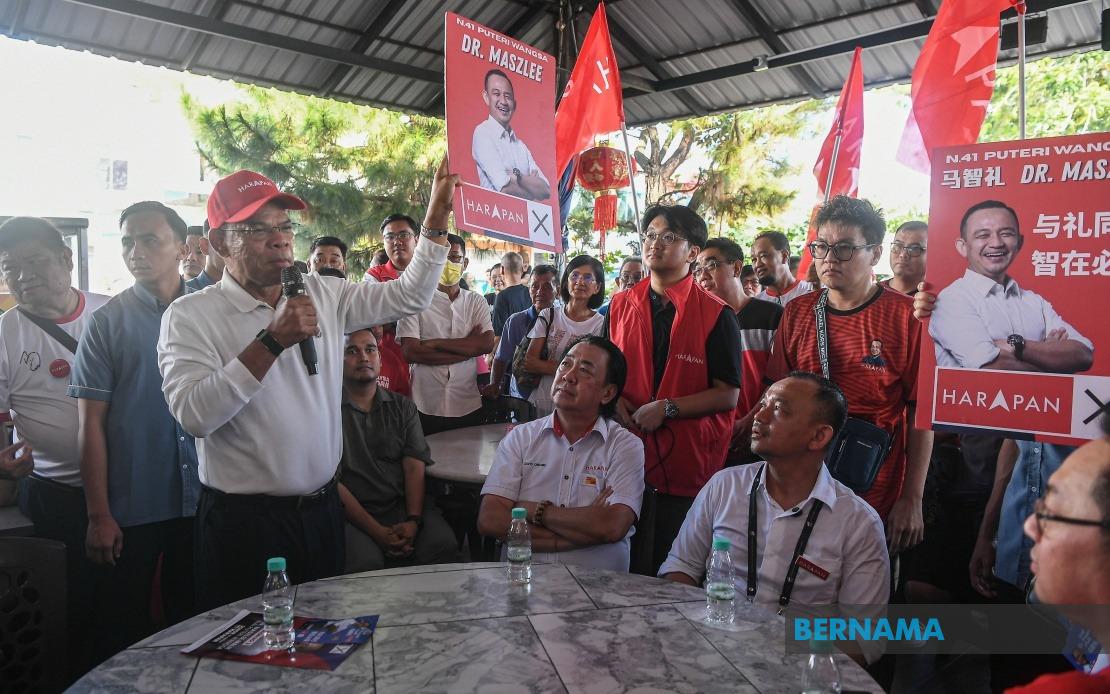
Pakatan Harapan's rising support in the Johor state election campaign reflects a carefully calibrated strategy that moves beyond mass rallies and broad messaging, focusing instead on specific constituencies and their unique political dynamics. PH secretary-general Datuk Seri Saifuddin Nasution Ismail outlined the coalition's methodology during a community engagement session in Johor Bahru on July 5, emphasising that victory will depend on understanding and responding to localised conditions rather than applying a one-size-fits-all approach across all 56 state seats up for grabs.
The heart of PH's campaign framework rests on a classification system that assigns priority grades to individual constituencies based on real-time ground intelligence and voter sentiment. Rather than treating all seats equally, the coalition identifies pockets of strength and areas requiring concentrated effort, allocating resources and campaign attention accordingly. Saifuddin Nasution illustrated this distinction by comparing Puteri Wangsa with Johor Lama and Larkin with Endau, underlining that each seat presents distinct voter profiles, demographic compositions, and local concerns that demand tailored messaging and candidate selection. This segmentation allows PH's machinery to deploy campaign energy where it yields the highest return, a pragmatic adaptation to the realities of state-level contests where seat-by-seat margins often determine overall outcomes.
The coalition's transparency in announcing its seat distribution and candidate lineup has also emerged as a strategic asset in the competitive Johor race. By contrast, rival parties have taken different approaches that, in Saifuddin Nasution's assessment, have inadvertently benefited PH. The Islamic Party of Malaysia (PAS) opted to contest only 11 seats while directing supporters to vote for Barisan Nasional candidates elsewhere, a move that has created confusion among opposition voters and potentially driven disaffected supporters toward PH. This tactical divergence between PAS and the governing coalition has highlighted the fragmentation within Malaysia's broader opposition landscape and presented PH with an opportunity to position itself as the more coherent and credible alternative to the incumbent state government.
PH's fielding of candidates across all 56 constituencies demonstrates its determination to contest every available seat and claim victory on a clear mandate. The coalition's slate comprises 20 representatives from PKR, 19 from Amanah, and 17 from DAP, reflecting a balance that aims to satisfy each component party's organisational strength and electoral prospects. This distribution strategy also signals to voters that PH is mounting a serious, comprehensive campaign rather than a symbolic effort, a crucial signal in a state where voter turnout and engagement levels determine electoral outcomes. The deliberate seat allocation also manages internal coalition dynamics by ensuring each party receives a meaningful opportunity to build its presence and parliamentary representation.
The presence of former UMNO Supreme Council member Datuk Dr Mohd Puad Zarkashi at a series of discussions with Prime Minister Datuk Seri Anwar Ibrahim at Felda Ulu Tiram added another dimension to PH's momentum narrative. Zarkashi's participation in high-level coalition talks with the premier signalled potential realignment within Johor's political establishment and demonstrated that PH's appeal extends beyond traditional opposition constituencies into segments of the ruling Malay-Muslim establishment. Such cross-currents within elite politics often generate uncertainty that benefits challengers, as voters question the stability and unity of incumbent governments. The symbolism of a former UMNO figure engaging substantively with PH leadership serves as a powerful reminder that Malaysia's political coalitions remain fluid and that conventional alignments continue to shift.
The candidate selection process itself reflects PH's confidence in its electoral prospects, particularly evident in its choice of Datuk Dr Maszlee Malik as the Puteri Wangsa standard bearer. Saifuddin Nasution described Maszlee as a qualified candidate and a valuable asset should the coalition secure a mandate to form the next state government. Such language signals that PH is not merely contesting for opposition representation but actively building an alternative government-in-waiting, a crucial psychological messaging point that distinguishes genuine challenges from symbolic campaigns. The investment in candidate quality and positioning shapes voter perceptions about whether a coalition is mounting a serious bid for power or simply occupying space in the political arena.
The July 11 polling date brings together 172 candidates vying for 56 state seats, a ratio that reflects moderate competition by Malaysian standards. Early voting scheduled for July 7 provides an additional variable in the campaign equation, as candidates must mobilise key constituencies during what is typically a lower-engagement period. This compressed timeline intensifies the importance of PH's seat-by-seat strategy, as the coalition has limited time to shift voter sentiment and consolidate support in priority constituencies. The concentration of campaign effort and messaging becomes even more critical when the election calendar compresses the entire campaign cycle into a matter of days.
PH's campaign messaging emphasises a reasonable manifesto paired with demonstrated implementability, distinguishing the coalition's approach from what it characterises as more ideologically-driven alternatives. This framing attempts to position PH as the pragmatic, business-friendly choice while reserving space for progressive policies that appeal to younger and urban voters. Such balancing acts prove particularly important in Johor, a state with significant manufacturing, port, and tourism sectors where business confidence and economic management messaging carries considerable weight among both corporate and working-class voters. The emphasis on implementable policies also implicitly challenges incumbent governments to account for their actual delivery record on previous electoral promises.
The campaign dynamics in Johor carry significance extending well beyond the state itself. As one of Malaysia's largest and most economically important states, Johor's electoral outcome will shape the broader national political balance and potentially influence federal-level coalition dynamics. A strong PH performance in Johor could strengthen Anwar Ibrahim's political positioning within the federal government and bolster the coalition's claims to represent a viable national alternative to UMNO-led administrations. Conversely, a disappointing result might embolden UMNO and strengthen arguments for different coalition arrangements at the national level. This downstream significance adds stakes to what might otherwise be treated as a routine state election, compelling all parties to invest heavily in the Johor contest as a test of their respective political strength and organisational capacity.

