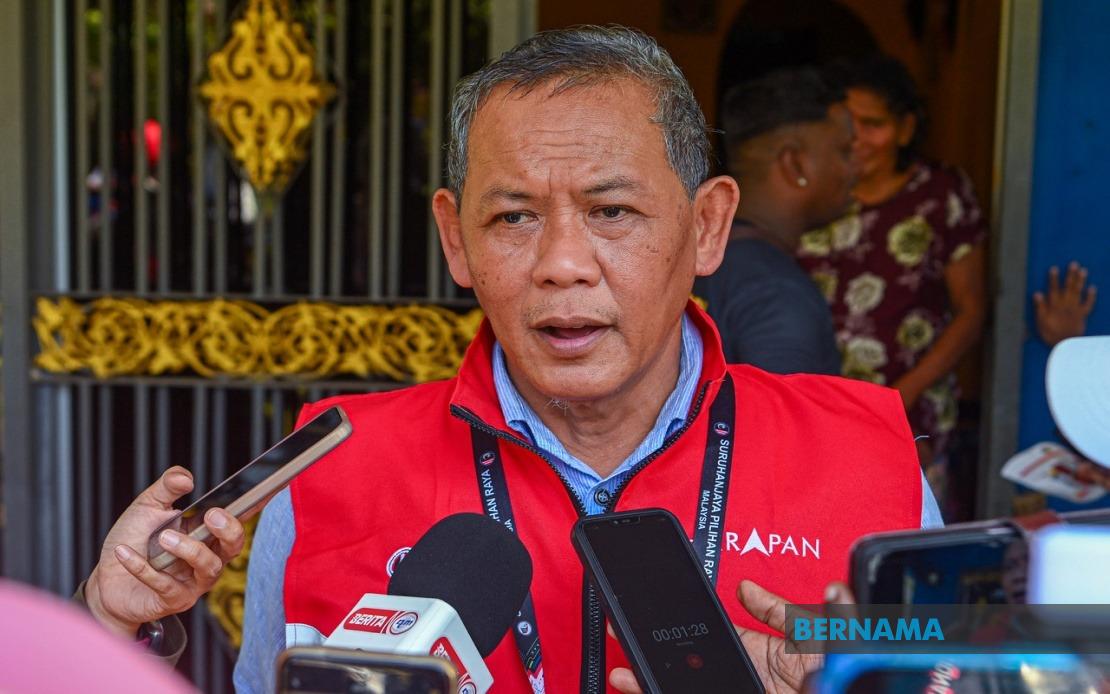
Pakatan Harapan has unveiled an election manifesto for the 16th Negeri Sembilan state election that deliberately extends its social support initiatives beyond the lower-income bracket to capture the middle-income M40 demographic, marking a strategic shift in the coalition's approach to economic inclusivity. State PH chairman Datuk Seri Aminuddin Harun announced the development at a community engagement session in Sekang Estate, Linggi, on July 21, positioning the move as evidence of the coalition's commitment to broadening welfare reach across a more substantial cross-section of Negeri Sembilan's population.
The manifesto, branded 'Negeri Sembilan Kekal Harapan' (Negeri Sembilan Stays with Harapan), encompasses ten key commitments designed to enhance living standards across different income tiers. Aminuddin's explicit acknowledgement that previous PH initiatives focused predominantly on the B40 household category—those earning below RM4,850 monthly—suggests internal recognition that middle-income families, despite earning between RM4,851 and RM10,970, face genuine affordability pressures in education, healthcare, and housing that had been underaddressed in earlier campaign cycles. This recalibration reflects evolving political calculations across Southeast Asia, where the M40 segment increasingly represents a swing voter constituency dissatisfied with traditional party messaging.
The expansion into M40-focused policies carries particular significance for Malaysian electoral dynamics. Middle-income households have demonstrated greater electoral volatility than both the poorest and wealthiest segments, oscillating between coalitions based on perceived competence and targeted benefits. In Negeri Sembilan specifically, where urban and semi-urban voters constitute a meaningful proportion of the electorate, M40 families wrestling with children's education costs and mortgage obligations represent precisely the demographic that responsive parties must court. PH's decision to explicitly broaden educational access and economic initiatives to this cohort suggests the coalition recognises that 2023's narrow victories in several states cannot sustain themselves without deepening engagement beyond traditional base constituencies.
Aminuddin, who simultaneously serves as Menteri Besar, Negeri Sembilan PKR chairman, and PKR vice-president, presented this expanded manifesto within the context of his own three-cornered contest in the Linggi state seat. He faces incumbent Datuk Mohd Faizal Ramli of Barisan Nasional and Zamri Md Said of Bersatu, a configuration that mirrors the fragmentation now characterising Malaysian politics beyond peninsular heartlands. His willingness to campaign aggressively on delivery record rather than mere promises reflects confidence that PH's state-level governance since 2018 provides tangible evidence upon which voters might base decisions, particularly among M40 families assessing whether incumbent administrations have improved their circumstances.
The Menteri Besar stressed that transforming manifesto commitments into implemented policy presents significantly greater difficulty than crafting appealing electoral pledges. This framing serves dual purposes: it pre-emptively moderates voter expectations regarding implementation speed, while simultaneously constructing a narrative wherein PH's 2018-2023 track record becomes the primary campaign argument. For middle-income voters evaluating which coalition deserves continued trust, evidence of past completion becomes more persuasive than opposition promises, particularly when those voters lack time and resources to comprehend complex policy positions. This rhetorical strategy targets the M40 demographic's rational self-interest, positioning election choice as a practical calculation rather than ideological commitment.
The dissolution of the Negeri Sembilan State Legislative Assembly on June 5 initiated a campaign timeline culminating in August 1 polling, with early voting scheduled for July 28. This abbreviated election window constrains both major coalitions' capacity to conduct extended ground campaigns, elevating the importance of manifestos and media messaging. For PH, the M40-inclusive manifesto becomes a document capable of rapid dissemination and straightforward explanation, addressing the reality that voters in employment often make political decisions based on limited, concentrated information available during compressed campaign periods. The August 1 date also falls within school holiday season, potentially influencing turnout patterns among parents in the M40 category most concerned with education policy.
Aminuddin's appeal for a mature, harmonious campaign reflects genuine tensions within Malaysian electoral discourse, where communal sensitivities remain politically exploitable despite consensus among mainstream parties regarding social stability's importance. His explicit call for refraining from issues that could undermine cohesion suggests PH recognises that negative campaigning focused on identity or religious matters, while potentially mobilising certain voter segments, carries risks for the middle-income cohort he is attempting to cultivate. The M40 demographic, despite lower education levels than the affluent, typically demonstrates greater pragmatism regarding economic policy and less volatility regarding identity-based messaging, making this constituency potentially responsive to appeals emphasising competent administration over divisive rhetoric.
The coalition's emphasis on delivering education access to M40 families carries particular weight in Negeri Sembilan's context. The state possesses a smaller population than major urban centres, reducing economies of scale in education infrastructure provision but also meaning that targeted initiatives prove more visible and tangible to beneficiaries. Middle-income families in smaller states often report greater awareness of government service quality because alternatives and escape routes remain limited, making education policy performance directly observable. When such families perceive genuine improvement in school quality or reduction in education-related expenses, political gratitude translates into electoral loyalty more readily than in metropolitan areas offering multiple private sector alternatives.
PH's transition from B40-exclusive to inclusive M40 strategy also reflects labour market realities across Malaysia. The pandemic and subsequent economic disruptions substantially altered employment patterns, with previously secure B40 positions disappearing while new gig economy and service sector roles created a larger M40 cohort experiencing income instability despite nominal classifications as middle-income. These households maintain aspirational middle-class self-perception while confronting material pressures resembling those faced by lower-income groups, creating distinct political requirements. Manifestos addressing this cohort's simultaneous desires for both upward mobility and basic security prove more electorally effective than programmes treating middle-income voters as surplus affluent groups requiring minimal attention.
The Port Dickson Member of Parliament's framing of the August 1 election as an opportunity for voters to assess which coalition genuinely delivers on promises positions the campaign within practical rather than ideological parameters. For the M40 demographic that PH is now explicitly pursuing, this approach aligns with their reported preference for competent administration over programmatic consistency. Whether PH's expanded manifesto successfully converts M40 voters will depend substantially on whether these families perceive genuine improvement in education access and economic opportunity during the compressed campaign period and subsequent months, making post-election implementation arguably more consequential than current manifesto promises for determining the coalition's long-term viability in Negeri Sembilan.

