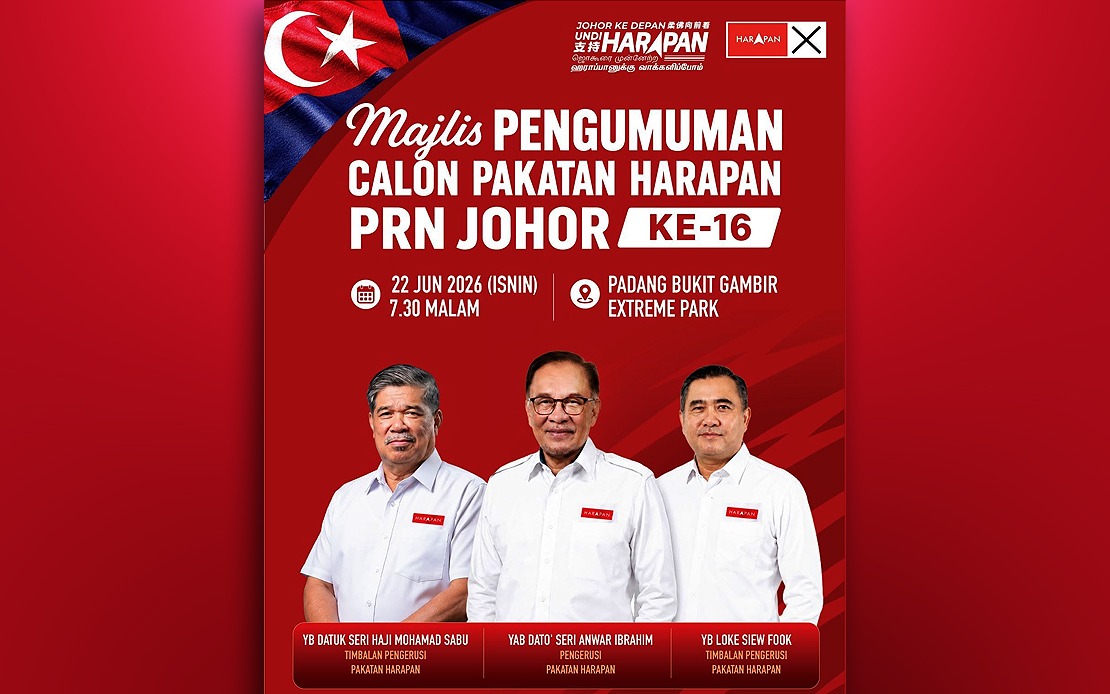
Pakatan Harapan will roll out its manifesto for the Johor state election shortly after nomination day on Saturday, June 27, according to PKR vice president Datuk Seri Amirudin Shari. The coalition is positioning the campaign around a development blueprint titled 'Johor Ke Depan', which will highlight concrete achievements delivered in other states where PH governs to demonstrate what voters can expect if the coalition gains power in Malaysia's southern heartland.
Amirudin's announcement came during the PH candidate launch event at Padang Bukit Gambir Extreme Park in Tangkak, attended by senior coalition figures including PH chairman Datuk Seri Anwar Ibrahim, DAP secretary-general Anthony Loke, and Amanah president Datuk Seri Mohamad Sabu. The timing reflects PH's strategy to build momentum after candidate nominations are formally processed, allowing the party to present its vision when public attention peaks during the formal campaign period.
The manifesto represents a deliberate shift in campaigning approach. Rather than presenting theoretical promises or aspirational goals, PH intends to anchor its proposals in tangible results from Selangor, Penang and Negeri Sembilan—three states where the coalition currently holds or recently held government. This evidence-based strategy addresses a persistent vulnerability in Malaysian electoral politics, where voters often question whether political parties can deliver on campaign pledges. By grounding the Johor manifesto in documented governance outcomes, PH seeks to overcome scepticism and distinguish itself from opposition parties.
The choice to launch the manifesto after rather than before nomination day carries political significance. The nomination period serves as a filtering mechanism where the Election Commission formalises candidate registrations, and the timing allows PH to showcase its full slate of nominees alongside policy commitments. This sequencing creates an integrated narrative: here are our candidates, and here is what we will accomplish with them. The approach also provides additional preparation time for the manifesto team, ensuring the document reflects final candidate selections and addresses state-specific concerns identified during the campaign build-up.
Johor represents strategically crucial terrain in Malaysian politics. As the nation's second-largest state by population and a significant economic contributor, Johor elections carry implications beyond state boundaries. The state has historically been a BN stronghold, though recent years have seen growing opposition presence. PH's focus on demonstrating comparative competence rather than making unfounded promises suggests the coalition recognises that winning Johor requires overcoming deep-rooted voter attachments to the ruling coalition and requires presenting a credible alternative administration.
The invocation of Selangor as a model is particularly instructive. Under PH governance, Selangor has maintained economic growth while expanding social programmes, allowing the coalition to claim it can simultaneously deliver development and welfare improvements. Penang's track record on transparency and anti-corruption measures provides another narrative pillar, while Negeri Sembilan offers lessons in state-level governance across a mid-sized economy. Together, these examples provide PH with multiple policy domains to showcase—economic management, social provision, institutional integrity, and infrastructure development.
The Election Commission's electoral calendar structures the campaign timeline tightly. With nomination day set for June 27, early voting on July 7, and election day on July 11, the campaign window spans merely two weeks. This compressed timeframe makes manifest launches particularly important, as they must capture media attention and shape voter perception rapidly. PH's decision to announce the manifesto within days of the nomination deadline maximises the coverage window, allowing multiple rounds of media engagement before polling begins.
For Malaysian voters, particularly those in Johor, the manifesto's substance will ultimately matter more than its timing. The key questions are whether PH's documented achievements in other states address Johor-specific priorities—whether concerning infrastructure modernisation, economic diversification away from petroleum dependency, youth employment, or education quality. The manifesto must demonstrate that PH understands Johor's distinct challenges and has tailored solutions rather than simply transplanting policies designed for other states.
The presence of Anwar Ibrahim at the announcement ceremony underscores the national significance attached to the Johor contest. As PH chairman and Prime Minister, Anwar's personal involvement signals that the coalition views this state election as consequential for the federal government's political positioning. A strong showing in Johor would validate PH's governance claims heading toward the next general election, while a poor performance would embolden opposition arguments that voters lack confidence in the ruling coalition.
For Southeast Asian observers, the Johor election offers insights into how opposition coalitions in established democracies transition from protest politics to governing parties. PH's reliance on documented achievements rather than ideological rhetoric reflects the maturation that occurs when opposition movements gain power. The coalition must balance maintaining its reform identity with demonstrating competent administration, and the manifesto will reveal how successfully PH has navigated this transition in the minds of voters.

