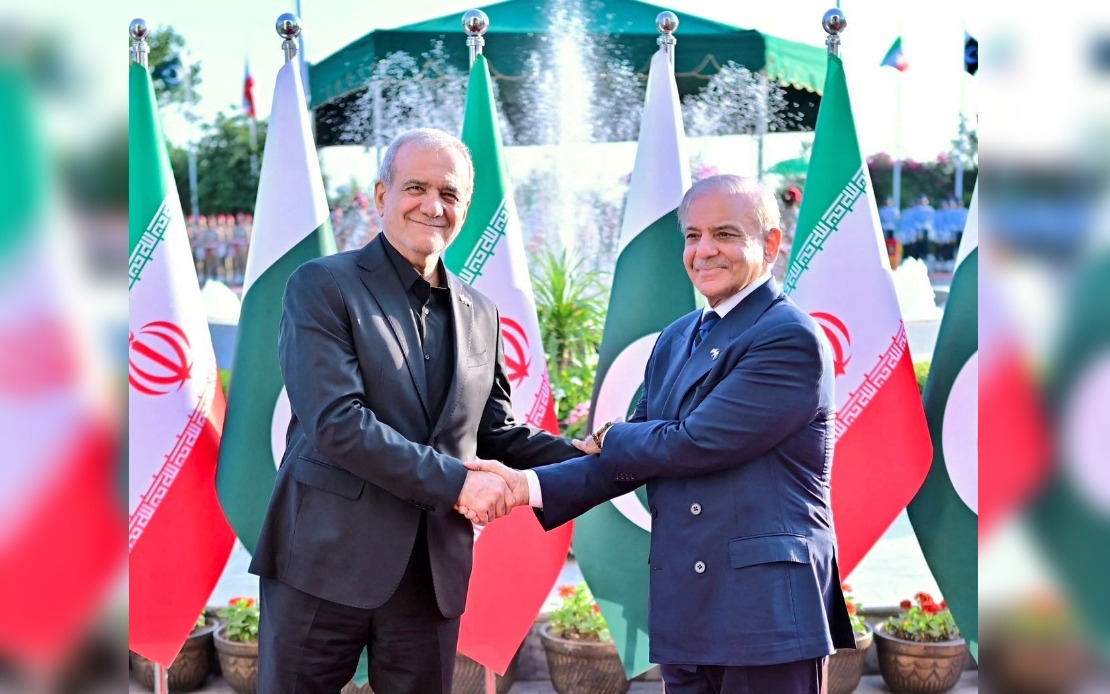
Pakistan's Prime Minister Shehbaz Sharif has thrown his weight behind Iran's ballistic missile capabilities, declaring during a high-level meeting in Islamabad that Tehran should not face restrictions other nations avoid. Speaking alongside Iranian President Masoud Pezeshkian on Tuesday, Sharif made clear that Pakistan—which brokered the recent understanding between Washington and Tehran—would not permit the subject of Iranian missiles to become a sticking point in future negotiations or international discourse.
The timing of Sharif's robust statement carries significance within the context of regional tensions. His assertion that ballistic missiles were conspicuously absent from the negotiating table when Pakistan helped facilitate the June 17 memorandum of understanding between the US and Iran effectively shields Iran from pressure to curtail its arsenal. By emphasizing that the Iranian delegation never sought to discuss the topic and considered it beyond the scope of talks, Sharif has positioned Pakistan as a guarantor that no side breached understandings by later attempting to impose missile restrictions.
The principle Sharif articulated—that international arms regulations should apply uniformly across nations rather than selectively—strikes at a longstanding grievance in the Iranian government's calculations about global fairness. When one country possesses advanced ballistic missiles while another is denied similar capabilities, Tehran argues, it creates an asymmetry that undermines security. Sharif's framing as "double standards" echoes language Iranian officials have consistently used when challenging Western objections to their weapons programmes, giving Pakistan's diplomatic voice to arguments Iran itself champions.
Context for understanding Iran's perspective on its missile arsenal emerged from Pezeshkian's own remarks during the joint press appearance. The Iranian president emphasized that his nation's defensive capabilities represent an existential necessity rather than mere strategic preference. He drew a stark parallel to Gaza, suggesting that without its missile deterrent, Iran would face military action comparable to what Palestinians have experienced. This worldview, shaped by decades of perceived or actual threats from Israel and the United States, frames Iran's weapons development as a rational response to genuine security concerns rather than destabilizing aggression.
The diplomatic choreography surrounding Pezeshkian's visit underscored the importance Pakistan places on the relationship. Pakistan's Air Force provided a six-aircraft escort for the Iranian president's arrival in Islamabad, while President Asif Ali Zardari and Prime Minister Sharif welcomed him personally. The 21-gun salute and grand state reception communicated respect and solidarity, signals that regional audiences instantly decode. For Pakistan, cultivating its relationship with Iran serves multiple strategic interests: counterbalancing other regional powers, securing the western border, and positioning itself as a serious diplomatic actor capable of managing complex regional disputes.
Sharif's gratitude toward Iran for trusting Pakistan's mediation efforts—a process that involved Deputy Prime Minister and Foreign Minister Ishaq Dar and Pakistan's Chief of Army Staff Field Marshal Syed Asim Munir—reveals the institutional depth of this diplomatic engagement. Pakistan had previously brokered a temporary ceasefire between the US and Iran in April before achieving the broader understanding the following month. Such sustained mediation effort requires deep channels of communication and demonstrated reliability on both sides, elements Sharif suggested Pakistan has successfully cultivated.
However, the Pakistani leader also acknowledged significant obstacles to translating this agreement into lasting peace. He identified unspecified "spoilers" globally who seek to undermine the accord, a reference widely understood in diplomatic circles to encompass Israel and other regional actors opposed to any improvement in US-Iran relations. Israel, according to Sharif's assessment, represents the principal impediment to West Asian stability through its military operations affecting Lebanon and Palestinian territories. This analysis aligns with Iran's own interpretation of regional dynamics and reflects Pakistan's public positioning on Israeli actions.
US President Donald Trump's recent comments lend unexpected support to the Iranian and Pakistani positions. When Trump conceded that Iran possessing ballistic missiles represented a reasonable position—given that other nations similarly armed themselves—he undermined potential American efforts to negotiate missile restrictions in future talks. Trump's statement to reporters in Paris essentially validated the argument that attempting to single out Iran for missile restrictions would indeed constitute double standards. Whether Trump's position reflects his administration's formal policy or represents his personal view remains somewhat ambiguous, creating diplomatic space for Pakistan and Iran to cite his words while negotiating with the broader US government.
For Malaysia and Southeast Asian observers, this episode illustrates how regional powers leverage diplomatic mediation to advance their interests while building influence. Pakistan has positioned itself indispensably within high-stakes Middle Eastern negotiations, earning credibility and strategic value with both Iran and the United States. The explicit public defense of Iran's military capabilities—delivered by a major Muslim-majority nation that maintains its own ballistic arsenal—sends messages beyond the immediate US-Iran context, reinforcing arguments that developing nations deserve equivalent security capabilities as established powers.
The broader implications extend to how international norms around weapons proliferation and non-proliferation may be evolving. When Pakistan publicly argues that restrictions should apply uniformly or not at all, it challenges the established architecture in which developed nations maintain advanced arsenals while restricting others' capabilities. This perspective resonates across the developing world, where nations perceive historical injustice in asymmetrical security arrangements. Pakistan's willingness to articulate this position prominently suggests growing confidence in challenging what it views as unfair international arrangements.
Looking forward, Pakistan's mediation role may expand as regional players recognize its unique positioning between Washington and Tehran. The successful negotiation of the June agreement, following the April ceasefire, demonstrates that Pakistan possesses channels and credibility neither side dismisses. However, Pakistan's explicit defense of Iran's missiles potentially complicates its claimed neutrality, though Sharif would argue he simply acknowledges agreed facts rather than taking sides. The stability this agreement helps generate directly affects Pakistan's own security calculus, making its investment in the arrangement's success substantial and genuine.

