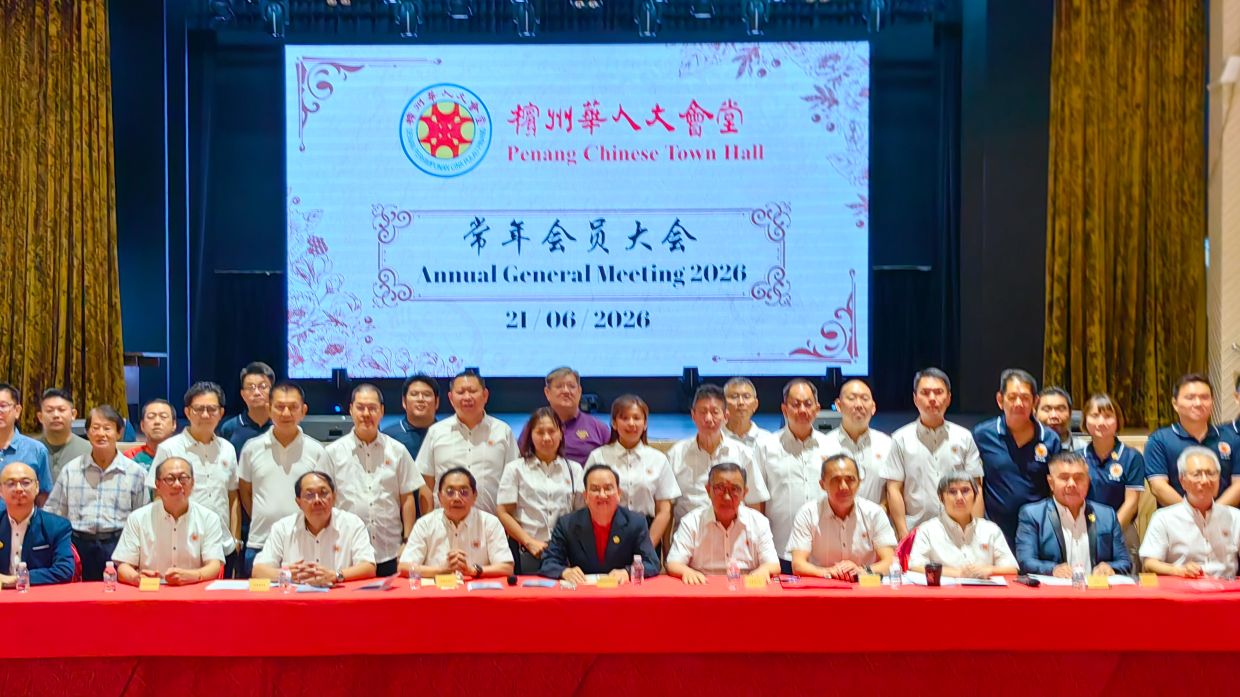
Penang Chinese Town Hall concluded its 2025 financial year with total income of RM12.61mil against expenditure of RM12.55mil, delivering a narrow surplus of RM59,191 according to its annual report filed following the organisation's annual general meeting. The financial outcome reflects steady operational performance for the venerable community institution, which serves as a significant cultural and civic hub for Penang's Chinese community.
Donations formed the financial backbone of the organisation, contributing RM11.24mil or approximately 89 percent of total revenue. This dominant reliance on philanthropic support underscores the community-driven nature of PCTH's mission. Supporting revenue streams included rental and maintenance fees totalling RM439,671, auditorium rental income of RM361,245, and anniversary-related receipts of RM222,498. The diversified revenue mix, though modest relative to donations, demonstrates the organisation's efforts to generate sustainable income through facility utilisation and special events.
Examining expenditure patterns reveals that charitable distributions represented the largest spending category at RM11.12mil, representing approximately 88.6 percent of total outflows. This figure represents a significant decline from RM12.35mil in 2024, suggesting either reduced charitable commitments or more targeted philanthropic allocation during the year. In contrast, personnel costs moved in the opposite direction, with salaries and allowances increasing to RM502,625 from RM452,761 in the previous year, reflecting either staffing expansion or salary adjustments for existing personnel.
The organisation's annual general meeting on June 21 attracted approximately 200 members, who gathered to review the financial statements and hear remarks from chairman Tan Sri Prof Tan Khoon Hai. His address pivoted from financial matters to broader civic themes, with particular emphasis on the electoral process. Against the backdrop of state elections scheduled for Johor and Negri Sembilan in 2025, Tan urged Malaysians to discharge their voting responsibility with careful consideration of candidates' qualifications and party platforms. His remarks reflected a philosophical perspective that electoral choices carry consequences extending beyond immediate local concerns to shape national trajectories across multiple domains.
Tan framed elections as consequential deliberations affecting not merely infrastructure and service delivery but the nation's fundamental direction regarding economic competitiveness, social cohesion and political stability. He advocated for voters to assess competing parties' track records and policy proposals through rational analysis rather than emotion or habit, emphasising the importance of selecting representatives capable of fostering national unity alongside economic advancement. This intervention into political discourse, albeit framed in terms of civic virtue rather than partisan advocacy, highlights how community organisations like PCTH position themselves within Malaysia's democratic apparatus.
On the institutional front, Tan unveiled the extensively renovated Ping Zhang Hall, which has undergone comprehensive modernisation to enhance functionality and aesthetic appeal. The refurbished venue now features enhanced spatial design alongside professional-grade audio, lighting and LED infrastructure, positioning it as a sophisticated option for corporate functions, association celebrations, anniversary commemorations, charitable fundraisers and diverse gathering requirements. This facility upgrade represents significant capital investment and reflects PCTH's commitment to maintaining competitive positioning within Penang's event and hospitality landscape.
Beyond community-focused activities, PCTH is positioning itself at the intersection of regional technological advancement through a planned international forum. The organisation will jointly organise the 2026 China-Asean Artificial Intelligence Cooperation Forum in Penang during November, collaborating with technology and business organisations from China and across the Asean region. This initiative represents an expansion of PCTH's institutional mandate beyond traditional cultural and community functions into emerging domains of strategic economic importance.
Tan emphasised Penang's particular suitability as a forum venue, citing the state's established credentials as Malaysia's premier electrical and electronics manufacturing hub and its colloquial designation as the Silicon Valley of the East. The forum architecture envisages convening technological experts, enterprise leaders and sector representatives across the region to exchange insights regarding advanced artificial intelligence technologies, commercial deployment strategies and collaborative cross-border initiatives. By positioning PCTH as a convener for such high-level regional dialogue, the organisation seeks to elevate its profile and contribute substantively to Penang's technological ecosystem.
The chairman explicitly encouraged PCTH members possessing relevant technical expertise to participate actively in forum preparation and execution, framing such engagement as a contribution to strengthening Penang's role within regional artificial intelligence cooperation structures. This collaborative approach reflects recognition that technological advancement increasingly depends on knowledge networks and cross-border partnerships rather than isolated institutional capabilities. For Malaysian policymakers and business communities, PCTH's initiative signals how community organisations are adapting to participate in emerging domains of regional competition and cooperation.
The juxtaposition of PCTH's conservative financial management—delivering modest surpluses and maintaining disciplined expenditure—with its ambitious international initiatives reveals an institution consciously balancing traditional community stewardship with aspirations toward regional relevance. The organisation's decision to leverage its Penang location and convening capabilities to facilitate China-Asean technological dialogue positions it within broader regional narratives regarding technology-driven development and intra-Asean cooperation. This strategic orientation may offer templates for how Malaysian community institutions can remain financially sustainable while contributing to national and regional technological competitiveness objectives.
The modest financial surplus, though numerically small, reflects operational efficiency within an organisation heavily dependent on annual donations. Rather than accumulating significant reserves, PCTH's expenditure patterns demonstrate commitment to immediate charitable purposes and community support. Whether this approach proves optimal for funding future facility enhancements and international initiatives remains an open question, particularly as ambitions expand toward hosting major regional technological forums. The coming years will reveal whether PCTH can sustain simultaneous commitments to traditional philanthropic distributions and emerging technology cooperation platforms.
%22%2F%3E%3C%2Fpattern%3E%3C%2Fdefs%3E%3Crect%20width%3D%22100%25%22%20height%3D%22100%25%22%20fill%3D%22url(%23ph5bjwng)%22%2F%3E%3Crect%20width%3D%22100%25%22%20height%3D%22100%25%22%20fill%3D%22url(%23ph5bjwnp)%22%2F%3E%3Ctext%20x%3D%2250%25%22%20y%3D%2250%25%22%20text-anchor%3D%22middle%22%20dominant-baseline%3D%22central%22%20fill%3D%22rgba(255%2C255%2C255%2C0.95)%22%20font-family%3D%22Georgia%2C%20'Times%20New%20Roman'%2C%20serif%22%20font-weight%3D%22700%22%20font-size%3D%22226%22%20letter-spacing%3D%22-0.02em%22%3EHamzah%3C%2Ftext%3E%3C%2Fsvg%3E)
%22%2F%3E%3C%2Fpattern%3E%3C%2Fdefs%3E%3Crect%20width%3D%22100%25%22%20height%3D%22100%25%22%20fill%3D%22url(%23ph5pue1g)%22%2F%3E%3Crect%20width%3D%22100%25%22%20height%3D%22100%25%22%20fill%3D%22url(%23ph5pue1p)%22%2F%3E%3Ctext%20x%3D%2250%25%22%20y%3D%2250%25%22%20text-anchor%3D%22middle%22%20dominant-baseline%3D%22central%22%20fill%3D%22rgba(255%2C255%2C255%2C0.95)%22%20font-family%3D%22Georgia%2C%20'Times%20New%20Roman'%2C%20serif%22%20font-weight%3D%22700%22%20font-size%3D%22170%22%20letter-spacing%3D%22-0.02em%22%3ETambirat%3C%2Ftext%3E%3C%2Fsvg%3E)
%22%2F%3E%3C%2Fpattern%3E%3C%2Fdefs%3E%3Crect%20width%3D%22100%25%22%20height%3D%22100%25%22%20fill%3D%22url(%23ph444f3g)%22%2F%3E%3Crect%20width%3D%22100%25%22%20height%3D%22100%25%22%20fill%3D%22url(%23ph444f3p)%22%2F%3E%3Ctext%20x%3D%2250%25%22%20y%3D%2250%25%22%20text-anchor%3D%22middle%22%20dominant-baseline%3D%22central%22%20fill%3D%22rgba(255%2C255%2C255%2C0.95)%22%20font-family%3D%22Georgia%2C%20'Times%20New%20Roman'%2C%20serif%22%20font-weight%3D%22700%22%20font-size%3D%22194%22%20letter-spacing%3D%22-0.02em%22%3EBintulu%3C%2Ftext%3E%3C%2Fsvg%3E)