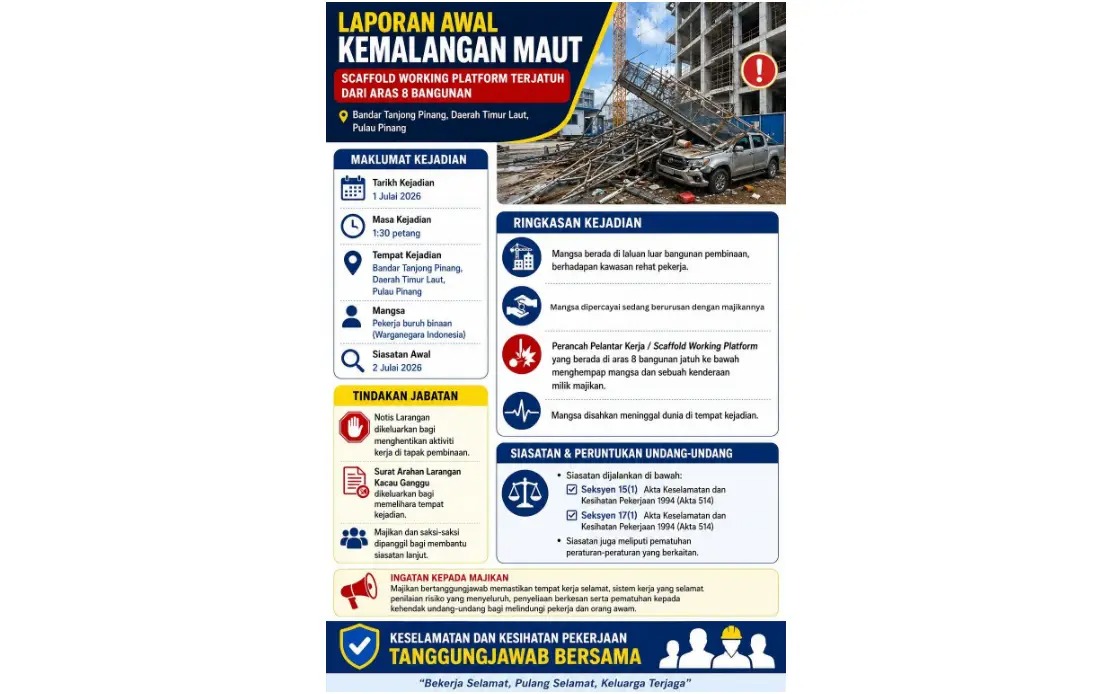
The Department of Occupational Safety and Health (DOSH) Penang has moved swiftly to impose a complete work prohibition at a construction site in Bandar Tanjong Pinang following a fatal accident that claimed the life of an Indonesian worker on July 1. The incident, which occurred at approximately 1.30 pm, resulted in immediate enforcement action as authorities launched a comprehensive investigation into the circumstances surrounding the tragedy.
The fatal accident unfolded when a scaffolding working platform detached from the eighth floor of the building, plunging downward and striking the worker as he stood on an external walkway positioned in front of a designated rest area for construction personnel. The worker was engaged in conversation with his employer at the moment of impact, placing him directly in the path of the falling structure. The same incident also resulted in damage to a vehicle owned by the employer, underscoring the force and severity of the collapse.
In response to the incident, DOSH Penang immediately issued a prohibition notice requiring the cessation of all related construction activities at the site. Alongside this enforcement measure, a non-disturbance order has been imposed to preserve the accident scene in its existing state, ensuring that critical evidence and structural details remain unaltered during the ongoing investigation. This dual approach reflects the seriousness with which Malaysian occupational safety authorities treat fatal workplace incidents.
The investigation is currently examining compliance with specific legal obligations outlined in the Occupational Safety and Health Act 1994, particularly Sections 15(1) and 17(1), which establish the statutory duties that employers must fulfil in maintaining safe working conditions. These sections form the legal backbone of workplace safety enforcement in Malaysia, requiring employers to implement adequate systems, procedures, and safeguards to protect workers from foreseeable hazards. The inquiry will focus on whether the employer, contractor, and subcontractors adhered to these fundamental requirements.
Authorities have begun systematic interviews with employers and witnesses present at the time of the incident. These testimonies will be crucial in reconstructing the events leading to the platform's failure and determining whether negligence, inadequate maintenance, improper installation, or insufficient safety protocols contributed to the tragedy. The investigation team will examine maintenance records, work permits, safety training documentation, and site inspection logs to establish whether all necessary precautions were in place and properly implemented.
DOSH Penang's statement emphasised that workplace fatalities, particularly in construction sectors where risks are inherently elevated, trigger the most rigorous investigative response available to the authority. The department reiterated its commitment to holding employers and contractors accountable under existing legal frameworks, indicating that formal enforcement action including potential prosecutions will follow if violations are substantiated through the investigation.
For Malaysia's construction industry, this incident serves as a stark reminder of the persistent dangers associated with inadequate safety management on building sites. The country has witnessed recurring scaffolding failures and platform collapses over recent years, suggesting systemic issues in how safety standards are applied and monitored across the sector. Many construction sites, particularly those relying on subcontracted labour, sometimes prioritise speed and cost reduction over comprehensive safety infrastructure, creating conditions where preventable accidents occur.
The involvement of foreign workers, a significant demographic within Malaysia's construction workforce, also underscores broader concerns about whether migrant workers receive adequate safety training and orientation upon arrival at work sites. Language barriers, unfamiliarity with Malaysian construction practices, and potential vulnerability to exploitation can compound safety risks for foreign workers who may hesitate to report unsafe conditions for fear of employment consequences.
DOSH Penang has directed its message not only at individual employers but also at developers, main contractors, and subcontractors operating throughout the state. This broad-based communication emphasises that safety responsibility extends across the entire construction chain, with each party bearing obligations to plan work meticulously and execute it according to established safety protocols. The authority's tone indicates a willingness to pursue legal consequences against any party found negligent, potentially serving as a deterrent to others operating on construction sites.
The prohibition notice itself represents significant economic disruption to the project, as all associated work activities must cease until investigation conclusions are reached and corrective measures are verified. Depending on investigation findings, permit reinstatement could require comprehensive safety audits, structural assessments, safety system redesigns, or extensive retraining programmes. This enforcement mechanism provides powerful incentive for operators to maintain rigorous safety standards prospectively.
Construction industry observers across Southeast Asia will monitor this investigation's conclusions closely, as Malaysia's approach to scaffolding safety incidents influences regional practices. The incident highlights the critical importance of regular inspections, maintenance protocols, and proper engineering oversight for temporary structures that support workers during building operations. Many accidents stem not from deliberate non-compliance but from gaps in knowledge, inadequate resource allocation, or insufficient supervisory oversight.
Moving forward, the industry must recognise that worker safety represents not merely a compliance obligation but a fundamental ethical responsibility. Investment in proper training, quality materials, regular inspections, and adequate staffing levels for safety supervision reduces accident rates substantially. The fact that this worker was fatally injured while performing routine duties near a rest area demonstrates how accidents can strike when preventive measures prove inadequate.

