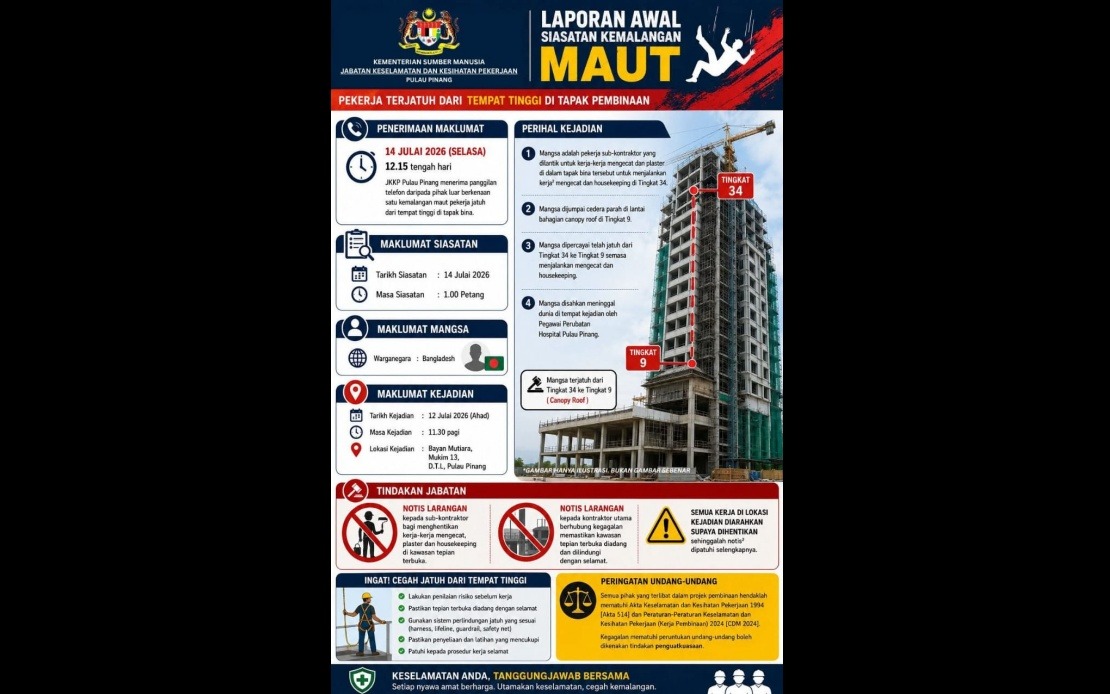
The Penang Department of Occupational Safety and Health (DOSH) has launched a formal investigation into the death of a Bangladeshi construction worker following a fatal fall at a building site in Bayan Mutiara. The incident, reported to authorities on July 15 at 12.15 pm, has prompted immediate regulatory action and a temporary halt to all related construction activities on the premises, raising fresh concerns about worker safety standards across Malaysia's property development sector.
According to Penang DOSH director Hairozie Asri, the department mobilised a team of investigating officers immediately upon receiving notification of the incident from an external party. The worker, employed by a subcontractor responsible for painting, plastering, and housekeeping operations, was discovered with severe injuries on the canopy roof at Level 9 after apparently falling from the 34th floor where he had been assigned to work. Medical personnel from Penang Hospital subsequently confirmed the worker's death at the scene.
The tragic incident underscores the persistent vulnerability of migrant workers in Malaysia's construction industry, where foreign labourers frequently undertake high-risk tasks often with inadequate safety infrastructure and oversight. Bangladesh has emerged as a major source of construction workers for Malaysia's booming property market, yet documented cases of workplace fatalities and serious injuries among these workers continue at alarming rates. This particular case exemplifies the dangers inherent when safety protocols are insufficiently implemented across multiple layers of subcontracting arrangements.
Hairozie's statement revealed that preliminary findings indicated the victim had been engaged in work at considerable height without apparently adequate fall protection measures. The 25-storey drop from the 34th floor to the Level 9 canopy roof represents a catastrophic failure of what should have been comprehensive safety systems. Such incidents typically point to systemic weaknesses: inadequate harnesses, missing guardrails, insufficient supervision, or pressure on workers to complete tasks rapidly regardless of hazard levels.
In response to the fatality, DOSH issued multiple prohibition notices targeting both the subcontractor and the main contractor. The subcontractor received a specific notice prohibiting all painting, plastering, and housekeeping operations in open-edge areas—regions where workers face unprotected exposure to falls from heights. Simultaneously, the main contractor received its own prohibition notice, reflecting regulatory determination to hold both tiers of the contracting hierarchy accountable for safety failures.
Moreover, DOSH ordered an immediate cessation of all work activities at the accident site pending complete compliance with the prohibition notices. This comprehensive work stoppage represents a significant enforcement action that carries financial implications for the project timeline and budget. Such interventions, while necessary to protect remaining workers, often create tension between safety regulators and developers keen to maintain construction schedules.
The incident reflects broader challenges within Malaysia's construction oversight framework. While DOSH possesses statutory authority to enforce occupational safety standards under the Occupational Safety and Health Act 1994, implementation gaps persist, particularly regarding migrant worker protection and subcontractor accountability. The layered subcontracting structure—whereby main contractors engage multiple specialised subcontractors—can diffuse responsibility, leaving workers uncertain about reporting safety concerns and supervisors unclear about their obligations.
International labour organisations and human rights groups have repeatedly flagged Malaysia's construction sector for inadequate protections afforded to migrant workers. Many arrive from Bangladesh with limited knowledge of their rights, language barriers that complicate communication about hazards, and economic desperation that pressures them to accept unsafe working conditions. Employers have sometimes exploited these vulnerabilities, and even well-intentioned companies can overlook safety requirements amid competitive cost pressures.
For Malaysia's property development industry, which has experienced sustained growth over recent years, this incident carries warning implications. High-profile fatalities attract regulatory scrutiny, media attention, and potential project delays—costs that extend beyond the immediate human tragedy. Developers increasingly recognise that robust safety cultures reduce incidents, minimise regulatory intervention, and ultimately protect their commercial interests alongside worker wellbeing.
The investigation by Penang DOSH will likely examine multiple factors: whether appropriate fall protection equipment was provided and used, whether workers received adequate safety training, whether site supervisors conducted proper risk assessments, and whether communication channels existed for workers to raise safety concerns. The findings may inform regulatory guidance for the broader sector and potentially influence how main contractors manage subcontractor compliance going forward.
For Bangladeshi worker communities in Malaysia, this tragedy reinforces the need for stronger support systems, including independent worker advocacy organisations, multilingual safety training, and clearer channels for reporting unsafe conditions without fear of retaliation or employment termination. Several NGOs and trade unions have expanded their engagement with migrant workers, yet resource constraints limit their reach across Malaysia's sprawling construction sites.
Penang's construction boom continues undeterred by this incident, yet the fatality serves as a stark reminder that Malaysia's impressive infrastructure development comes with human costs that extend disproportionately to vulnerable migrant populations. How effectively DOSH investigates this case and whether the industry implements systemic improvements will determine whether this death catalyses genuine safety reform or becomes merely another documented tragedy in Malaysia's ongoing development narrative.

