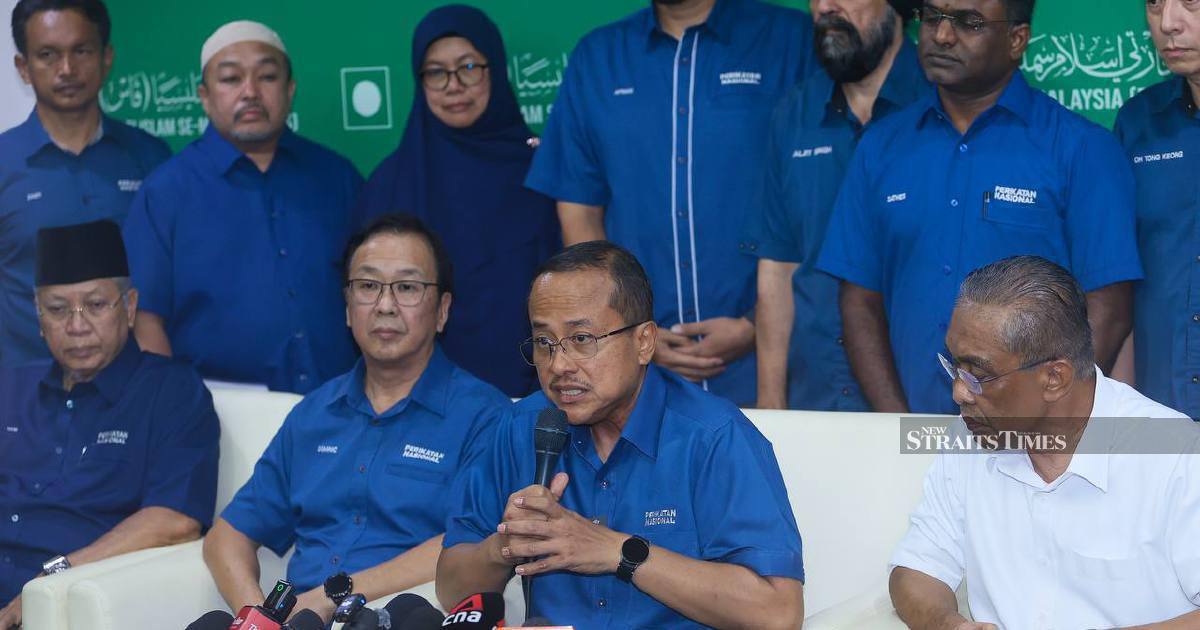
Perikatan Nasional took a significant step forward in expanding its membership on Thursday night when coalition chairman Datuk Seri Dr Ahmad Samsuri Mokhtar announced the acceptance of two additional political parties during an emergency Supreme Council session in Kuala Lumpur. The move reflects PN's continued efforts to strengthen its organisational footprint and consolidate its position as a credible political force in Malaysia's fractious coalition landscape, though questions linger over the coalition's strategic direction and ideological coherence.
While PN moved swiftly to formalise the new memberships, the emergency meeting notably sidestepped discussions on two contentious issues that have been subject to mounting internal debate: the adoption of a unified coalition logo and the status of Wawasan 2024, the stated framework through which PN has positioned its political vision. The absence of these deliberations from the formal agenda signals either pragmatic sequencing to avoid derailing the membership expansion or a deeper reluctance to address unresolved disagreements among the coalition's constituent parties about its fundamental identity and forward policy direction.
The timing of PN's expansion carries particular significance in Malaysia's current political climate, where coalition mathematics remain razor-thin and volatile. Each additional party that joins the bloc theoretically strengthens its parliamentary representation and electoral potential, though the stability and ideological alignment of new members remain critical variables. The coalition has long sought to position itself as an alternative to Pakatan Harapan and internal government structures, and accumulating parties is essential to that strategic positioning, yet expansion without clear internal consensus on fundamental matters risks creating organisational fragmentation.
The deferral of the logo discussion may seem procedural, but it carries symbolic weight in Malaysian politics. A unified logo serves as a visual expression of coalition identity and voter recognition—factors that proved significant in PN's strong performance during the 2022 general election. That the coalition chose not to finalise this element during a critical expansion moment suggests either that consensus remains elusive among larger and smaller parties within the bloc, or that leadership deliberately decided to prioritise member acquisition before resolving aesthetic and identity questions. Either interpretation points to underlying tensions within PN's internal dynamics.
Wawasan 2024 represents PN's attempt to articulate a comprehensive policy platform distinct from rivals. The framework was introduced as a blueprint for governance should the coalition return to federal power, encompassing economic development, social policy, and institutional reform priorities. By deferring discussion of this document during a period of coalition expansion, PN risks presenting an unclear policy proposition to both new members and the broader electorate. New parties joining without clarity on collective policy commitments may struggle to explain their decision to their own grassroots supporters, creating potential friction down the line.
For Malaysian observers monitoring coalition stability, these developments underscore the challenging equilibrium that PN must maintain. Larger component parties such as Perikatan Keadilan Rakyat and Parti Islam Se-Malaysia possess different organisational cultures, voter bases, and policy priorities. Smaller parties joining the coalition often do so seeking platform elevation and parliamentary resources. Managing these disparate interests while maintaining coherent messaging requires careful calibration, and the strategic deferral of logo and Wawasan discussions may represent an attempt to avoid triggering internal conflicts that could destabilise the membership expansion process itself.
The two newly admitted parties, though unspecified in the immediate announcement, would expand PN's reach into constituencies or demographic groups not previously well-represented. This incremental approach to coalition building reflects a longer-term strategy to position PN as an increasingly comprehensive political vehicle capable of competing effectively across Malaysia's diverse electoral landscape. Regional variations in political sentiment—particularly in Peninsular Malaysia versus East Malaysia—mean that parties with strong local presence can offer coalition partners significant value beyond their parliamentary numbers alone.
Datuk Seri Dr Ahmad Samsuri's role as PN chairman places him at the centre of balancing these internal pressures. His decision to convene an emergency meeting specifically to formalise new party memberships while deliberately postponing more divisive discussions about coalition identity and policy demonstrates political judgment aimed at building momentum while avoiding precipitous conflicts. However, this approach creates a temporal problem: at some point, PN must achieve internal consensus on logo and Wawasan matters, and deferring these conversations may simply defer rather than resolve underlying disagreements.
For Southeast Asian context, PN's expansion mirrors broader coalition-building dynamics across the region, where multi-party political systems require continuous negotiation among diverse ideological and organisational actors. Thailand, Indonesia, and the Philippines have all experienced periods where expanding coalitions struggled with identity and coherence questions. PN's experience offers lessons in how rapidly-expanding blocs can manage growth without fracturing along internal fault lines—though the evidence so far suggests this remains an open question.
Looking forward, PN's leadership will need to schedule substantive discussions on logo adoption and Wawasan 2024 before these become sources of public dispute or media criticism. The coalition's credibility with voters depends partly on projecting organisational unity and policy clarity. While short-term expansion may be celebrated internally, long-term viability requires resolving the strategic and identity questions that tonight's emergency meeting left unaddressed. The window for achieving this consensus while maintaining coalition cohesion remains open but is narrowing as Malaysia approaches the next electoral cycle.

