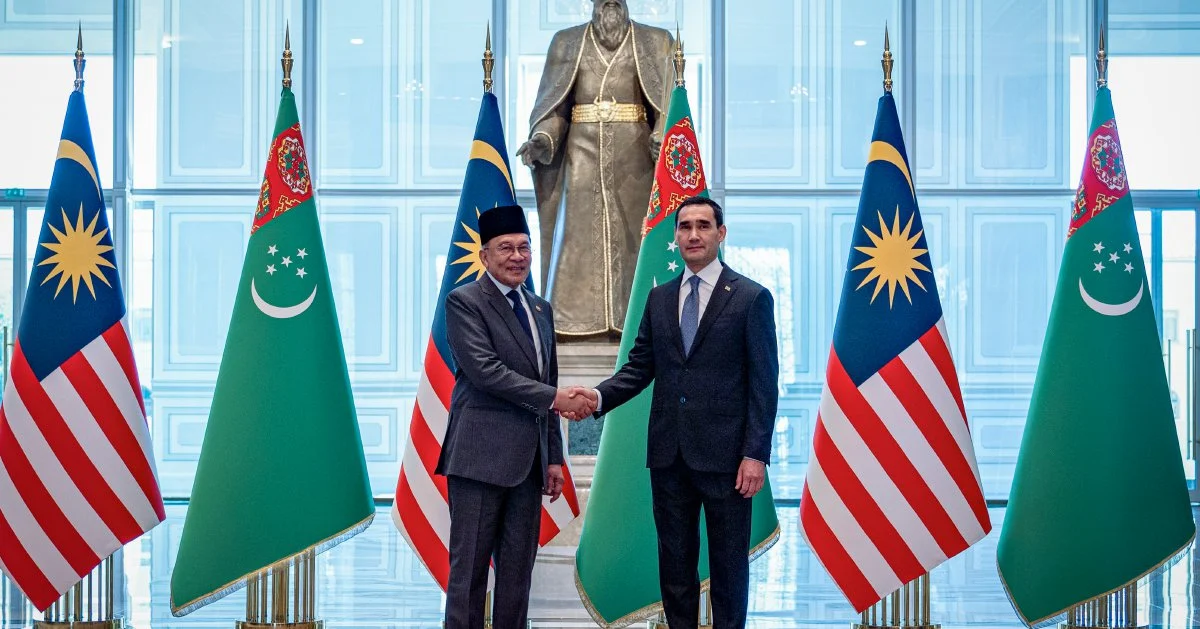
Malaysia's national energy champion Petronas is positioning itself at the centre of an ambitious effort to revitalise bilateral relations with Turkmenistan, a strategically important Central Asian energy producer. The company's deepening involvement in the former Soviet republic marks a significant shift in how Kuala Lumpur is engaging with energy-rich nations beyond its traditional Southeast Asian sphere, particularly following Prime Minister Datuk Seri Anwar Ibrahim's high-profile official visit that has redefined the diplomatic agenda between the two nations.
The timing of Petronas's expanded commitment to Turkmenistan reflects broader Malaysian foreign policy objectives that recognise the importance of diversifying energy sources and developing relationships with emerging markets in Asia. Over several years, Petronas has quietly accumulated substantial operational experience and infrastructure within Turkmenistan's hydrocarbon sector, positioning the company uniquely to bridge Malaysian interests with the Central Asian nation's vast natural gas reserves and production capabilities. This foundation, accumulated through patient investment and technical expertise, now serves as the launching pad for far more ambitious cooperation frameworks that extend well beyond conventional petroleum commerce.
Turkmenistan's energy landscape presents compelling opportunities for a company of Petronas's calibre and ambition. The nation ranks among the world's leading producers of natural gas, with reserves that dwarf many traditional suppliers to Asian markets. For Malaysia specifically, which faces its own energy security challenges as domestic oil and gas reserves gradually deplete, strategic partnerships with major gas exporters offer a pathway to long-term supply stability and competitive pricing advantages. Petronas's pre-existing operational relationships and technical knowledge within Turkmenistan's fields provide it with institutional advantages that newer market entrants simply cannot replicate in the short term.
Prime Minister Anwar's recent diplomatic mission to Ashkhabad carried substantial symbolic weight, signalling that Malaysia's government views Turkmenistan not merely as a transactional energy supplier but as a partner worthy of high-level political engagement. Such visits typically precede and facilitate the expansion of commercial frameworks, providing political cover and institutional support for large-scale business initiatives that might otherwise face bureaucratic obstacles. The Prime Minister's presence validates Petronas's strategic initiatives and signals to Turkmen counterparts that energy cooperation carries genuine importance within Malaysia's national development strategy.
Beyond crude extraction and gas production, the partnership framework encompasses broader economic dimensions that could reshape Malaysia-Turkmenistan interaction patterns. Joint ventures in downstream processing, technology transfer initiatives, and capacity-building programmes represent avenues through which Malaysia might export expertise and industrial capabilities while simultaneously securing preferential access to energy resources. For a developing nation with sophisticated oil and gas infrastructure and technical prowess, such arrangements create employment opportunities, enhance industrial competitiveness, and generate foreign exchange earnings that support the broader economy.
The geopolitical context surrounding this cooperation cannot be overlooked. Central Asia remains a region where major powers—Russia, China, and increasingly Western nations—compete for influence and commercial advantage. Malaysia's deliberate cultivation of relationships with Turkmenistan and its repositioning through Petronas as a significant economic actor demonstrates strategic thinking about middle-power engagement in a multipolar world. By engaging constructively on energy matters without entanglement in regional power competitions, Malaysia carves out a distinctive diplomatic space that respects national interests while avoiding polarisation.
For Southeast Asia more broadly, Malaysia's deepening engagement with Central Asian energy producers creates potential spillover benefits. Other regional economies seeking to diversify energy sources might explore similar partnerships, potentially creating networks of cooperation that bind Asia's peripheries more tightly together. Petronas's success in Turkmenistan could establish a template for Malaysian energy companies' expansion into other promising markets, gradually enhancing the nation's role as a regional energy hub and major player in global petroleum commerce.
The technical dimensions of expanded cooperation deserve particular attention. Petronas brings to Turkmenistan expertise in offshore exploration and production, liquefied natural gas processing, and sophisticated reservoir management that command premium pricing in global markets. Conversely, Turkmenistan's vast onshore gas reserves and developing production technologies offer learning opportunities for Petronas personnel, creating knowledge exchange that strengthens institutional capabilities across both organisations. Such technical cooperation, sustained over years or decades, builds resilience into bilateral relations that transcends political fluctuations and temporary diplomatic coolness.
Investment commitments flowing from this enhanced partnership will likely reshape Malaysia-Turkmenistan economic architecture. Capital expenditure on exploration, production facility upgrades, and associated infrastructure projects generates employment in both nations while building tangible assets that bind economic interests together. Malaysian engineers, technicians, and support personnel working on Turkmen projects become informal ambassadors, fostering people-to-people understanding that complements official diplomatic channels. The economic ties thus created become constituencies for maintaining positive bilateral relations even when political circumstances shift.
Looking forward, the Malaysian government and Petronas appear committed to evolving this partnership beyond energy into adjacent sectors. Potential collaboration in petrochemicals manufacturing, fertiliser production, and industrial gas applications could emerge naturally from established energy relationships. Such diversification would insulate cooperation from commodity price fluctuations while creating more resilient, multipronged economic integration that withstands temporary setbacks in any single sector.
The international energy transition, with its accelerating shift toward renewable sources and decarbonisation imperatives, introduces both urgency and complexity into Malaysian-Turkmenistan energy partnerships. Securing reliable supplies of natural gas during the transition period, when hydrocarbons remain essential to global energy systems but face mounting pressure, makes partnerships with major gas producers increasingly valuable. Petronas's presence in Turkmenistan thus represents strategic positioning for a longer timeframe than conventional energy commerce alone might suggest, acknowledging that energy futures remain uncertain and diversified portfolios provide necessary flexibility.
Ultimately, Petronas's expanding role in Turkmenistan reflects sophisticated Malaysian statecraft that leverages corporate capabilities to advance national interests while generating commercial returns. The company serves simultaneously as energy company, development partner, and diplomatic instrument, multiplying the impact of Malaysian engagement with important Central Asian players. As this cooperation matures and deepens, it will incrementally reshape economic relationships across the broader Asian continent.

