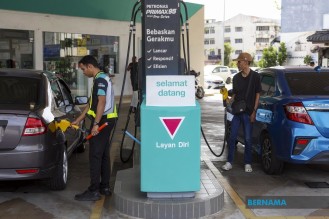
Fuel availability across Petronas petrol stations nationwide will remain secure and adequate through August, Datuk Seri Azalina Othman Said, Minister in the Prime Minister's Department (Law and Institutional Reform), announced on June 25 during a weekly meeting of the National Economic Action Council (MTEN). The reassurance comes in response to earlier concerns about supply constraints, with the government drawing on formal correspondence from Petronas to substantiate the outlook. The statement underscores Malaysia's determination to maintain fuel accessibility amidst a volatile international energy landscape shaped by geopolitical tensions.
Petronas Dagangan Bhd, the publicly listed downstream subsidiary of national oil company Petronas, operates the retail network responsible for meeting approximately half of Malaysia's domestic fuel consumption. This substantial market share positions the company as a critical infrastructure provider, making its supply continuity essential to economic stability and public mobility. The confirmation of adequate inventories through August suggests that current procurement strategies and storage capacity are performing adequately against present demand levels. However, the temporal specificity of this assurance—limited to a defined three-month window—indicates that planners view the outlook beyond August with greater uncertainty.
Global energy markets remain under considerable strain due to ongoing conflict in West Asia, a region that traditionally supplies significant quantities of crude oil to Asia-Pacific markets. This geopolitical instability has prompted energy security concerns across the region, including Malaysia, which depends partly on imports to meet refining and consumption requirements. The government's explicit acknowledgment of the "global energy crisis" stemming from West Asian tensions reflects the seriousness with which officials are treating potential supply disruptions. By publicly confirming fuel availability through August, authorities aim to prevent panic purchasing and hoarding behaviour that could artificially tighten supplies.
In response to these challenges, Malaysia has established a Crisis Management Task Force (PPPK) operating under MTEN's coordination. This dedicated body functions as an ongoing monitoring mechanism, maintaining real-time awareness of fuel, petroleum, and energy supply dynamics across the country. The task force's mandate extends beyond simple supply tracking; it encompasses price regulation efforts designed to prevent consumer-level cost spikes, as well as enforcement activities targeting fuel smuggling and irregular market activities. Such comprehensive institutional oversight represents a multi-layered approach to energy security that addresses both physical availability and market integrity.
Government strategy includes active diversification of crude oil sourcing, moving beyond traditional West Asian suppliers to establish relationships with producers in West Africa and the Americas. This geographic reorientation of import patterns aims to reduce vulnerability to any single regional disruption. Such sourcing decisions necessarily involve careful evaluation of crude characteristics and their compatibility with Malaysia's existing refinery infrastructure, as well as commercial negotiations to secure competitively-priced supplies. The willingness to develop alternative supply chains demonstrates forward-thinking risk management, though the timeline for fully operationalising these relationships remains undisclosed.
Malaysia's energy supply challenge reflects broader Southeast Asian concerns about import dependence and geopolitical exposure. Unlike some regional peers with substantial domestic petroleum reserves, Malaysia must balance its own production with import requirements to meet national demand. This dual reliance creates strategic vulnerabilities that become acute during periods of international tension. The government's current approach—combining short-term assurances with medium-term diversification—acknowledges both the immediate stability of current arrangements and the need for structural adjustments to enhance long-term resilience.
The assurance regarding fuel supply through August does not address what contingency arrangements might apply should global conditions deteriorate further. Khairil Nizam Khirudin, the opposition member for Jerantut, explicitly raised this concern, pointing to Petronas's earlier statement guaranteeing supplies only through June 2026. The apparent discrepancy between official timelines invites scrutiny regarding whether current confidence reflects genuine supply security or represents an interim position pending resolution of geopolitical tensions. Clarity on fallback measures—whether involving demand rationing, further sourcing adjustments, or temporary supply restrictions—would better equip businesses and households to prepare for potential future constraints.
For Malaysian consumers and businesses, the August timeline carries significant implications. Companies dependent on fuel-intensive operations can proceed with confidence in their near-term energy availability, though prudent planning should account for possible tightening beyond August. Transportation operators, manufacturers, and logistics providers would benefit from using this assured-supply window to stabilise contracts and optimize operational efficiency. The three-month visibility also provides time for government and private sector coordination on any necessary adjustments should supply conditions shift as August approaches.
The international energy market's trajectory remains uncertain, with West Asian developments continuing to influence global crude prices and availability. Malaysia's positioned between major Asian energy consumers, meaning regional demand competition could intensify should multiple countries simultaneously pursue alternative suppliers. This crowding effect in non-traditional markets could potentially limit pricing flexibility and availability for smaller importing nations. The government's task force structure, by maintaining continuous environmental scanning, should be positioned to identify emerging constraints early and recommend adjustments to maintain supply security.
Price stability represents an equally critical dimension of energy security. Uncontrolled fuel cost escalation, even with physical supplies remaining adequate, creates economic ripples affecting transportation, food prices, manufacturing competitiveness, and ultimately consumer purchasing power. The task force's price monitoring mandate reflects recognition that energy security encompasses affordability alongside availability. This dual-track approach—ensuring adequate supply while preventing excessive cost volatility—defines modern energy policy in import-dependent economies like Malaysia.

