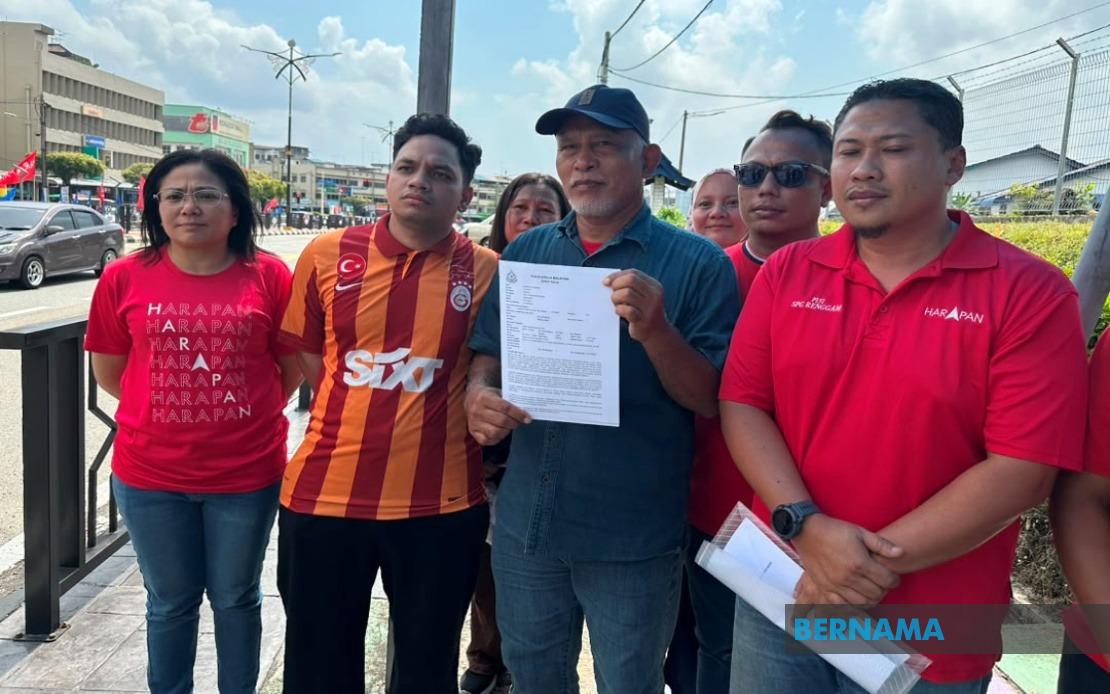
The Pakatan Harapan campaign machinery has escalated its complaints about electoral conduct in Johor, with Khiru Nasir Rohani filing a formal police report at Simpang Renggam district headquarters on Tuesday against Menteri Besar Datuk Onn Hafiz Ghazi. The allegation centres on what the PH representative describes as a systematic effort to mobilise students from vocational training institutions to participate in programmes designed to bolster support for Barisan Nasional candidates ahead of Saturday's state election.
Khiru Nasir, who serves as deputy chief of Simpang Renggam Amanah, contends that the practice represents a breach of electoral law, particularly the Election Offences Act 1954. His complaint specifically references provisions protecting against undue influence and the misuse of official authority or educational facilities for partisan political purposes. The allegation suggests a coordinated campaign rather than isolated incidents, pointing to what he characterises as an orchestrated mobilisation strategy that exploits the captive audience of students within government-administered vocational institutions.
The controversy gained traction following reports that a cohort of TVET students was required to attend a programme held in Kluang on July 4. According to accounts cited by the PH campaign team, the event functioned as a platform for direct political campaigning on behalf of candidates contesting the state-level poll, raising questions about the appropriate use of government resources and student time during the election period.
The specific legal framework governing this dispute carries particular weight in Malaysian electoral politics. The Election Offences Act 1954 establishes parameters around what constitutes impermissible influence during campaigns, distinguishing between legitimate political engagement and activities that cross into coercion or manipulation. The allegation that an incumbent state leader, wielding significant administrative authority, deployed government-run educational institutions to generate political momentum for his own coalition introduces a power imbalance that election law attempts to regulate. Whether institutions like TVET colleges can be considered government resources subject to misuse protection remains a recurring tension in Malaysian electoral contests.
The timing of the complaint reflects the compressed schedule characteristic of state election campaigns in Malaysia. With polling set for the coming Saturday and 172 candidates competing for 56 state assembly seats, the campaign period represents a high-stakes window when both established and challenger coalitions deploy available resources and influence networks. The allegation targets what PH perceives as inappropriate leveraging of administrative capacity by the incumbent BN-aligned state government, a charge that carries particular resonance in a closely contested electoral environment.
Khiru Nasir's appeal extends beyond police to encompass the Malaysian Anti-Corruption Commission and the Election Commission, reflecting a multi-agency approach to addressing perceived violations. This strategy acknowledges that electoral misconduct often involves overlapping concerns: potential abuse of public office (MACC jurisdiction), breach of election law (EC jurisdiction), and criminal conduct (police jurisdiction). The invocation of multiple institutions signals an intention to ensure comprehensive scrutiny, though it also underscores the fragmented nature of electoral enforcement mechanisms in Malaysia.
The involvement of TVET students carries particular significance given their demographic profile and circumstances. Vocational training programmes house young Malaysians in structured environments where attendance can often be managed through institutional authority rather than purely voluntary participation. Students participating in TVET schemes typically face fewer employment prospects and greater vulnerability to administrative pressure than their university-educated counterparts, potentially making them more susceptible to mobilisation through institutional channels. The allegation therefore raises concerns about the protection of relatively vulnerable populations from electoral manipulation.
For Johor specifically, the complaint lands within a competitive state election where incumbent BN faces genuine challenge from PH and other coalitions. The state election represents a significant electoral test, particularly given Johor's historical importance to BN's national electoral calculations. Any perception that governing coalitions are deploying institutional advantages through inappropriate channels becomes politically consequential and potentially shapes both campaign dynamics and voter sentiment regarding electoral fairness.
The broader implications extend to questions about the distinction between government functions and political activity during election periods. Malaysian electoral law attempts to protect this boundary, yet practical enforcement remains inconsistent. The complaint highlights the continuing challenge of preventing officeholders from leveraging administrative resources and institutional access for partisan advantage, a problem that crops up repeatedly across state and federal contests. Without clear institutional sanctions and consistent enforcement, the temptation for governing coalitions to blur these lines persists.
The outcome of police, MACC, and EC investigations will likely influence not only the immediate campaign environment but also precedent regarding what constitutes permissible institutional mobilisation during elections. If authorities determine that pressure on TVET students crossed legal thresholds, the decision could reshape how government institutions manage student participation in campaign-related activities. Conversely, should investigations conclude that no violations occurred, the finding would signal expanded scope for institutional mobilisation under existing legal frameworks, with implications for future electoral contests.

