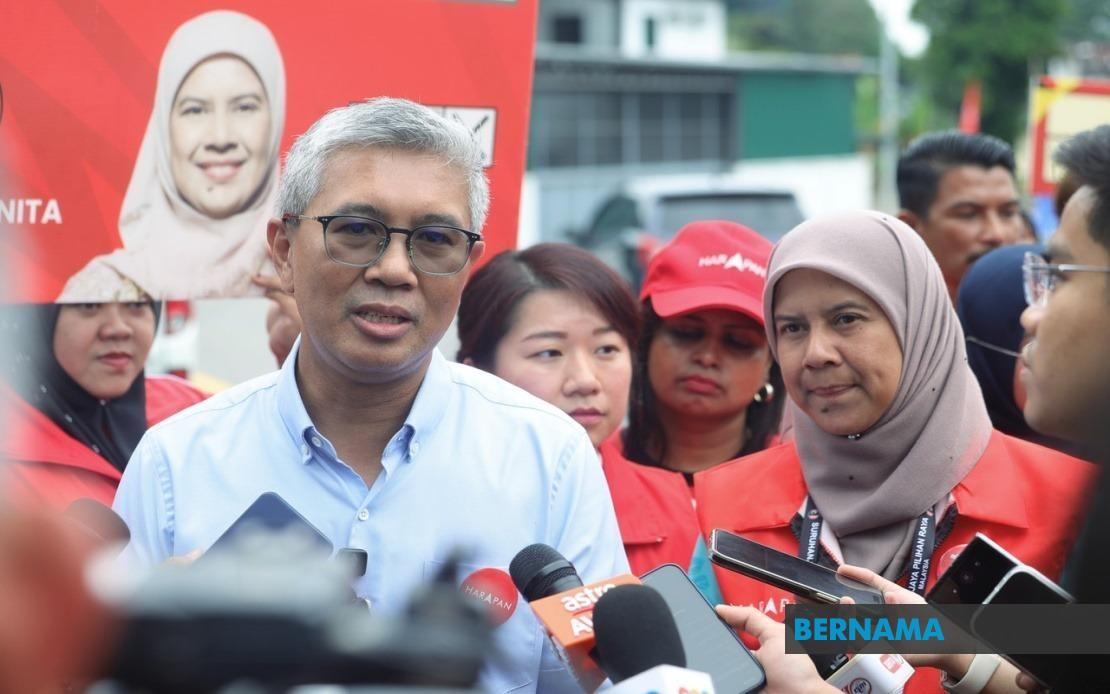
With campaigning in full swing for Negeri Sembilan's state election, Pakatan Harapan's political machinery is projecting confidence about retaining the Pilah seat, bolstered by what senior party officials describe as overwhelmingly positive ground feedback. Tengku Datuk Seri Zafrul Tengku Abdul Aziz, the Prime Minister's Senior Political Advisor, highlighted during a campaign visit to Kuala Pilah that extensive surveys and grassroots assessments indicate constituents view the coalition's incumbent state assemblyman, Datuk Noorzunita Begum Mohd Ibrahim, favourably based on her service record.
The confidence expressed by the PH campaign reflects a broader narrative the coalition has emphasised throughout the Negeri Sembilan State Election: that residents value economic stability and visible government services. Tengku Zafrul underscored this by pointing to Negeri Sembilan's financial health, noting that total investments have climbed to RM19 billion and state reserves have exceeded RM1 billion. These figures, he suggested, demonstrate the effectiveness of the state's governance under Menteri Besar Datuk Seri Aminuddin Harun, though the implication that maintaining political continuity depends on PH's electoral performance this August warrants scrutiny.
Noorzunita Begum faces a straight contest against Barisan Nasional's candidate S. Leza Md Yasin for the Pilah seat, one of five state constituencies within the larger Kuala Pilah parliamentary division. According to the Election Commission's updated electoral roll from June 4, the constituency comprises 18,034 registered voters split nearly evenly by gender—8,925 male voters at 49.49 per cent and 9,109 female voters at 50.51 per cent. The relatively balanced demographic suggests neither candidate enjoys a demographic edge, making ground organisation and message resonance potentially decisive factors.
The campaign narrative from PH centres on bridging economic opportunity gaps between urban and rural areas within Negeri Sembilan. Tengku Zafrul stressed the importance of attracting professional employment opportunities that would allow Generation Z residents to build careers locally rather than migrate to major cities. This emphasis addresses a tangible concern in constituencies like Pilah, where youth unemployment or underemployment in professional roles has historically driven rural-to-urban migration. The MADANI Government's positioning on this issue suggests awareness that economic grievances, particularly among younger voters, could swing marginal contests.
Noorzunita Begum reported that her campaign machinery had by the eighth day of campaigning already covered most residential areas, with plans to intensify outreach in traditional villages during the final week before polling. She noted strong local demand among young people specifically for professional job opportunities, indicating that youth employment concerns resonate significantly with constituents she meets on the ground. This grassroots intelligence aligns with the broader campaign strategy but also suggests that voter preoccupation with economic prospects rather than other policy domains may shape the election's outcome in constituencies like Pilah.
The push to engage traditional villages reflects a time-tested approach in Malaysian state elections, where community-based outreach in less densely populated areas can prove decisive in close contests. Noorzunita Begum's commitment to address the concerns of Gen Z, education quality, and senior citizens indicates an attempt to appeal across demographic groups, though the emphasis on youth employment suggests that this segment is viewed as either swing voters or a source of growth in PH's support base. Whether such outreach translates into actual votes depends significantly on the credibility of both the incumbent's record and the feasibility of promised interventions.
The confidence displayed by Tengku Zafrul and the PH campaign machine must be tempered by the acknowledgment he himself offered: that overconfidence or complacency poses risks. This rhetorical caution, while standard in campaign messaging, hints at underlying awareness that Pilah is not a guaranteed hold. In the context of the 16th Negeri Sembilan State Election, the outcome in constituencies like Pilah will collectively determine whether Menteri Besar Aminuddin Harun's coalition maintains or loses its grip on state government. A loss here, combined with similar setbacks elsewhere, could reshape Negeri Sembilan's political trajectory.
Geographically, Pilah's location in central Negeri Sembilan, situated between Seremban and Bahau, positions it as a semi-rural seat that has historically been competitive. The constituency's relatively modest voter base of just over 18,000 registered electors means that targeted mobilisation and turnout differentials could significantly influence the result. Early voting scheduled for July 28 and polling day set for August 1 compress the campaign window, leaving limited time for the momentum to shift dramatically, though unexpected developments in either party's messaging or candidate controversies could alter voter calculations in the final days.
For Malaysian observers tracking state elections as bellwethers of federal political health, the Negeri Sembilan contest offers insights into whether PH's national governance message resonates at the state level and whether economic narratives around investment and job creation successfully counter opposition messaging. The Pilah result, while representing only one of dozens of state seats being contested, will contribute to the broader picture of voter sentiment toward the ruling coalition and the durability of its political positioning heading into potential future federal elections.

