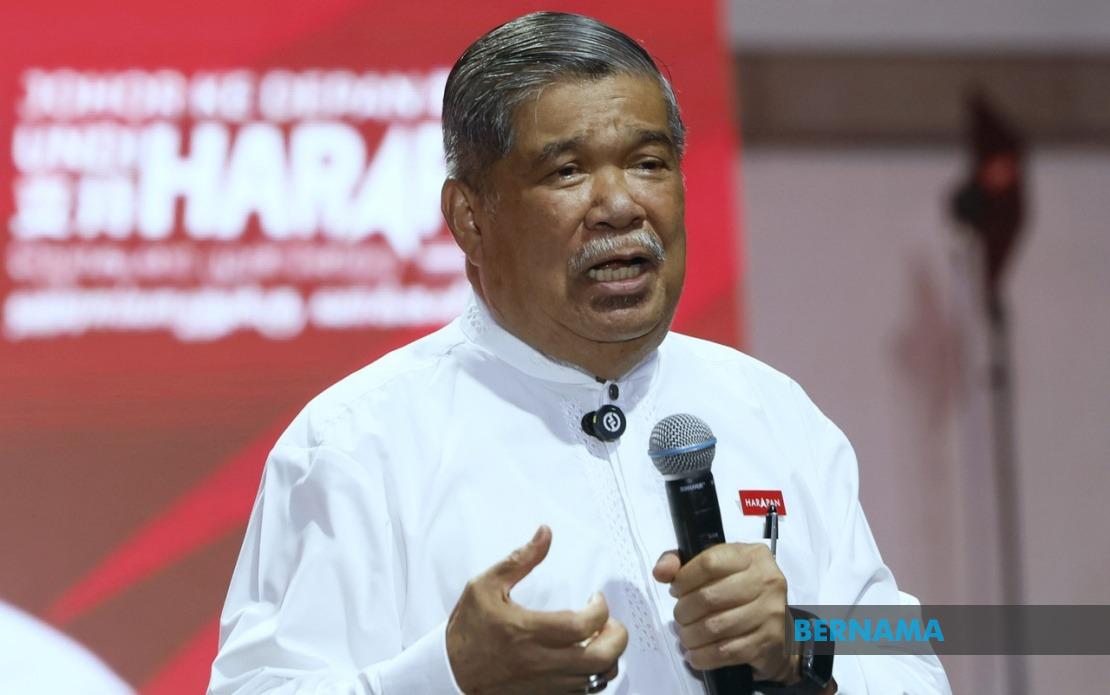
Pakatan Harapan leadership has declared its resolve to press ahead with campaigning unaffected by PAS's recent directive instructing supporters to back Barisan Nasional candidates in uncontested seats during the Johor state election. Speaking after a coalition rally in Permas Jaya on July 1, Amanah president Datuk Seri Mohamad Sabu characterised the opposing strategy as mere provocation, asserting that PH would remain focused on its own electoral platform without distraction from rival manoeuvres.
Mohamad, who holds the portfolio of Minister of Agriculture and Food Security, framed PH's electoral proposition around the strength of its multiracial and multi-religious collaborative model. He argued that this foundational principle of political cooperation underpins not only governmental stability but also forms the bedrock for sustained economic development. Rather than retreating into identity-based campaigning, the Amanah leader pressed Johor voters to evaluate candidates on the basis of demonstrated competence, service history and dedication to justice.
The coalition's messaging strategy reflects a deliberate pivot toward substance over sentiment at a critical juncture in the campaign cycle. Mohamad urged voters to grant PH the electoral mandate that would enable administrative synchronisation between state and federal governments, a point he emphasised holds particular significance for Johor given the interconnected nature of regional development. This alignment, he contended, remains indispensable for executing transformative initiatives spanning the public transport network, upgrading infrastructure at international boundary crossings and cultivating investor confidence in the state.
DAP strategic director Liew Chin Tong, simultaneously serving as Deputy Finance Minister, introduced a different analytical angle by highlighting voter participation as the principal variable determining electoral outcomes. His assessment drew heavily on lessons from the 2022 Johor state election, where depressed turnout—particularly among younger voters—created conditions favourable to BN's performance. Liew attributed part of that suppression to the practical inability of Johor residents working across the border in Singapore to physically return home and cast ballots during pandemic-related travel restrictions.
The DAP leader's analysis carries particular relevance for understanding regional demographic and economic patterns. The sustained outflow of Johor's working-age population to Singapore underscores a critical vulnerability in the state's employment ecosystem that campaign messaging has begun to address more directly. Both Liew and other PH figures have pivoted toward articulating concrete policy responses to reverse this brain drain, recognising that merely invoking governance principles without addressing material anxieties rings hollow for voters considering opportunities elsewhere.
Liew pressed for the second phase of campaigning to transcend the typical confines of political faction rivalry, instead positioning policy substance as the arena where competition should unfold. He identified employment quality and remuneration as foundational to retaining young talent within Johor, presenting this not as abstract economic theory but as a direct challenge to the state's demographic future. Should younger residents continue migrating to Singapore in significant numbers, the tax base erodes and electoral participation among remaining voters skews toward demographics less responsive to PH's modernisation agenda.
The coalition's policy platform extends across several domains identified as requiring urgent state-level attention. Public transportation infrastructure, flood mitigation and drainage system maintenance emerged repeatedly in PH messaging as areas where federal-state cooperation could accelerate delivery. The approach signals a recognition that infrastructure governance operates across jurisdictional boundaries and that voters increasingly judge political parties on capacity to deliver tangible improvements rather than ideological positioning alone.
Preparations for an ageing population and expansion of accessible childcare facilities featured prominently in the DAP leader's enumeration of priorities, reflecting demographic shifts reshaping Johor's social fabric. These elements speak to constituencies beyond the youth employment focus, acknowledging that PH must construct a coalition encompassing multiple generational cohorts with distinct material interests. The precision of these policy commitments distinguishes them from broader appeals to multiracial cooperation, providing voters with measurable standards against which to evaluate post-election performance.
Liew specifically highlighted the Johor-Singapore Special Economic Zone as a strategic initiative requiring accelerated federal-state coordination to unlock high-quality employment generation. The JS-SEZ represents the kind of cross-border economic architecture that could theoretically address the Singapore migration phenomenon by creating employment opportunities competitive with external alternatives. Positioning this initiative centrally in campaign messaging frames PH as capable of engaging with regional economic realities rather than operating within purely domestic political parameters.
The electoral contest itself encompasses the complete slate of 56 state seats, with both PH and BN contesting all constituencies. Polling is scheduled for July 11, with early voting commencing on July 7, providing approximately one week for campaigns to crystallise voter preferences. This compressed timeline increases the significance of campaign efficiency and message clarity, particularly as cooler policy-focused discourse competes against emotionally resonant appeals to religious or racial sentiment.
The strategic positioning by PH leadership reflects sophisticated recognition that Malaysian voters increasingly distinguish between campaign theatre and governance capacity. By rejecting the PAS directive as beneath serious engagement, while simultaneously articulating concrete policy commitments addressing material concerns, the coalition attempts to elevate the electoral conversation. This approach acknowledges that Southeast Asian voters, particularly in relatively developed urban-suburban contexts like Johor, increasingly make electoral decisions based on economic performance expectations and quality-of-life improvements rather than purely communal attachments.
The election carries implications extending beyond Johor's borders, testing whether voters will reward coalitions offering integrative multiracial governance models supported by specific policy commitments or whether narrower factional appeals retain greater electoral potency. The outcome may provide insight into broader Southeast Asian trends regarding how voters weigh identity-based and performance-based considerations in an era of rising economic pressures and demographic change.

