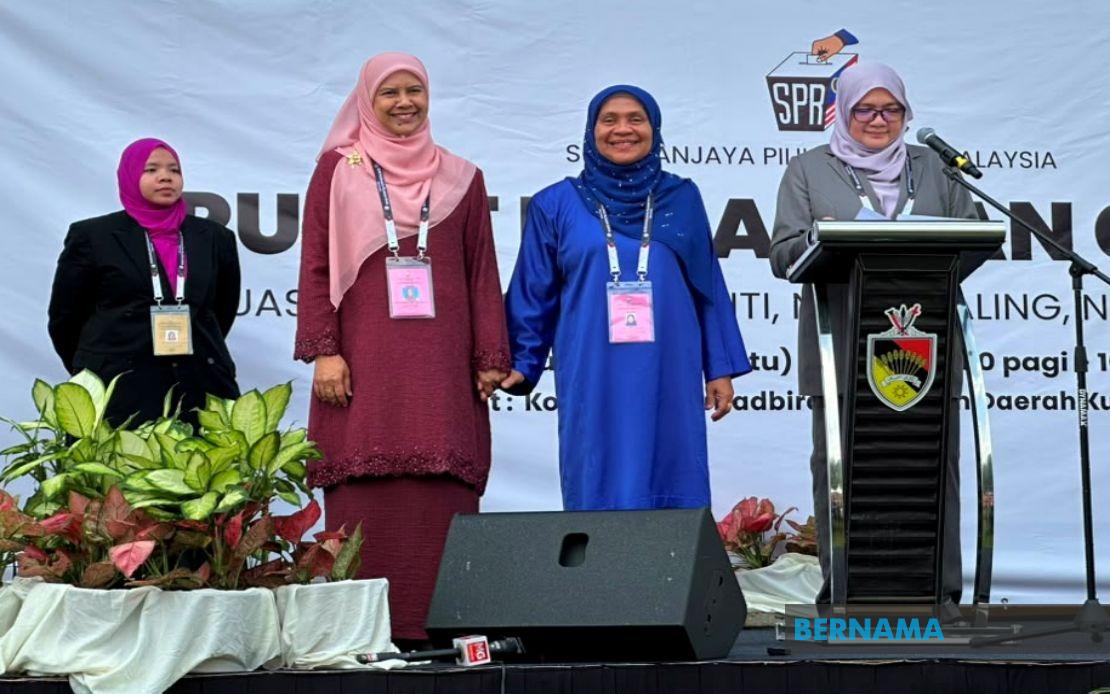
The Pilah state seat in Negeri Sembilan's 16th state election will feature an exclusively female contest, with incumbent Datuk Noorzunita Begum Mohd Ibrahim of the Pakatan Harapan coalition facing Barisan Nasional's S. Leza Md Yasin in a direct two-way battle. The nomination period concluded on July 18 after the Kuala Pilah returning officer Nawal Mohammed Amin confirmed both candidates had submitted their nomination forms during the morning proceedings, with Noorzunita Begum filing her papers at 9.03 am followed by S. Leza at 9.09 am.
This all-women contest for Pilah stands out as voters increasingly witness diverse candidate profiles across Malaysia's state and federal elections, reflecting evolving demographic representation in political contests. The straight fight format, which typically produces clearer mandates compared to multi-cornered races, will give Pilah constituents a stark choice between the ruling coalition and the opposition's visions for their constituency. Both candidates will have had to navigate registration procedures and campaign organisation timelines identical to their male counterparts, though the visibility of female candidates in such prominent electoral matchups often draws heightened public interest and media scrutiny.
The broader Negeri Sembilan election landscape reveals a complex multi-party competition across several seats. Juasseh will feature a three-way contest among Pakatan Harapan's Mohd Aidil Abdullah, incumbent Datuk Ismail Lasim representing Barisan Nasional, and Bersatu's Mohd Zuhami Md Yusof, fracturing votes across multiple camps and potentially creating unpredictable outcomes. Similarly, Seri Menanti will see a three-cornered clash involving PH's Mohd Kamarul Arifin Mohd Wafa, incumbent Muhammad Sufian Maradzi of BN, and Bersatu's Datuk Seri Megat D. Shahriman Zaharuddin, with Bersatu's participation further complicating traditional PH-BN electoral arithmetic.
The Senaling state seat rounds out the three-way contests with Pakatan Harapan's Mohd Hanis Mohd Alimin, Barisan Nasional's Mohamad Qayyum Abd Jalil, and Bersatu's Mohd Izzafi Khan vying for representation. This multiplication of contested seats with three or more candidates reflects the more fragmented political environment in Malaysia since Bersatu's emergence and subsequent political realignments. Conversely, the Johol seat will witness a conventional two-person fight between PH's Mohd Zailan Mohd Munawar and the incumbent Datuk Saiful Yazan Sulaiman of Barisan Nasional, allowing voters there a more straightforward choice between continuity and change.
Pakatan Harapan mobilised senior figures to support the nomination process, with PKR Wanita chief Fadhlina Sidek, who concurrently holds the Education Ministry portfolio, accompanying the coalition's candidates throughout the proceedings. The presence of such high-level ministerial personnel signals the strategic importance Pakatan Harapan attributes to the Negeri Sembilan election despite it being a state-level contest. Dr Mohammed Taufiq Johari, serving as Angkatan Muda Keadilan vice-chief alongside his Youth and Sports Ministry responsibilities, and Sim Tze Tzin, the Deputy Investment, Trade and Industry Minister representing Bayan Baru in Parliament, further underscored the national government's direct engagement with Negeri Sembilan's electoral process.
Barisan Nasional similarly deployed heavyweight political machinery, with Deputy Home Minister and UMNO Supreme Working Council member Datuk Seri Dr Shamsul Anuar Nasarah taking active roles in accompanying BN nominees through nomination procedures. The coalition also drew on Perak's political apparatus, with Perak Menteri Besar and Perak UMNO chairman Datuk Seri Saarani Mohamad present during BN's candidate registration, suggesting cross-state coordination and resource-sharing between state governments allied under the BN banner. This inter-state mobilisation reveals how state elections have become focal points for demonstrating national coalition strength and solidarity.
The Election Commission has structured the electoral calendar with early voting scheduled for July 28, providing registered early voters—including security personnel and those working in essential services—opportunities to cast ballots before the main polling day. The commission designated August 1 as the official polling date for the entire Negeri Sembilan state election, setting a clear timeline for campaigning and voter mobilisation efforts across all contested seats. This compressed campaign period, spanning from nomination day through to election day, concentrates political messaging and grassroots engagement activities within a fortnight.
For Negeri Sembilan voters, the election represents a significant opportunity to evaluate the performance of incumbent representatives and assess competing party platforms. The multiplicity of contests—combining straight fights with multi-cornered races—means that strategic voting calculations will differ substantially across constituencies. In Pilah specifically, the all-women contest may energise particular voter constituencies and generate discussions around female political leadership, potentially influencing turnout patterns among demographics historically engaged with women's representation issues.
The electoral dynamics in Negeri Sembilan also reflect broader national political trends regarding coalition stability and voter preferences. Barisan Nasional's continued fielding of incumbents like Ismail Lasim, Muhammad Sufian Maradzi, and Saiful Yazan Sulaiman suggests confidence in defending seats despite national-level political turbulence, while Pakatan Harapan's fielding of fresh candidates in several contests indicates either strategic renewal initiatives or internal candidate negotiations. Bersatu's participation across three seats suggests the party is attempting to maintain political relevance at state level even as its national profile has fluctuated considerably since 2018.

