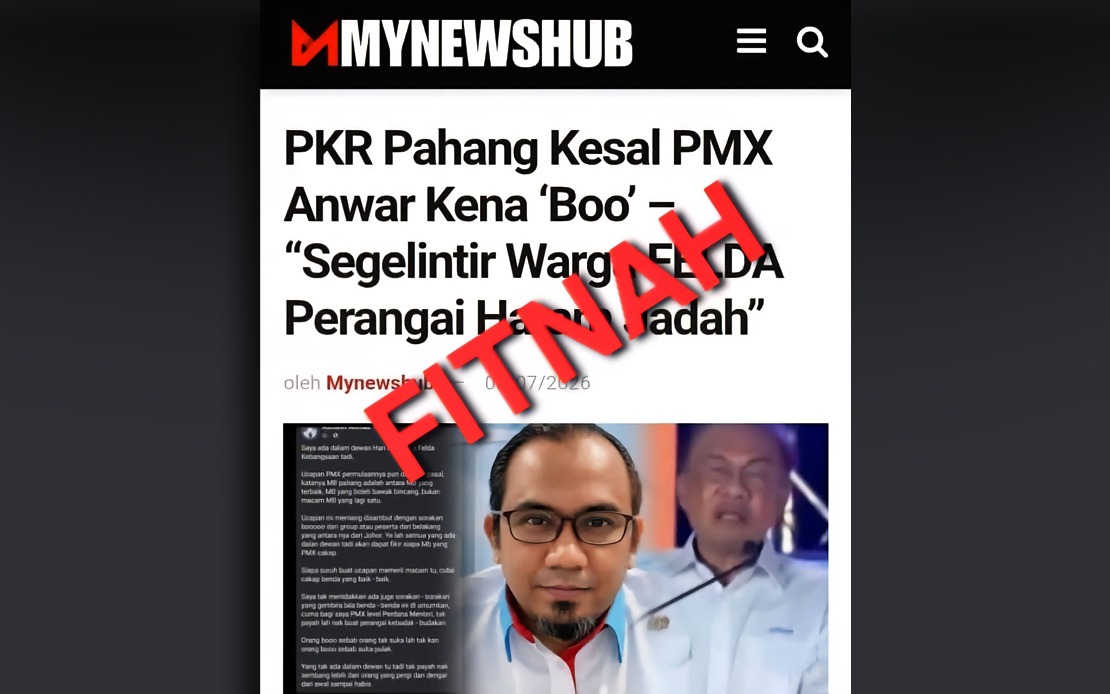
PKR Pahang has moved swiftly to refute allegations published by an online news portal suggesting the party had expressed dismay over purported negative responses directed at Prime Minister Datuk Seri Anwar Ibrahim during the Felda Settlers' Day commemoration and FELDA's 70th anniversary gathering held yesterday in Jengka. The party's information chief Datuk Dr Suhaimi Ibrahim issued a categorical denial, asserting that PKR Pahang had never made such statements and that the report fundamentally misrepresents the actual atmosphere of the event.
Dr Suhaimi, who attended the celebration at Stadium Tun Abdul Razak in Jengka, provided a firsthand account of proceedings throughout the day. He emphasised that the narrative suggesting the Prime Minister was booed represents a distorted and sensationalised characterisation that bears no resemblance to what actually transpired on the ground. According to his observations, the event proceeded smoothly without any notable incidents of the kind described in the online report. The gathering drew tens of thousands of FELDA settlers, and the atmosphere remained vibrant and engaged from beginning to end.
The PKR official further highlighted that announcements concerning new initiatives and welfare improvements for settlers were consistently met with applause and constructive engagement from attendees. Rather than the hostile reception implied by the online portal's reporting, the actual reception reflected enthusiasm for the government's policy announcements directed at the FELDA community. This distinction between the reported narrative and the actual environment on the ground underscores the significance of accurate reporting in political discourse, particularly when matters touch upon sensitive rural constituencies that form a crucial voting bloc.
Dr Suhaimi took particular exception to the manner in which PKR Pahang's name was invoked in the report without any actual statement from the party. He characterised the use of the party's name and identity to create false impressions of official party positions as irresponsible and potentially damaging to the party's standing within the community. This type of misrepresentation, he argued, extends beyond mere journalistic inaccuracy; it deliberately manufactures a false narrative for political purposes while leveraging a legitimate party's credibility.
The PKR Pahang information chief explicitly stated that the party has never issued statements employing the language or terminology attributed to it in the online report, and certainly would never use characterisations that could be construed as insulting to the FELDA community. FELDA settlers represent a traditionally important constituency in Malaysian politics, and any suggestion that a major coalition party would demean or disrespect them would strike at fundamental political relationships. The deliberate misuse of PKR Pahang's name to create such impressions therefore constitutes a serious breach of reporting standards.
In his assessment, Dr Suhaimi identified the core problem as a narrative architecture designed primarily to shape political perception rather than convey factual information. The strategy of attributing false statements to a major political party and then broadcasting claims of party disappointment or criticism serves to manufacture controversy where none existed. This approach exploits the tendency of readers to accept statements attributed to official sources without independent verification, thereby amplifying the false narrative beyond what editorial responsible coverage would permit.
The incident highlights recurring challenges within Malaysia's media ecosystem regarding information verification and source accountability. Online portals operating with minimal editorial oversight and fact-checking infrastructure can disseminate misleading narratives rapidly across social networks before corrections gain equivalent traction. The damage to political discourse and public understanding occurs primarily during this initial distribution phase, while subsequent denials often reach a smaller audience.
Dr Suhaimi extended his critique to encompass the broader responsibility borne by media organisations and social media users to ensure information accuracy before amplification. He called for heightened diligence in the verification process and more ethical standards governing information sharing across platforms. This appeal addresses not only professional media practitioners but also ordinary citizens whose sharing behaviour can amplify misinformation exponentially through social networks.
Meanwhile, the actual FELDA event proceeded with Prime Minister Anwar Ibrahim officiating proceedings and announcing seven new incentive schemes aimed at bolstering development and welfare programmes within the FELDA community. These initiatives formed the legitimate news angle of the gathering, representing substantive policy announcements that warranted coverage and public attention. The focus on concrete government support measures for FELDA settlers constituted the newsworthy dimension of the event and the genuine story emerging from the proceedings.
The contrast between the fabricated narrative of the online portal and the actual substantive policy announcements underscores why accurate reporting matters profoundly in political communication. When legitimate policy developments are obscured by manufactured controversy, the public loses access to information necessary for informed civic participation. Readers deserve reporting that faithfully represents events and statements without embellishment, invention, or misattribution.
For Malaysian political parties navigating an increasingly complex information landscape, this episode illustrates the necessity of rapid response mechanisms to counter demonstrably false claims. PKR Pahang's swift and detailed rebuttal, grounded in firsthand observation and supported by specific factual assertions, demonstrates how parties can defend their reputations and correct the public record when misrepresented. The party's approach combined denial with affirmative statement of facts, rather than simply attacking the online portal's credibility.
Looking forward, the incident serves as a reminder of the importance of media literacy among Malaysian audiences and the value of consulting multiple sources before accepting claims attributed to political figures or organisations. As the information environment becomes increasingly fragmented across platforms with varying standards of editorial rigour, individual readers bear greater responsibility for scepticism and verification. For the broader media industry, maintaining editorial standards and accountability mechanisms remains essential for preserving public trust and enabling democratic discourse grounded in shared factual reality.

