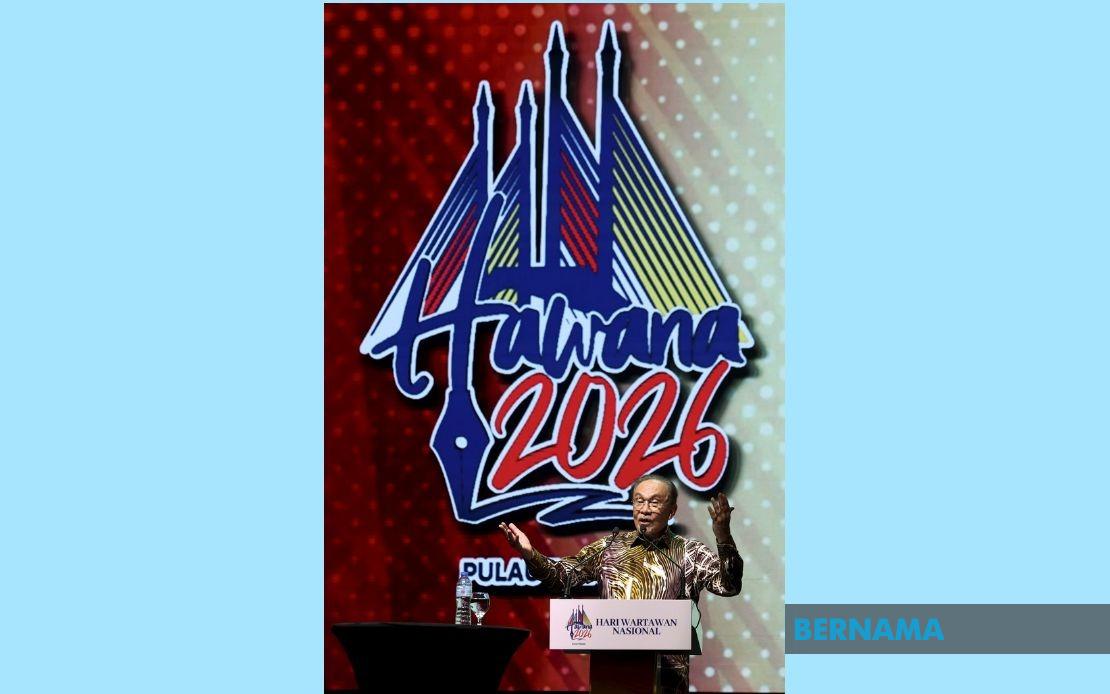
Prime Minister Datuk Seri Anwar Ibrahim unveiled an additional RM1 million allocation for Tabung Kasih@HAWANA during the official commemoration of National Journalists' Day (HAWANA) 2026 in Butterworth, signalling the federal government's sustained commitment to buttressing the socio-economic resilience of Malaysia's media workforce. The announcement, made while Anwar discharged his duties as Finance Minister, underscores a deliberate policy orientation towards recognising the material vulnerabilities faced by journalists and news workers across the country.
Since its establishment in conjunction with HAWANA 2023, the mutual assistance fund has processed disbursements reaching RM2.26 million to 773 media practitioners nationwide. These financial transfers represent a multifaceted support mechanism encompassing emergency grants, coverage of medical and healthcare costs, family welfare provisions, and supplementary aid designed to mitigate hardship among individuals working in journalism and media production. The expansion of the fund's allocation reflects administrative confidence in both the scheme's operational effectiveness and the continuing necessity of such interventions within a sector often characterised by employment precarity and income volatility.
The government's financial commitment to media welfare carries implicit significance for the sector's operational sustainability. By institutionalising a dedicated assistance channel, policymakers acknowledge that journalism in Malaysia grapples with structural challenges including wage stagnation, irregular contractual arrangements, and the financial pressures accompanying industry consolidation. For media practitioners confronting sudden medical emergencies, unexpected family crises, or prolonged employment gaps, such targeted support provisions function as a social safety net where mainstream welfare mechanisms prove inadequate or administratively burdensome to access.
The HAWANA 2026 gathering itself functioned as a platform for reasserting the significance of media integrity and professional credibility within the broader information ecosystem. Held at the PICCA Convention Centre@Butterworth Arena and convening over one thousand media professionals from Malaysia and neighbouring jurisdictions including Timor-Leste, Cambodia and Laos, the occasion embodied a regional commitment to journalistic standards. The thematic emphasis on 'Media Integrity Strengthens Credibility' resonated particularly amid contemporary anxieties regarding misinformation, disinformation, and the erosion of public trust in news institutions across Southeast Asia.
Penang Chief Minister Chow Kon Yeow and Communications Minister Datuk Fahmi Fadzil's participation alongside senior ministry personnel and Malaysian National News Agency (Bernama) leadership demonstrated coordinated governmental engagement with media sector priorities. Such visible political attendance signals to practitioners that their professional challenges receive consideration at both federal and state administrative levels, potentially strengthening institutional relationships between government and the fourth estate during a period when such bonds face considerable strain from competing narratives about editorial independence and political neutrality.
The Tabung Kasih@HAWANA framework represents an evolution in how state apparatus engages with media sector welfare, moving beyond rhetorical gestures towards concrete fiscal mechanisms. The fund's accessibility criteria and disbursement procedures, while not exhaustively detailed in official communications, establish a precedent for categorising media work as a profession deserving of occupational social insurance protections. This positioning distinguishes journalism from casual or gig economy employment while acknowledging that news production, despite its cultural and democratic significance, generates insufficient sustainable income for many practitioners.
For Malaysian journalists, the RM1 million supplementary allocation offers tangible immediate relief even as it illuminates the inadequacy of permanent structural solutions. The fund represents approximately RM1,295 per beneficiary based on current distribution patterns—a sum substantial enough to address urgent crises yet insufficient to resolve endemic employment precarity within news organisations. The scheme's expansion therefore functions simultaneously as genuine welfare provision and an implicit acknowledgment that systemic challenges within media economics persist beyond the scope of short-term financial remedies.
The international participation at HAWANA 2026, particularly attendance from fellow Southeast Asian nations, contextualises Malaysian journalistic challenges within a regional framework. Neighbouring countries confront parallel difficulties regarding media industry sustainability, advertiser revenue decline, and the competitive pressures imposed by digital transformation. The gathering facilitated professional dialogue that transcends national boundaries, potentially enabling knowledge exchange regarding practitioner support mechanisms and industry adaptation strategies that have demonstrated effectiveness across different regulatory environments.
Communications Minister Datuk Fahmi Fadzil's involvement reflects the portfolio's expanded mandate encompassing not merely telecommunications regulation but increasingly, media sector development and welfare considerations. This bureaucratic positioning signals potential for more comprehensive policy interventions addressing employment standards, contractual protections, and skill development opportunities beyond charitable assistance frameworks. Whether such ambitions translate into substantive regulatory or legislative reform remains contingent upon sustained political will and resource allocation across subsequent fiscal years.
The announcement's timing during National Journalists' Day carried symbolic weight, situating media practitioner welfare within celebrations of journalistic profession and identity. This ceremonial framing elevates financial assistance from mere charitable disbursement to recognition of professional contribution and societal value. For practitioners experiencing financial precarity, such symbolic validation accompanying material support offers psychological reinforcement that their labour, while economically undercompensated, receives acknowledgment from state institutions.
Looking forward, the sustainability of such initiatives depends upon consistent budgetary provisioning and potentially, institutional mechanisms ensuring accessibility to eligible beneficiaries. The announcement of RM1 million for 2026 provides clarity for current fiscal year planning, yet practitioners require assurance regarding perpetual availability of such assistance. Establishing statutory foundations or endowment mechanisms could strengthen the fund's permanence, transforming it from discretionary government allocation subject to budgetary pressures into a more durable institutional commitment.
The larger imperative confronting Malaysian media institutions involves transitioning beyond welfare provision toward employment model reform addressing root causes of practitioner financial vulnerability. While Tabung Kasih@HAWANA ameliorates acute suffering, sustainable sectoral health requires addressing fundamental challenges including newsroom downsizing, advertising revenue decline, and the delayed adoption of viable digital business models. Government support for welfare funds complements but cannot substitute for broader industrial transformation enabling journalists to maintain professional integrity whilst achieving economic security.

