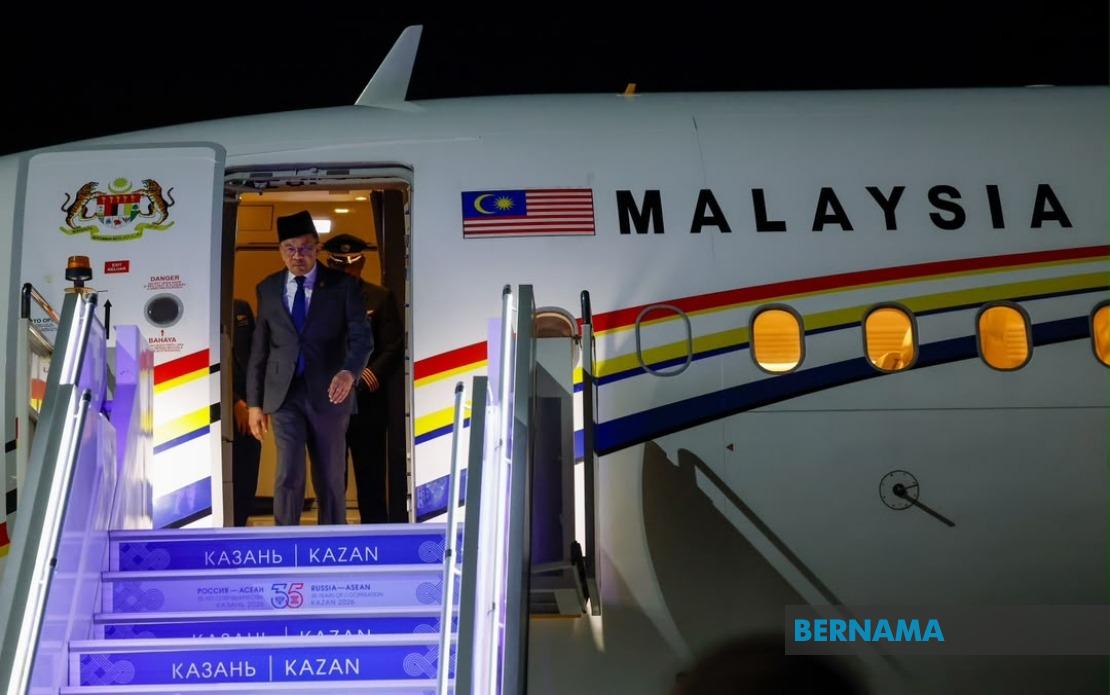
Prime Minister Datuk Seri Anwar Ibrahim touched down in Kazan on Sunday evening to participate in a high-level diplomatic gathering that underscores Malaysia's continued commitment to strengthening ties between Southeast Asia and Russia at a pivotal moment in global affairs. The premier's aircraft landed at Kazan International Airport at 10.20 pm local time, ushering in a two-day engagement that carries considerable strategic weight for the region. His delegation included Minister of Investment, Trade and Industry Datuk Seri Johari Abdul Ghani and Minister of Economy Akmal Nasrullah Mohd Nasir, signalling the economic dimensions of this visit alongside its diplomatic significance.
The reception ceremony reflected the importance both nations accord this encounter. Malaysia's Ambassador to Russia Datuk Cheong Loon Lai greeted the prime minister, while the Russian side deployed senior officials including Ilya Nachvin, the Minister of Digital Development of Tatarstan, and Kazan Mayor Ilsur Metshin. This calibre of official turnout demonstrates Moscow's recognition of Malaysia's role as a voice within ASEAN and a potential bridge in cultivating deeper partnerships across the Global South.
The ASEAN-Russia Commemorative Summit scheduled for June 17 and 18 will serve as a milestone moment for both parties, celebrating 35 years since their initial diplomatic engagement was formalised in Kuala Lumpur during 1991. For Malaysian policymakers and regional observers, this gathering carries added resonance as it occurs amid intensifying geopolitical competition and the search for alternative frameworks beyond traditional Western-centric structures. The timing reflects a broader recalibration of global politics, where middle powers and regional groupings like ASEAN increasingly assert agency in shaping international outcomes.
The substantive agenda encompasses a deliberately broad sweep of contemporary policy challenges that resonate deeply with Malaysia and its neighbours. Participants will deliberate on fortifying commercial and investment linkages, a priority for Southeast Asian economies seeking diversified trading relationships. Energy cooperation warrants particular attention given the region's growing demands and the volatile international energy landscape. Food security, too, emerges as a critical focus area—a concern that has intensified across Asia following supply disruptions and climate-related agricultural pressures in recent years. The inclusion of digital economy discussions reflects recognition that technological advancement and cyber cooperation increasingly shape state capacity and economic competitiveness.
Four formal outcome documents are anticipated to emerge from these discussions, providing the architectural framework for future engagement. The Kazan Declaration on the 35th Anniversary of ASEAN-Russia Relations will establish political commitments and shared vision statements. Companion documents on energy cooperation and cultural ties will translate broad ambitions into specific operational guidance. Most significantly, the Comprehensive Plan of Action to Implement the ASEAN-Russia Strategic Partnership 2026-2030 will furnish a multi-year roadmap directing practical collaboration, ensuring that rhetorical commitments translate into measurable institutional outcomes and tangible benefits for participating nations.
Malaysia's presence and active participation underscores Anwar's strategic orientation toward preserving and enhancing ASEAN Centrality—a concept that remains contested and requires continuous reinforcement. By attending such summits and engaging substantively, Malaysia helps ensure that Southeast Asia remains a consequential party to major geopolitical conversations rather than a passive recipient of great power decisions. This commitment gains added importance in an environment where external powers compete to influence regional outcomes through diplomatic outreach, investment, and security partnerships.
During his stay, Anwar will pursue bilateral engagement with Russian President Vladimir Putin and the Rais of the Republic of Tatarstan, using these face-to-face moments to advance Malaysian interests across multiple dimensions. The confirmed focal areas—dialogue and peace advocacy, economic resilience, energy and food security, and people-to-people connections—reflect a balanced approach that combines pragmatic economic statecraft with principled positioning on international affairs. This reflects Malaysia's traditional diplomatic posture of maintaining working relationships across ideological divides while advocating for rules-based international order and peaceful dispute resolution.
This marks Anwar's third visit to Russia since assuming office in November 2022, a frequency that illustrates the premium his administration places on the bilateral relationship. His September 2024 participation in the Eastern Economic Forum in Vladivostok provided opportunity for economic networking and exposure to Far Eastern investment opportunities. Subsequently, his May 2025 official visit to Moscow deepened the relationship through direct conversations with Putin on interconnected areas including trade, investment, agriculture, education, aerospace and energy cooperation. That sequence demonstrates sustained engagement rather than episodic diplomacy, suggesting Malaysia views Russia as a consequential partner despite geopolitical complexities and international sanctions affecting Moscow's external relations.
For Malaysian stakeholders, these diplomatic moves carry practical implications across sectors. Enhanced energy cooperation could provide alternative supply sources and partnership models as the country navigates energy transition and long-term supply security. Agricultural collaboration may yield technological transfers and market access beneficial to Malaysian producers. Aerospace and education exchanges foster human capital development and technological learning. The deliberate cultivation of people-to-people connections through cultural and educational programmes builds societal-level understanding that can buttress state-level relationships through periods of external pressure or diplomatic tensions.
The broader context matters here as well. ASEAN's relationship with Russia, while historically cooperative, operates within constraints imposed by divergent voting positions at the United Nations, Western sanctions regimes affecting Russian economic activity, and competing great power pressures within the region itself. For Malaysia and ASEAN collectively, maintaining pragmatic engagement with Russia while preserving relationships with Western powers requires sophisticated diplomatic navigation. This summit provides an opportunity to demonstrate that regional actors can maintain autonomous foreign policies and diverse partnerships without being forced into exclusive blocs—a position increasingly difficult to sustain in a world moving toward greater strategic competition.
The emphasis on practical cooperation across economic, environmental, and technological domains reflects recognition that enduring partnerships rest on mutual benefit rather than ideological alignment. Southeast Asian nations, including Malaysia, have consistently advocated for a multipolar world order where diverse models coexist and nations retain freedom of manoeuvre. Russia, despite its reduced economic weight and international isolation, remains a significant energy supplier, arms manufacturer, and permanent UN Security Council member whose cooperation proves valuable on issues from cybersecurity to space exploration. The summit thus serves as both celebration of historical ties and pragmatic reset for future engagement tailored to contemporary realities and mutual interests.

