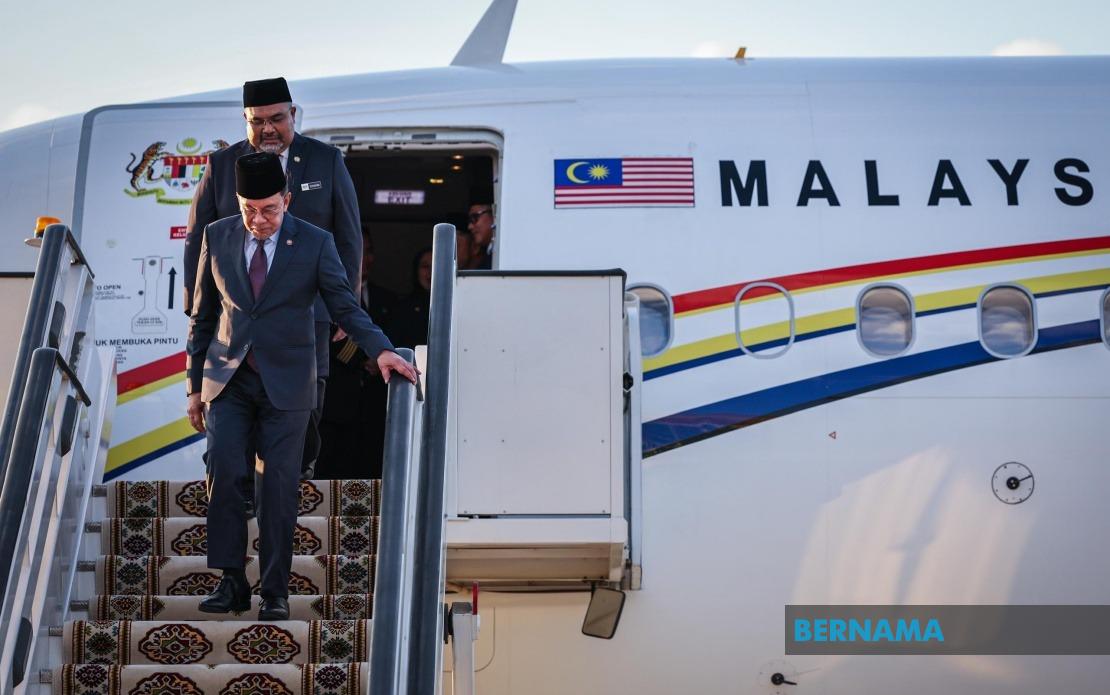
Prime Minister Datuk Seri Anwar Ibrahim touched down in Ashgabat on June 18, marking the beginning of a two-day official visit to Turkmenistan following his completion of a separate working engagement in Kazan, Republic of Tatarstan. The aircraft landed at Ashgabat International Airport at 8 pm local time, with the prime minister's delegation comprising Minister of Investment, Trade and Industry Datuk Seri Johari Abdul Ghani, Minister of Economy Akmal Nasrullah Mohd Nasir, and representatives from Malaysia's Prime Minister's Office and Foreign Ministry. Upon arrival, Malaysia's Ambassador to Turkmenistan Mohd Suhaimi Ahmad Tajuddin received the delegation, while the host nation was represented by Deputy Chairman of the Cabinet of Ministers for Oil and Gas Guvanch Agajanov.
The visit comes at the formal invitation of Turkmenistan President Serdar Berdimuhamedov and serves as a reciprocal gesture following the Turkmenistan leader's official tour of Malaysia in December 2024. This represents Anwar's inaugural official visit to the Central Asian nation, though not Malaysia's first engagement with the country. As the fifth official visit by a Malaysian prime minister to Turkmenistan, the trip underscores the continued diplomatic importance both nations place on strengthening bilateral ties. The itinerary demonstrates substantive engagement beyond ceremonial pleasantries, with substantial economic and investment discussions anticipated throughout the visit.
On the evening of arrival, Anwar is scheduled to attend a dinner reception with members of Malaysia's expatriate community and local supporters of Malaysia-Turkmenistan relations. This engagement reflects the diplomatic practice of connecting with diaspora communities, who often serve as informal ambassadors and cultural bridges between nations. The gathering provides an opportunity to update the Malaysian community on the government's international initiatives and gather grassroots perspectives on bilateral cooperation.
The formal programme on June 19 commences with an official welcoming ceremony at the Presidential Palace, where Berdimuhamedov will receive the Malaysian prime minister. Following this ceremonial beginning, Anwar and Berdimuhamedov will engage in a private one-on-one meeting, providing space for candid discussion on strategic priorities. The bilateral talks will subsequently convene relevant ministers and officials from both governments to address specific sectoral cooperation. During these discussions, both leaders are expected to sign a joint statement articulating shared objectives and vision, while government representatives will exchange multiple agreements and memoranda of understanding that have been previously negotiated.
The schedule integrates religious observance into diplomatic proceedings, with Anwar performing Friday prayers at the Turkmenbashi Ruhy Mosque, locally known as the Gypjak Mosque. This inclusion reflects Malaysia's consistent approach of acknowledging shared Islamic heritage during high-level visits to Muslim-majority nations and demonstrates respect for local religious traditions. Such gestures carry symbolic significance in strengthening people-to-people connections alongside official government engagement.
An official luncheon hosted by Berdimuhamedov will precede the evening's economic forum. The Malaysia-Turkmenistan Forum, to be jointly inaugurated by both leaders at the Chamber of Commerce and Industry of Turkmenistan, represents a crucial platform for expanding business connections and exploring investment opportunities. This forum structure allows Malaysian companies and business associations to directly engage with Turkmen counterparts, facilitating commercial relationships that extend beyond government-to-government protocols.
Turkmenistan's significance to Malaysia's regional strategy lies substantially in its energy resources and investment potential. In 2025, Turkmenistan ranked as Malaysia's fourth-largest trading partner among Central Asian nations, with bilateral trade reaching RM75.80 million. Malaysian exports to Turkmenistan totalled RM75.50 million, reflecting a notable 9 percent year-on-year increase that indicates growing commercial momentum. This upward trajectory suggests expanding business opportunities and deepening economic interdependence between the two nations.
The most substantial Malaysian presence in Turkmenistan comes through Petroliam Nasional Bhd (Petronas), the national oil and gas company. Since establishing operations in 1996, Petronas has accumulated investments valued at RM52.73 billion in Turkmenistan, making the country one of the company's most significant investment destinations globally. This massive capital commitment reflects Turkmenistan's critical importance to Malaysia's energy security strategy and Petronas's confidence in the nation's hydrocarbon reserves and investment climate. The company's long-standing operations in oil and gas exploration, production, and downstream activities represent Malaysia's deepest economic footprint in Central Asia.
For Malaysian stakeholders, particularly those in energy, investment, and trade sectors, this visit carries implications for future bilateral cooperation frameworks. The signed agreements and memoranda of understanding will likely address energy security, investment protection, trade facilitation, and potentially new sectoral partnerships. The Malaysia-Turkmenistan Forum offers avenues for Malaysian enterprises to explore opportunities in construction, technology, and service sectors where Turkmenistan demonstrates growing demand.
From Turkmenistan's perspective, the visit reflects interest in strengthening ties with Malaysia as a significant Islamic economy and gateway to Southeast Asian markets. Malaysia's position as a bridge between Middle Eastern, Asian, and Western markets makes it an attractive partner for Central Asian nations seeking diversified international engagement. The reciprocal visit structure emphasises mutual respect and equal partnership, important symbolism for a Central Asian nation conscious of great power dynamics.
The broader context of Anwar's Central Asian tour indicates Malaysia's strategic pivot toward deepening engagement with the region beyond traditional Southeast Asian focus. Central Asia represents emerging opportunities for Malaysian investors, trading companies, and development finance institutions. The accumulation of high-level visits and economic forums suggests Malaysia is positioning itself as a credible regional partner capable of facilitating meaningful commercial and diplomatic relationships.
As Anwar concludes his Central Asian engagement with the Turkmenistan visit, the trip embodies Malaysia's multifaceted approach to international relations—balancing diplomatic protocol, religious solidarity, economic interests, and strategic positioning. The visit's success will be measured not merely by ceremonial elements but by tangible progress in bilateral agreements and demonstrated commitment to expanding mutual cooperation across energy, trade, and investment domains. For Malaysia, Turkmenistan represents both a current economic partner and a future growth market warranting sustained high-level political attention.

