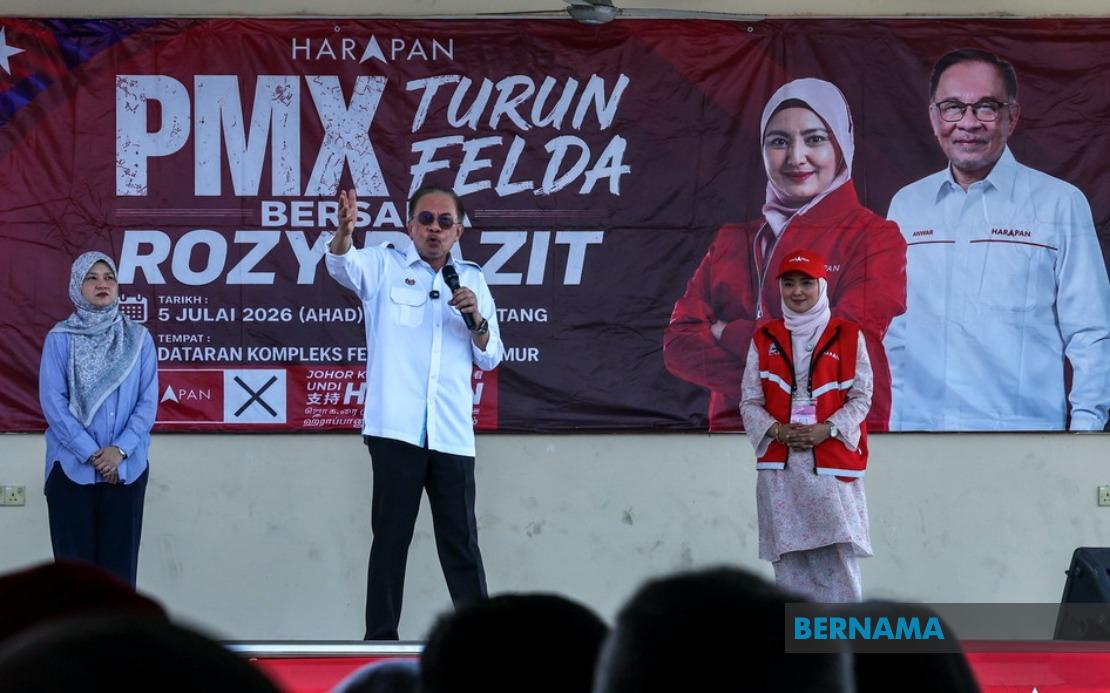
Prime Minister Datuk Seri Anwar Ibrahim has made a direct commitment to tackle the housing site predicament that has plagued the second generation of FELDA settlers for decades, positioning the issue as a priority during his tenure at the helm of government. Speaking at a public engagement session in Segamat, the Prime Minister emphasised that addressing this longstanding grievance represents a core policy objective, though he was candid about the structural constraints that have hindered progress.
The housing shortage among FELDA second-generation beneficiaries represents one of the federation's most intractable rural development challenges. Unlike their parents, who received land allocations and housing support as part of the original FELDA settlement scheme, successive cohorts of settlers' children have faced severe restrictions in accessing similar benefits. This generational disparity has created a demographic and social crisis within FELDA communities, where younger residents frequently lack secure homeownership pathways despite being born into settler families and relying on agricultural income from FELDA-administered land.
Anwar's acknowledgement that implementation requires substantial cooperation from state administrations reflects the constitutional reality governing Malaysian federalism. Land acquisition, administration, and the provision of foundational infrastructure such as roads, water, and electricity all fall within state jurisdiction rather than federal purview. This jurisdictional separation has historically complicated FELDA's capacity to expand housing programmes, as the agency must negotiate with thirteen separate state governments, each operating under different development priorities, budget constraints, and political orientations.
The Prime Minister's declaration came during a meet-the-people programme at Dataran Putra FELDA Palong Timur in the Buloh Kasap constituency, underscoring the government's intent to connect directly with affected communities. The setting was deliberate—FELDA settlements represent politically significant constituencies across multiple states, and settlers' grievances have featured prominently in election cycles. By committing to resolve the issue during his premiership, Anwar signalled that the government recognises both the legitimacy of the problem and its political salience.
The presence of senior officials at the event reflected the cross-ministerial nature of the challenge. Selangor Menteri Besar Datuk Seri Amirudin Shari's attendance demonstrated state-level engagement, critical given that Selangor hosts substantial FELDA operations. Education Minister Fadhlina Sidek and Deputy National Unity Minister R. Yuneswaran's participation highlighted broader government coordination. These attendees represent different political factions within the ruling coalition—notably, Amirudin represents PKR, Anwar's party—suggesting efforts to maintain unified messaging on the issue despite coalition tensions elsewhere.
The second-generation housing problem encapsulates deeper structural issues within FELDA's evolution. Originally established in 1956 as a land development scheme providing smallholder farming opportunities, FELDA expanded rapidly throughout the 1960s and 1970s, allocating land to rural settlers at concessional terms. However, by the 1980s, population growth within FELDA communities had outpaced available land, creating a demographic squeeze. Subsequent generations, ineligible for new allocations and unable to compete effectively for alternative housing in urban markets due to lower incomes, became trapped in precarious living arrangements or informal housing.
The policy framework Anwar outlined—establishing protections and guarantees for second-generation housing—marks a departure from previous approaches that often deferred the issue or offered piecemeal solutions. A comprehensive resolution would likely require innovative mechanisms: perhaps state-level land acquisition funds supported by federal grants, targeted mortgage subsidies, or cooperative housing models. However, such initiatives demand significant financial commitment and sustained political will across multiple government administrations.
For Malaysian policymakers and regional observers, the FELDA housing commitment illustrates the enduring challenge of inclusive development in agrarian societies. While Malaysia has achieved substantial urbanisation and economic diversification, rural constituencies—particularly agricultural settlement communities—remain economically vulnerable and politically important. Unresolved generational equity issues within such communities can fuel political discontent and undermine social cohesion. The FELDA case study demonstrates how development programmes, however successful initially, require adaptive management to address evolving demographic realities.
The involvement of state governments proves crucial but unpredictable. Federal-state coordination on FELDA matters has historically been inconsistent, with state administrations sometimes viewing FELDA land as potential revenue sources for broader development rather than prioritising settler welfare. Achieving sustainable resolution requires establishing clearer frameworks governing state-federal responsibility sharing and ring-fencing resources for second-generation housing from competing state priorities.
Anwar's public commitment carries both symbolic and practical weight. Symbolically, it acknowledges settler communities' legitimate grievances and signals high-level political engagement. Practically, however, translating the commitment into tangible housing allocations demands sustained effort over several electoral cycles, institutional coordination across federal and state levels, and potentially significant budgetary reallocations. The Prime Minister's timeline—framing resolution as achievable during his current tenure—establishes accountability benchmarks that will be assessed by both FELDA communities and opposition political actors.
Moving forward, successful implementation will require detailed policy design specifying allocation criteria, funding mechanisms, and timelines. Engaging FELDA settlers directly in policy formulation, rather than imposing solutions, would strengthen ownership and sustainability. Additionally, complementary investments in FELDA community infrastructure, agricultural productivity support, and livelihood diversification could address underlying economic vulnerabilities that make housing security particularly acute for second-generation residents dependent on farming income.
The FELDA housing initiative ultimately reflects broader questions about Malaysia's inclusive development trajectory. As the nation navigates transformation toward higher-income status, ensuring equitable outcomes for rural populations and maintaining social cohesion across geographically dispersed communities remains essential. The success or failure of Anwar's FELDA commitment will signal the government's capacity to address entrenched structural problems and deliver meaningful improvements for constituencies that have contributed substantially to Malaysia's agricultural and economic foundation.

