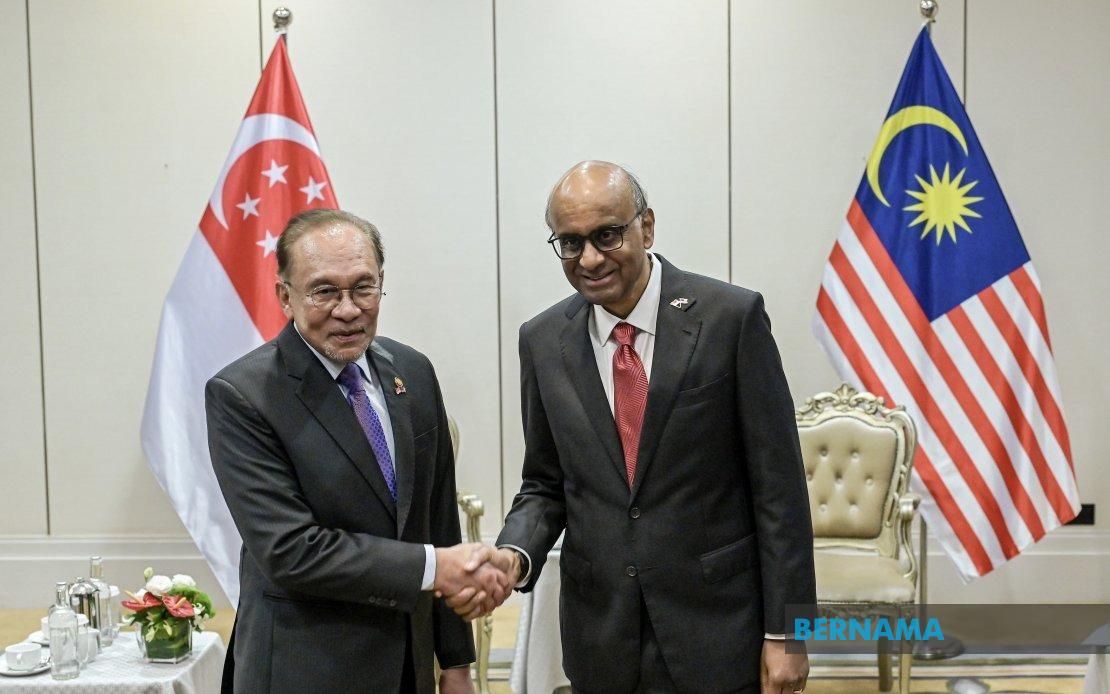
Prime Minister Datuk Seri Anwar Ibrahim received Singapore President Tharman Shanmugaratnam on Monday during a three-day state visit to Malaysia, underscoring the strategic importance both nations place on their bilateral relationship. The 40-minute session between the two leaders reflected the caliber of engagement between Malaysia and Singapore, with several senior ministers from the Malaysian government participating to demonstrate the cross-portfolio significance of the discussions.
The courtesy call, held in Kuala Lumpur, brought together Foreign Minister Datuk Seri Mohamad Hasan, Investment, Trade and Industry Minister Datuk Seri Johari Abdul Ghani, and Entrepreneur and Cooperatives Development Minister Steven Sim Chee Keong, alongside high-ranking officials from both governments. This composition of attendees suggests the talks extended beyond ceremonial pleasantries into substantive matters spanning diplomacy, commerce, and economic development. The presence of Malaysia's investment and trade minister particularly signals ongoing negotiations or discussions regarding commercial opportunities and sectoral collaboration between the two economies.
The state visit, extending from July 13 to 15 at the invitation of Yang di-Pertuan Agong Sultan Ibrahim, represents a reciprocal gesture following His Majesty's official visit to Singapore from May 6 to 7, 2024. Such exchanges at the highest level demonstrate the maturity and stability of Malaysia-Singapore relations, characterized by regular engagement that reinforces institutional connections and personal relationships between leadership. The reciprocal nature of these visits also reflects a commitment to maintaining balanced diplomatic attention, essential given the historical complexities and current regional dynamics that shape the two nations' partnership.
Economically, the relationship between Malaysia and Singapore remains robust despite global headwinds. Singapore holds the position of Malaysia's second-largest trading partner worldwide, a distinction underscoring the depth of commercial integration between the two neighbors. Within the ASEAN framework, Singapore's importance to Malaysia elevates further, as it represents Malaysia's largest trading partner among member states of the regional bloc. This concentration of bilateral trade reflects both the efficiency of supply chains linking the two countries and the complementary nature of their respective economies.
Bilateral merchandise trade between Malaysia and Singapore reached RM402.35 billion, equivalent to approximately US$93.97 billion, during 2025, marking a modest 1.5 per cent increase compared to the previous year. While this growth rate may appear incremental, it demonstrates resilience in the trading relationship amid broader economic uncertainties affecting Southeast Asia. The figure encompasses a diverse range of goods and services, from petrochemicals and electronics to financial services and professional expertise, reflecting the breadth of economic interdependence.
Performance in the first five months of 2025 suggests accelerating momentum in bilateral commerce. Trade during this period reached RM189.90 billion, equivalent to US$47.87 billion, representing a robust 14.5 per cent increase when compared against the corresponding January-to-May period in 2024, when bilateral trade stood at RM165.93 billion or US$37.65 billion. This sharper year-on-year growth in the early months of 2025 suggests that underlying commercial dynamics may be strengthening, potentially driven by specific sectoral improvements or recovery in demand for products where both nations hold competitive advantages.
The acceleration in trade growth merits closer examination within the Malaysian context. For Malaysia, Singapore serves not merely as a direct trading partner but as a gateway to global markets and a hub for regional financial and logistics activities. Many Malaysian companies utilize Singapore-based entities for regional distribution, financing, and management functions, meaning bilateral trade figures capture only a portion of the economic relationship's true significance. Malaysian exporters rely substantially on Singapore's infrastructure and expertise for value-added services that enhance product competitiveness in third-country markets.
From a strategic perspective, the strengthening of Malaysia-Singapore ties holds implications for Southeast Asian stability and ASEAN cohesion. The two countries' ability to manage their relationship effectively—navigating issues ranging from maritime boundaries to labor migration—sets a template for other regional partnerships. Moreover, their combined economic weight and complementary capabilities make their collaboration essential for ASEAN's collective response to challenges such as supply chain disruption, digital transformation, and climate transition. Enhanced coordination between Kuala Lumpur and Singapore can amplify ASEAN's voice in multilateral forums and strengthen the bloc's resilience.
Looking forward, the modest growth rates in bilateral trade suggest opportunities for deeper integration across new sectors. Both governments have emphasized digital economy development, green technology, and advanced manufacturing. Expanded cooperation in these domains could unlock substantially higher trade growth than historical rates, particularly if both nations align regulatory frameworks and investment incentives. The presence of multiple Malaysian ministers at President Tharman's meetings suggests government readiness to explore such possibilities.
The state visit also carries symbolism beyond immediate commercial interests. By hosting Singapore's president at the highest ceremonial levels—including the welcoming ceremony at Istana Negara by the Yang di-Pertuan Agong—Malaysia reaffirms its commitment to the bilateral relationship despite occasional tensions or disagreements. Such consistency in diplomatic engagement provides a stabilizing force in a region where geopolitical competitions and power rivalries occasionally create friction between nations. For Malaysian readers and policymakers, the visit reinforces that pragmatic engagement with Singapore remains central to Malaysia's regional strategy and economic interests.

