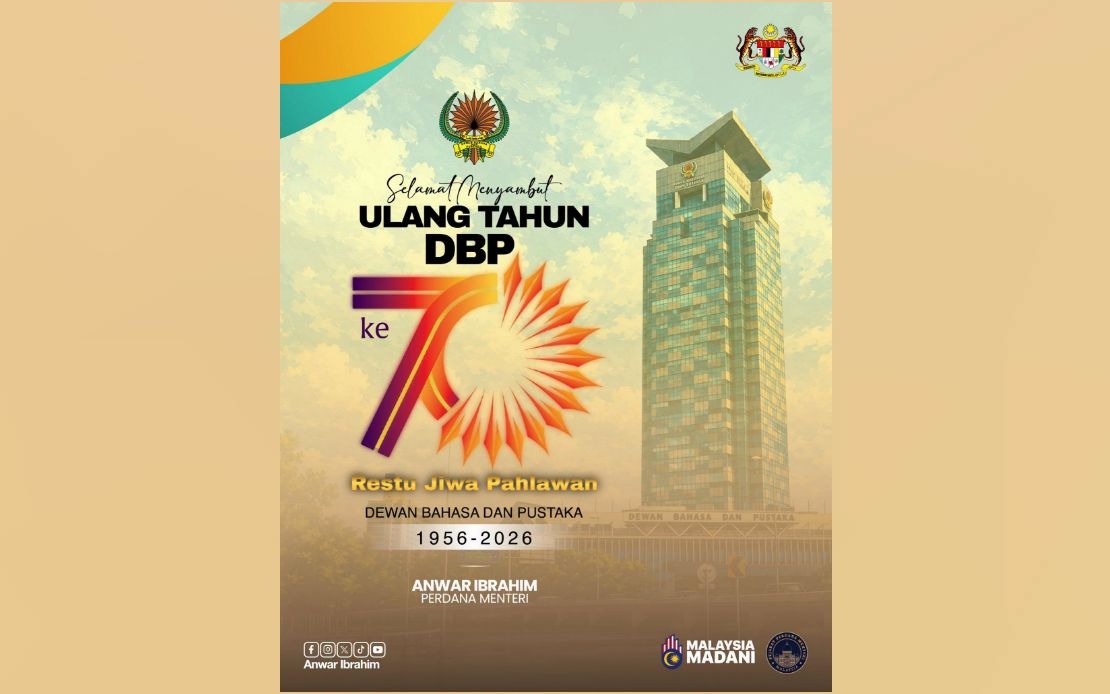
Prime Minister Datuk Seri Anwar Ibrahim has extended his greetings to Dewan Bahasa dan Pustaka (DBP) on the occasion of its 70th anniversary, acknowledging the institution's pivotal role in safeguarding Malaysia's linguistic and cultural identity through seven decades of dedicated service. In a statement posted on his Facebook page, the Prime Minister reflected on the foundational contributions made by generations of language advocates and scholars who have worked within the institution to preserve and promote the nation's linguistic heritage.
Anwar's message arrived as DBP marked this significant milestone with the thematic focus 'Restu Jiwa Pahlawan', a phrase capturing the notion of blessing and the warrior spirit that has animated the institution's mission. The Prime Minister's remarks underscored how the organisation's seven-decade journey has been constructed upon the dedication, bravery and steadfast commitment of those who came before, each generation passing the torch of cultural stewardship to the next. This intergenerational perspective reflects an appreciation for how institutions of national importance accumulate their strength and influence through continuity of purpose across time.
The DBP, established in 1953, has historically functioned as Malaysia's premier body for language standardisation, literary development and the promotion of Malay as the national language. As a constitutional institution tasked with elevating and protecting the Malay language—a cornerstone of Malaysian national identity—its institutional memory spans the nation's transformation from colonial possession to independent federation to a developing regional economy. The anniversary recognition by the Prime Minister thus serves as an affirmation of the state's commitment to the role such institutions play in nation-building beyond the economic and political spheres.
Anwar's invocation of the warrior spirit speaks to a particular framing of cultural and linguistic preservation as an active endeavour requiring vigilance and determination. This conceptual lens positions language advocacy not as a passive archival function but as a dynamic, ongoing struggle to maintain and elevate national cultural markers amid globalisation and the encroachment of international languages. For Malaysian readers, this resonates with longstanding debates about the status and vitality of Malay in an increasingly English-dominated world, particularly in higher education, commerce and technology sectors.
The Prime Minister's call for the 'fighting spirit' to persist within DBP and among language professionals more broadly signals official recognition that the institution faces contemporary challenges requiring renewed commitment. These challenges include the declining proficiency in formal Malay among younger Malaysians, competition from English-medium education and digital platforms predominantly utilising English, and the need to modernise linguistic standards to reflect evolving communication practices. By invoking the metaphor of warrior resilience, Anwar's message implicitly acknowledges these pressures while exhorting stakeholders to maintain their dedication to the institution's core mission.
From a regional perspective, Malaysia's investment in formal language institutions like DBP distinguishes it within Southeast Asia, where several neighbouring nations have undertaken similar but distinct approaches to linguistic nationalism and cultural preservation. Thailand's language academies, Indonesia's Badan Bahasa, and the Philippines' language commissions each navigate comparable tensions between standardisation and modernisation. DBP's seven-decade existence therefore represents a substantial institutional achievement in a region where such bodies often face resource constraints and shifting political priorities.
The timing of this anniversary recognition carries additional weight given broader discussions within Malaysia about national identity and social cohesion. Language remains one of the most tangible markers of belonging and national consciousness, and institutions dedicated to its cultivation serve symbolic as well as practical functions. By publicly honouring DBP, the Prime Minister reinforces the government's position that investment in cultural institutions merits inclusion alongside economic development priorities, a message particularly relevant as Malaysia competes regionally and globally while seeking to preserve distinct cultural characteristics.
Anwar's emphasis on the institution's role in 'restoring our fighting spirit' suggests an interpretation of cultural work as essential national renewal rather than heritage preservation in a purely backward-looking sense. This framing positions language and literature not as museum pieces but as living tools for contemporary expression and national communication. It acknowledges that a people without confident command of their national language risk losing a crucial medium for self-expression and internal cohesion, particularly in diverse, multilingual societies like Malaysia.
The 70th anniversary milestone also provides occasion to consider DBP's institutional evolution and future challenges. The rapid digitalisation of language use, the emergence of new linguistic varieties through hybrid online communication, and demographic changes affecting language transmission all present fresh frontiers for an institution historically focused on standardisation and literary canonisation. Anwar's message, while ceremonial in immediate purpose, implicitly calls for the institution to remain relevant by engaging with these contemporary developments while maintaining fidelity to core principles of linguistic excellence and cultural preservation.
Looking forward, the institutional significance of bodies like DBP may prove increasingly vital rather than diminishing. As economic integration advances within ASEAN and beyond, nations seeking to maintain distinct identities increasingly recognise that language institutions serve as bulwarks against cultural homogenisation. Malaysia's deliberate public recognition of DBP's contributions thus positions the nation as valuing linguistic diversity and cultural particularity alongside economic modernisation—a balance that many regional observers consider essential for sustainable national development and social stability.

